Walls of Ávila: Medieval Fortifications in Spain



Visitor Information
Google Rating: 4.8
Popularity: High
Google Maps: View on Google Maps
Official Website: muralladeavila.com
Country: Spain
Civilization: Medieval European
Remains: Military

History
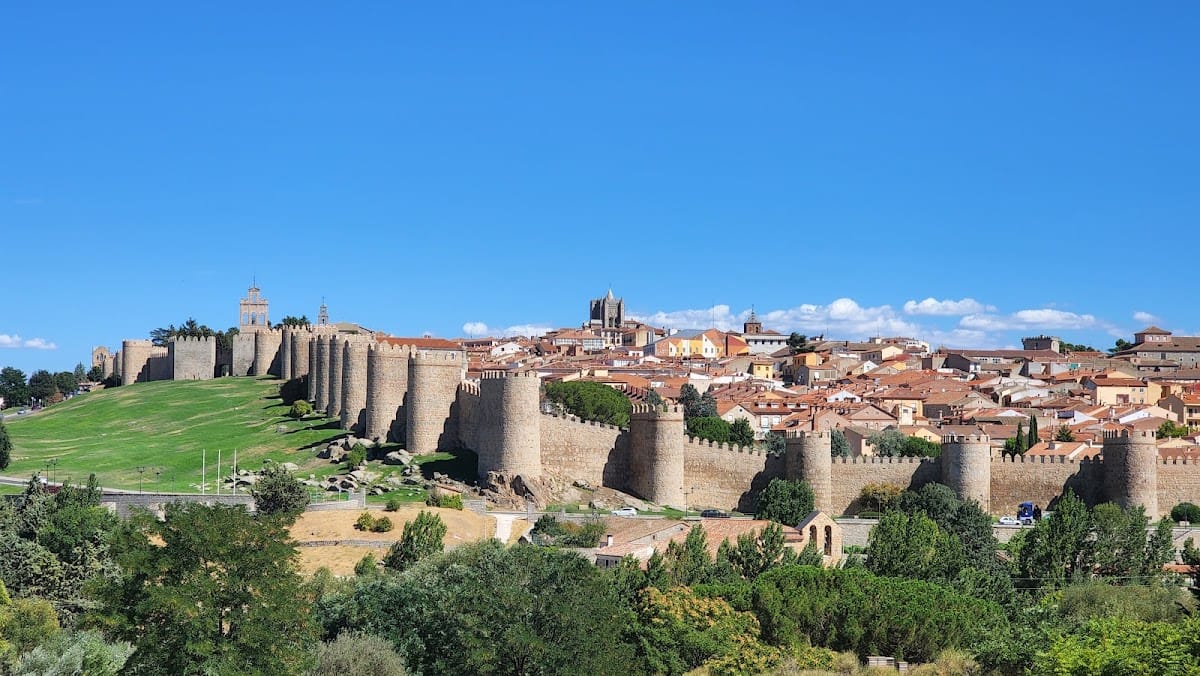
The Walls of Ávila surround the historic center of Ávila, located at C. Conde Don Ramón, 15, 05001 Ávila, Spain. Their construction began at the end of the 11th century under the order of King Alfonso VI of León and Castile. This initiative was part of a broader effort to repopulate and secure frontier lands that had been contested during the Reconquista, a period when Christian kingdoms sought to reclaim territory from Muslim rule. The walls were built alongside similar fortifications in Segovia and Salamanca, under the supervision of Count Raymond of Burgundy, husband of Infanta Urraca.
Traditionally, the construction of the walls has been attributed to the master builders Casandro Romano and Florín de Pituenga, with a supposed completion time of nine years between 1090 and 1099. However, scholars consider this timeframe unlikely, suggesting a longer and more complex building process. The walls incorporated remains of earlier Roman fortifications, including reused funerary stones and architectural fragments, especially near the Arco de San Vicente gate. This reuse indicates the site’s long-standing strategic importance.
In the 14th century, the walls underwent significant reinforcement. Some sections were raised to about 15 meters in height, and a secondary defensive barrier was added, featuring gunports designed for firearms, reflecting changes in military technology. Later, in 1596, King Philip II ordered restoration works to maintain the structure. During the 19th century, plans to demolish the walls were halted when they were declared a National Monument in 1884, ensuring their preservation.
The walls have historically marked the boundary between the urban, “civilized” space of Ávila and the surrounding rural areas. The maintenance costs, known as “reparo de los muros,” were largely borne by the peasant class, who contributed about 80% of the expenses. Over time, the walls came under the management of both the Spanish State and the Ávila City Council, though some sections remain privately owned due to their integration with palaces and churches. In 1985, the walls, along with the old town and extramural churches, were recognized as a UNESCO World Heritage Site.
Remains
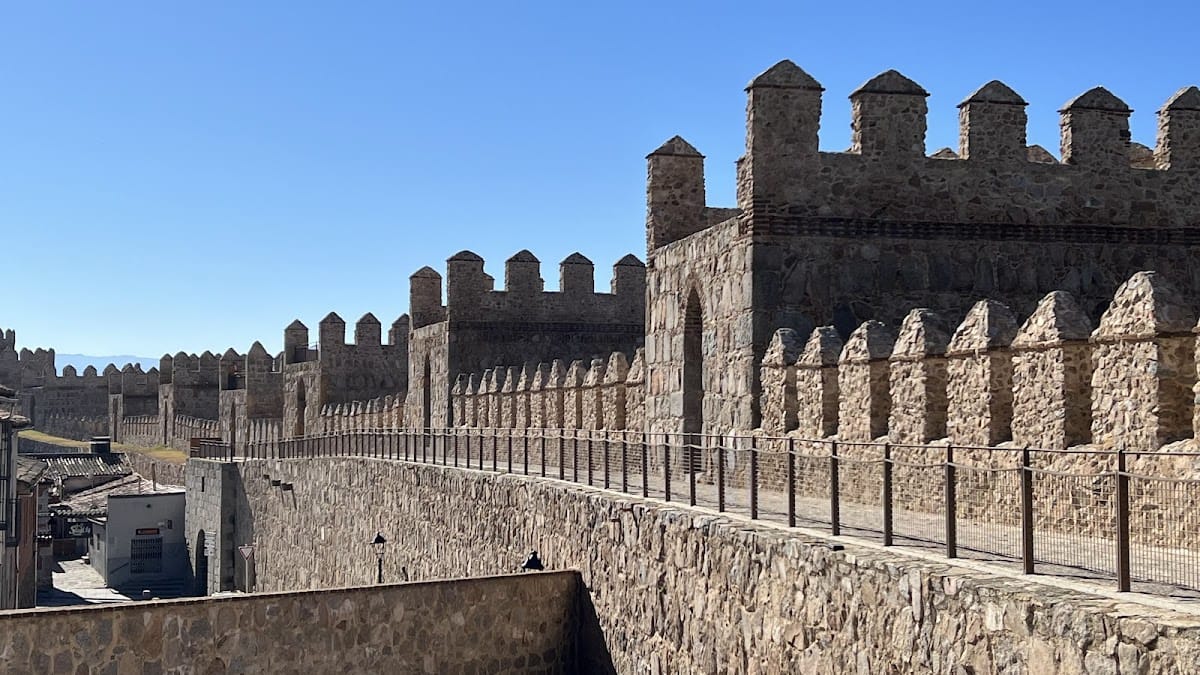
The Walls of Ávila form a nearly rectangular enclosure oriented east-west, enclosing about 33 hectares with a perimeter close to 2,515 meters. Constructed mainly from gray and black granite, the walls incorporate stones reused from Roman and Visigothic structures, including funerary stelae and elements from Roman necropolises. The walls are roughly 3 meters thick and average 12 meters in height, with some parts raised to 15 meters during 14th-century reinforcements. Brick, mortar, and lime were also used in their construction.
The fortification includes approximately 2,500 crenellations, which are the notched battlements atop the walls, and between 87 and 88 towers or bastions known as cubos. There are nine main gates, each historically defended by one or more palaces built between the 15th and 16th centuries. Among these, the Puerta del Alcázar, also called Mercado Grande, stands out. It is flanked by two large towers about 20 meters tall connected by a unique defensive bridge. This gate was originally part of the now-demolished Alcázar fortress and was restored in 1907, with added crenellations inspired by the Puerta de San Vicente.
The Puerta de San Vicente shares a similar design and is built over the Roman wall. Archaeological excavations here uncovered the original Roman gate and a 1.7-meter-long stone verraco, an animal sculpture carved into the rock. Other gates include the Puerta de la Catedral, opened in the 16th century to replace a former postern, and the Arco del Carmen, which saw restorations in the 14th and 16th centuries. The Puerta de la Mala Dicha provided access to the Jewish quarter, while the Puerta de la Santa led to Saint Teresa’s house. Additional gates are the Puerta del Rastro and Puerta del Puente, the latter restored in the 15th and 17th centuries.
Three posterns, or small secondary doors, are now blocked. These include one near the Alcázar, another close to the Palacio de los Abrantes, and the Portillo del Obispo, which was closed in 1518. The latter connected the cathedral to the clergy quarter. The cathedral’s apse, known locally as the cimorro, is integrated into the wall and considered the strongest defensive section. It features a walkway with machicolations—openings through which defenders could drop objects on attackers—and multiple layers of crenellated barriers. Military architectural elements were added here in the late 14th century.
The walls take advantage of natural terrain features such as slopes and rocky outcrops, without the use of talus (sloping bases) or buttresses. Defensive elements include arrow slits and a barbican, a fortified outpost or gateway, which no longer exists. Archaeological finds embedded in the walls include Roman funerary stelae and ceramic fragments dating from the 1st to 5th centuries. Today, about 1,400 meters of the ramparts remain accessible, with four main access points: Casa de las Carnicerías, Arco del Carmen, Puerta del Puente, and Puerta del Alcázar. The walls offer views of Ávila and nearby mountain ranges such as the Sierra de Ávila and the Sierra de la Paramera.
Nearby sites