Ancient Greek Sites in France: Explore Coastal Settlements and Mediterranean Trade
Ancient Greek sites in France centre on Mediterranean settlement and trade. The collection includes the fortified town of Olbia on the mainland coast and Aléria on Corsica, where the evidence spans Greek, Etruscan and Roman connections. Their surviving remains differ: Olbia exposes the plan of a Greek colony, while Aléria combines an ancient settlement with burial finds that help explain its earlier contacts.
Primary Function: All
Type: All
Civilization: All
Popularity: All
Rating: All

Aléria preserves evidence of prehistoric occupation, Greek-associated settlement, Roman urban development, medieval fortification, and Corsica’s…
Olbia was a fortified Greek colony of Massalia founded around 325 BC on the Mediterranean coast at Almanarre. Its remains reveal a planned…
For details on how to use the maps, which sites are included, how popularity and ratings are determined, and how sites are classified, see the help page.
Olbia: a fortified town divided into regular blocks
Olbia, near Hyères, was founded by settlers from Massalia around 325 BC. Its compact, roughly square enclosure contained a planned settlement divided into quarters. Streets separated long residential blocks, while the defensive perimeter and a principal gate controlled access from the coast.
The excavated walls make the organisation of ordinary housing particularly clear. Blocks were divided into repeated dwelling units, with rooms arranged within a limited share of space. The narrow lanes between them provided circulation through a densely occupied town. This regular division contrasts with a settlement that gradually accumulated buildings around winding streets.
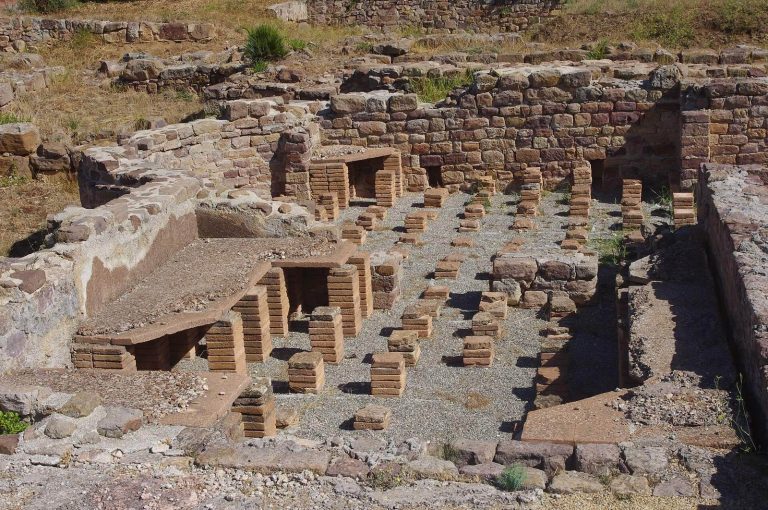
The location linked the colony with coastal shipping, and the entrance faced towards its maritime approach. Although most houses survive at a low level, the extent of the exposed plan allows streets, domestic plots and the fortified boundary to be considered as one town. Later Roman occupation introduced buildings and alterations, including baths; those belong to the settlement’s subsequent development.
Aléria: early trade and the later Roman city
Aléria, on Corsica’s eastern side, is associated in ancient accounts with the arrival of Phocaean Greeks in the sixth century BC. Archaeology also records strong Etruscan connections. The nearby Casabianda necropolis yielded imported pottery and other grave goods that help reconstruct those overlapping Mediterranean relationships.
Greek-made vessels are part of that evidence, rather than proof that every burial or building was Greek. The museum collections complement the excavated settlement by preserving objects whose decoration, manufacture and use are often easier to identify than the earliest phases of the town itself.
The substantial public remains at the archaeological site, including its forum and associated buildings, principally belong to Roman Aléria. They show the city’s later form. Its place in this collection rests on the earlier settlement history and archaeological material, with the Roman masonry kept distinct from that Greek connection.
Explore the collection
Explore sites on the map or in the grid. Map icons reflect each site’s primary function, helping you identify different kinds of places at a glance. Narrow the results by primary function, site type or era. Use the Civilization filter to select among the Greek and Hellenistic groups included here, with additional filters for popularity and rating. Select a map marker to view the site’s details and open its article, or open the article from its grid entry.