Phoenician Religion and Ritual Practices
Phoenician cities honoured gods associated with their own dynasties and sanctuaries. Rulers built temples, priests administered offerings and residents recorded vows. In western Phoenician communities, often called Punic, Tanit and Baal Hammon became prominent recipients of dedications.
On this page7 sections
City gods and changing religious relationships
Melqart held a special place in Tyre, while the Lady of Byblos connected that city with a long religious history. Sidonian traditions gave prominence to Astarte and Eshmun. The word baal, meaning lord, could form part of different divine titles, so its appearance does not always name one identical god across every inscription.
Religious relationships changed through time. Tanit and Baal Hammon became prominent in Carthaginian dedications, especially in the later first millennium BCE. A city god linked worship with a particular community and its history. Rulers could present themselves as protectors of a sanctuary, while families and travellers approached the deity with their own requests. Greek speakers identified Melqart with Heracles and Eshmun with Asclepius. At Pyrgi, an Etruscan sanctuary in Italy, around 500 BCE, a Phoenician dedication to Astarte accompanied Etruscan inscriptions associated with Uni, an Etruscan goddess. These texts joined two religious vocabularies within one sanctuary.
Temples, sacred spaces and patronage
Royal inscriptions frequently present building or restoring a sanctuary as an act of legitimate rule. Eshmunazar II’s Persian-period funerary inscription records that he and his mother Amoashtart built temples for Sidonian gods.
Sacred space could include rooms, courts, altars, water and standing stones in varied combinations. The temples and freshwater basin at Motya in Sicily show a particular arrangement monumentalised in the sixth century BCE. The pool belongs to a religious precinct rather than a standard inner harbour.
Priests and priestesses appear in inscriptions, including Amoashtart, Eshmunazar’s mother, who was queen and priestess of Astarte. Temple personnel maintained buildings and handled offerings. Donations paid for construction and repairs, while sacrificed animals provided portions for priests and other participants. The division of sacred space organised movement and action. An enclosure distinguished a precinct from its surroundings; entrances directed access; altars and installations provided places for offerings. Motya’s freshwater pool stood within a sacred enclosure beside temples. The interpretation of this complex as a sanctuary replaced the older identification of the basin as an inner harbour.
Other donors could commemorate gifts of images, objects or resources on a smaller scale.
Offerings, vows and public participation
A dedication could record a promise fulfilled or thanks for assistance. Many Punic inscriptions name the deity and dedicant and express that the god heard the person’s voice. Animal remains and ash preserve sacrificial deposits. Punic sacrificial tariffs, written schedules of ritual fees and meat portions, include the surviving Marseille tariff, which specifies shares allocated to priests for particular animals. Participation extended beyond rulers. Women and men commissioned dedications, and later inscriptions reveal people of varied standing. A vow joined a request with an undertaking to give something if the deity responded. The resulting dedication could identify the worshipper and mark the promise as fulfilled. This sequence gave a durable record to an otherwise temporary act.
Priests received offerings and distributed the shares specified for each animal and ritual category. Public offerings could also bring people together around food and shared observance, requiring cooperation among suppliers, religious personnel and participants.
Tophets: sacred deposits and a disputed practice
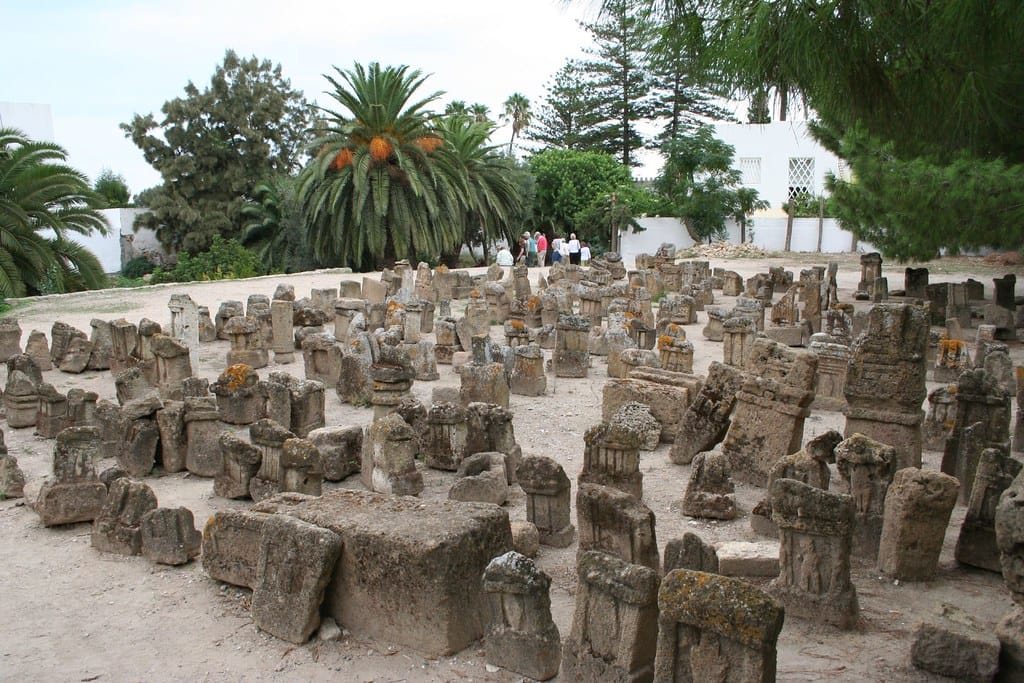
Above: View of the Tophet of Carthage, a sacred precinct filled with burial urns and stone stelae. This open-air enclosure was used between roughly the 8th and 2nd centuries BCE. Thousands of urns containing cremated remains of children and animals were interred here under inscribed markers, reflecting a unique and controversial aspect of Phoenician-Punic ritual.
Western areas conventionally called tophets combined urns, cremated remains and dedicatory monuments in distinctive sacred settings. At Carthage, the sequence extends from approximately the eighth century BCE to 146 BCE, with changing deposits and marker forms. Other western sites have their own sequences and proportions of human and animal remains.
Some researchers interpret tophets as places of child sacrifice, drawing on ancient testimony, dedications and the selection of remains. Others emphasise sacred burial of children who died naturally, including very young infants. Studies of bones disagree about age estimation and the effects of cremation. Human and animal remains occur in tophet urns in proportions that vary by site and phase. Some inscriptions name an offering but leave the circumstances of death unstated.
Symbols, inscriptions and material religion
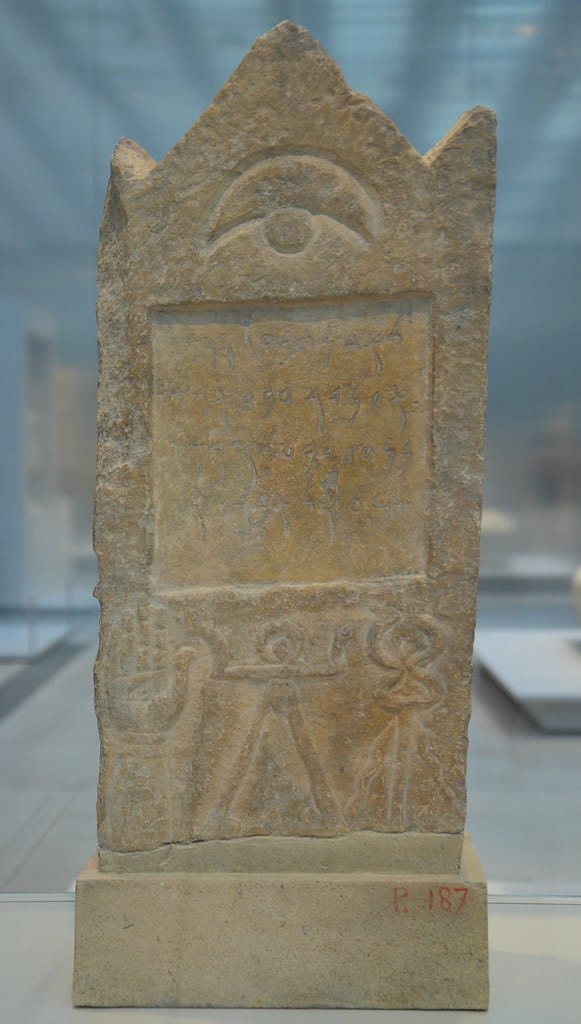
Above: A Punic stele from North Africa bearing a carved Tanit symbol (triangle with circle and horizontal bar) under a crescent moon. Such symbols were common on Phoenician and Carthaginian religious monuments.
Protective amulets, terracotta figures, carved signs and images placed religious ideas on portable objects and monuments. Egyptian forms, including Bes, a protective Egyptian deity, and the protective eye, circulated through Phoenician and Punic communities. Their use reflects local selection and adaptation as well as contact with Egypt. The sign conventionally associated with Tanit combines a triangular body, a horizontal element and a circle. It appears on western monuments alongside other motifs. Phoenician religion used both figurative representations and sacred stones. Images appeared on household amulets, funerary objects and sanctuary dedications, with protective and commemorative uses.
Funerary objects accompanied the deceased. Seals combined identification with imagery on small objects used to mark ownership or authorisation. Craftspeople carved stone monuments and made terracotta figures, metal objects and decorated vessels for religious use. Inscriptions could name donors, relatives and deities, giving dedications a particular social identity.
Burial customs and the afterlife
Ordinary cemeteries included cremations and inhumations in pits, jars, chambers and stone containers. Regional sequences varied. Early cremations at Motya, later monumental chambers at Baria and Persian-period royal sarcophagi from Sidon show different treatments within the wider Phoenician world. Grave goods included vessels, jewellery, lamps and amulets. At Sidon, members of the Persian-period dynasty used Egyptian-style stone sarcophagi bearing Phoenician inscriptions. Funerary warnings sought protection against opening a tomb or disturbing its occupant. Eshmunazar’s inscription invokes punishment and the loss of descendants for a violator.
Household worship, festivals and religious change
Everyday religious activity also involved protective objects, vows and participation in local gatherings. Traditions about Melqart’s awakening at Tyre and later Roman-period descriptions of Adonis rites at Byblos belong to particular sources and settings.
Communities abroad maintained some homeland connections while adapting to local gods and institutions. The related Etruscan and Phoenician dedications at Pyrgi around 500 BCE identify Uni and Astarte within one sanctuary. Under Roman rule in North Africa, worship associated with Baal Hammon contributed to changing traditions of Saturn.
Dedications continued in changing linguistic and civic settings, while rebuilding altered individual precincts.