Castell de Clarà: A Romanesque Fortress in Moià, Spain
Visitor Information
Google Rating: 4.4
Popularity: Very Low
Google Maps: View on Google Maps
Country: Spain
Civilization: Unclassified
Remains: Military

History
The Castell de Clarà is a Romanesque fortress located in the municipality of Moià, in modern-day Spain. Built during the medieval period, it originally served as a defensive stronghold connected to the protection of the town of Moià.
The castle’s earliest recorded name was “castell de Moià” around 912, reflecting its original role within the town’s boundaries. By 916, the name had shifted to “castell de Clarà,” indicating a possible development or renaming related to its surrounding territory. In 993, the castle gained prominence when it became part of the dowry of Ermessenda of Carcassonne, wife of Count Ramon Borrell of Barcelona. During this time, the first known feudal lord, Amat Elderic—who was the count’s seneschal, an official responsible for managing the lord’s estates—held the fortress. Later, Guillem Ramon de Montcada also served as seneschal, swearing allegiance to Count Ramon Berenguer IV in 1136.
Throughout the 13th century, the ownership of the castle shifted through a series of exchanges and sales among royalty and religious authorities. In 1246, King James I of Aragon traded the castle and town of Moià to the Bishop of Vic. Fourteen years later, in 1260, the bishop exchanged the church of Moià with the chapter of the Santa Maria de l’Estany. In 1288, King Alfonso II sold the castle and the associated lands but recovered them a decade later, which reflects the castle’s strategic or economic value over time.
The families who managed the castle, known as castellans, were initially the Gallifa family and eventually the Rocafort family. Historical records from the 11th and 12th centuries include their pledges of loyalty and negotiations with the counts of Barcelona, underscoring the feudal relationships that governed the castle’s control.
The Castell de Clarà’s active use ended in the early 18th century, when the fortress was ordered demolished by Bourbon authorities. This was a punitive act following the War of Spanish Succession, pointing to the castle’s association with Catalan resistance. After its demolition, the site was left abandoned. Over subsequent centuries, local inhabitants gradually took stones from the ruins to build rural homes and structures, leading to further dismantling during the Early Modern and Contemporary eras. Today, the remains are protected as a cultural heritage monument of national importance in Catalonia.
Remains
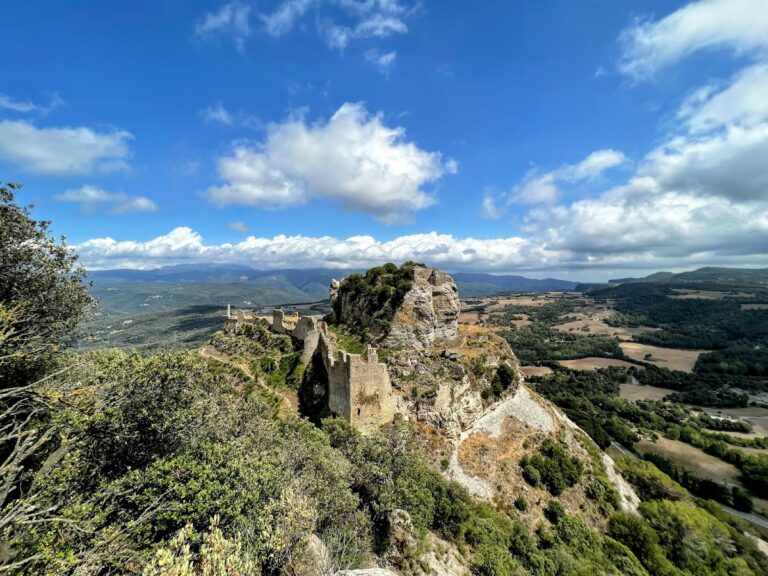
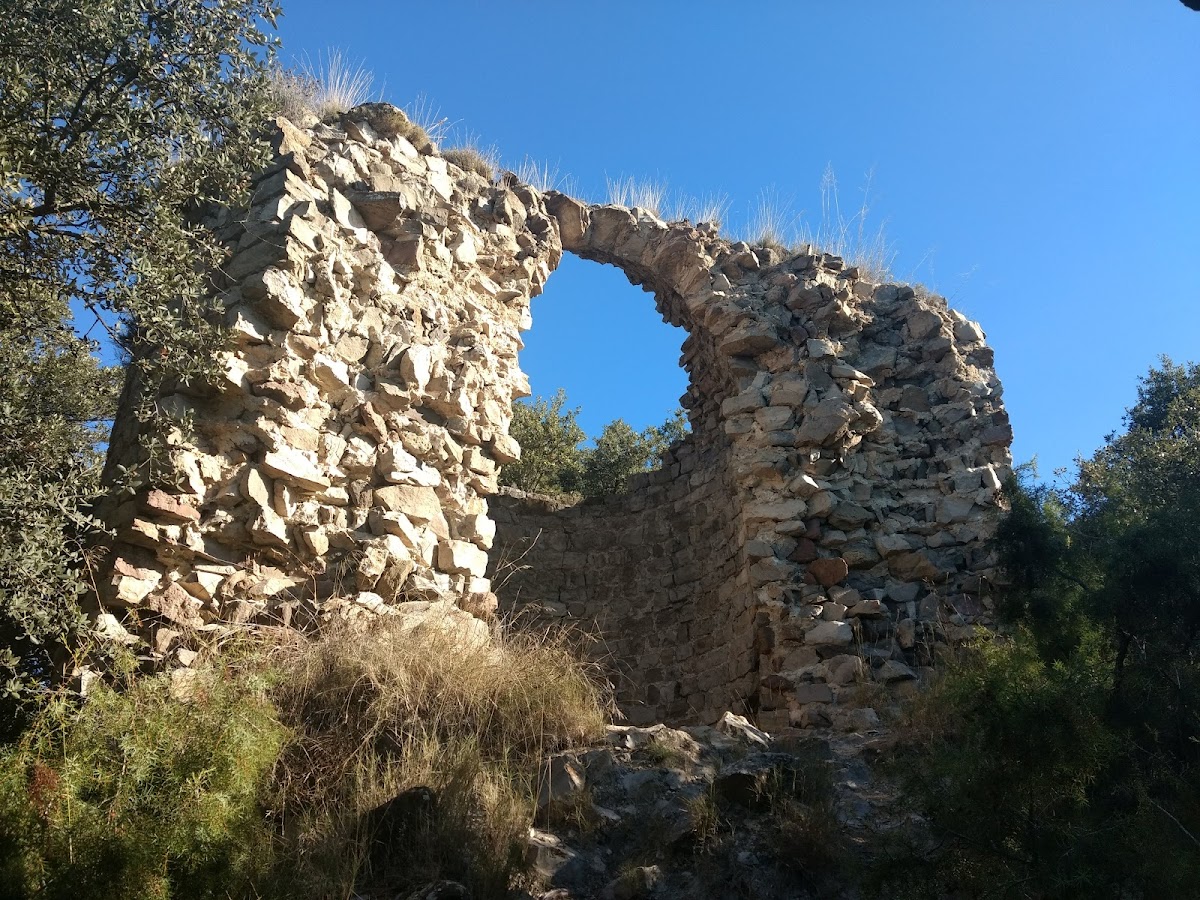
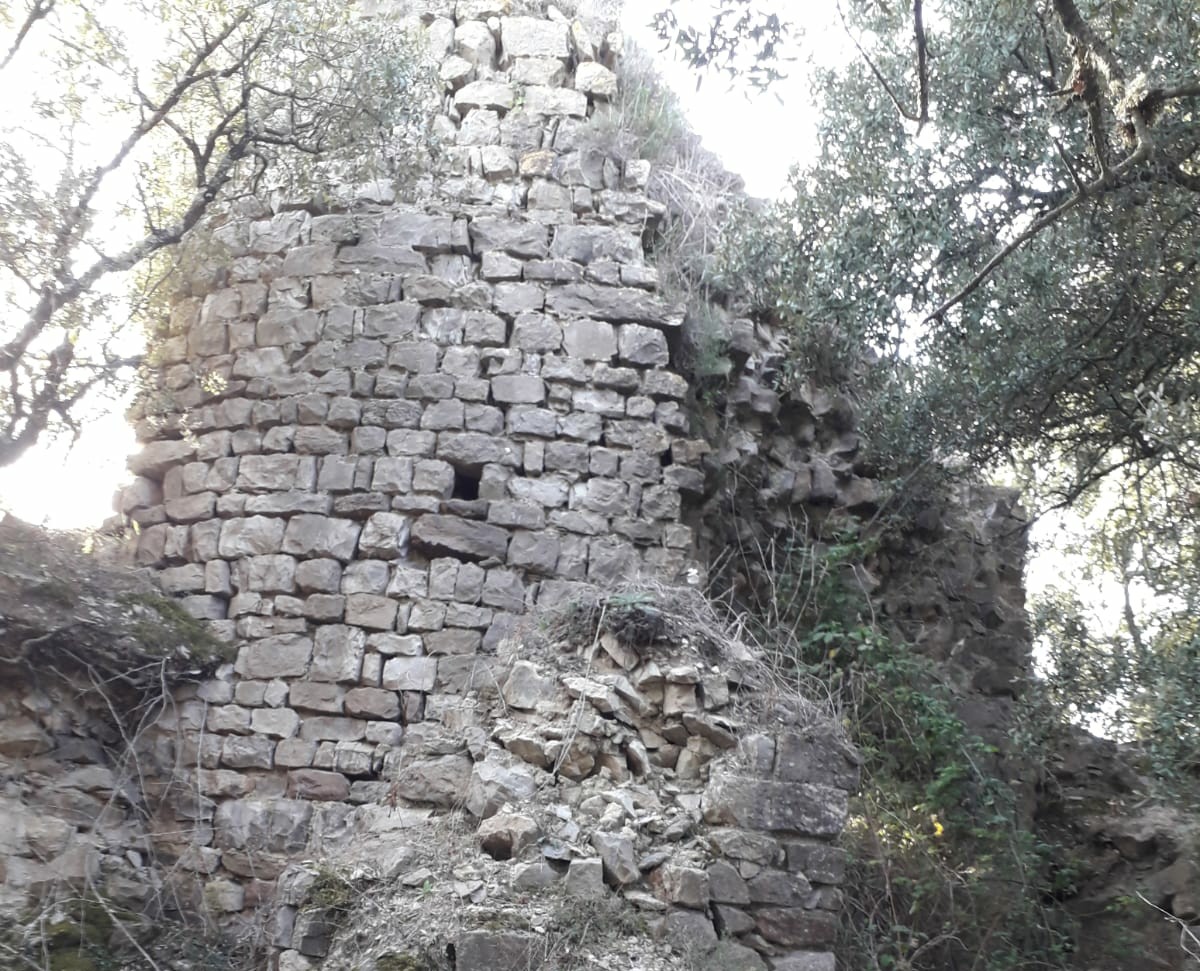
The ruins of Castell de Clarà stand on a hill near the church of Sant Andreu, overlooking the western side of the Moià municipality at roughly 800 meters above sea level. The castle’s layout centers on a circular main tower, or keep, which dates back to the 11th century. This tower measures nearly 7 meters across externally, with walls more than two meters thick, providing a sturdy stronghold. The walls are built from medium-sized stones roughly cut into square shapes and laid in even horizontal rows, a common medieval technique. On top, the stone dome roof—partially collapsed—rests on an arch about two meters wide, a feature that adds to the tower’s defensive design.
Immediately adjacent on the tower’s western side lies a circular cistern used for water storage, measuring just under three meters in diameter and nearly as deep. This cistern has walls built of smaller, more finely shaped stones than those of the main tower, and its interior was coated with mortar to hold water, traces of which survive today. The cistern’s careful construction suggests an important role in sustaining castle inhabitants during sieges.
The remainder of the castle comprises a series of medieval rooms and chambers surrounding the tower on all sides except the west. Most walls here rise to about two meters in height, constructed from medium-sized stones roughly squared and arranged in horizontal courses similar to the tower’s masonry but with somewhat thinner walls. On the northern side, two trapezoidal rooms connect via a narrow passage, each featuring arrow slits that would have served defensive purposes. The west room overlaps partially with the tower and measures roughly 5 by 4 meters, while the larger east room extends approximately 8 by 3 meters. The walls surrounding these rooms are notably thick on the outside to withstand attacks, while the interior partitions are slightly thinner. Doorways and a small entry vestibule with a partially preserved arch remain visible, giving insight into the castle’s layout.
On the southern side, there are two irregularly shaped chambers. One trapezoidal space, roughly 5 by 3 meters, has two doors—one opening toward the south exterior and another leading into a small adjoining room with an exit to the west. The other southern chamber, measuring about 4 by 3 meters, also connects to the vestibule and passageway, featuring remnants of a stepped floor which could have been used for seating or accessing different levels.
Beneath the ruins lies the chapel of Sant Andreu de Clarà, dating from the 11th or 12th centuries. Its position under the fortress indicates a close religious connection, likely serving the spiritual needs of the castle’s inhabitants. Together, these features present a well-ordered medieval fortress, with living spaces and defensive structures adapted over time but largely preserved in their foundational form despite centuries of abandonment.
Nearby sites