Château Moncade: A Medieval Castle in Orthez, France



Visitor Information
Google Rating: 4.2
Popularity: Low
Official Website: www.mairie-orthez.fr
Country: France
Civilization: Unclassified
Site type: Military
Remains: Castle

History
Château Moncade stands in the town of Orthez, France, built during the medieval period by the local ruling family. Its origins date back to around 1242, when Gaston VII, Viscount of Béarn, initiated its construction. At that time, Gaston VII moved the capital of the viscounty from Morlaàs to Orthez, establishing the castle as the new administrative and residential center. Politically, he aligned himself with the English crown and pledged loyalty to King Henry III of England in the same year the castle’s construction began. This allegiance influenced the castle’s role as a seat of power for the viscounts of Béarn throughout the 13th to mid-15th centuries.
The castle’s history is linked closely to the Moncada family, who were of Catalan origin. Gaston VII served as a significant patron to this family. In 1267, the castle passed under the administration of the Foix-Béarn family following the marriage of Marguerite de Moncade to Roger-Bernard III, marking an important dynastic shift. In the late 14th century, Gaston Fébus, also known as Gaston III of Foix-Béarn, made notable modifications to Château Moncade between 1368 and 1375. He enhanced the castle’s defenses and living quarters, particularly by raising the height of the pentagonal keep and adding a chapel tower.
Militarily, Château Moncade controlled critical points along the western Pyrenees through overseeing the valley of the gave de Pau and managing the northern border of the viscounty. However, its strategic position also exposed it to conflict. In 1569, during the Wars of Religion, the castle suffered significant damage as Protestant and Catholic forces clashed in the nearby Battle of Orthez. This violent encounter led to pillaging and contributed to the castle’s gradual decline.
Following the annexation of Béarn by France in 1620, Château Moncade was abandoned and fell into neglect. During the 18th century, the property was divided and sold in sections. The French Revolution further accelerated its dismantling, leaving the structure largely ruined. Recognizing its historical value, French authorities classified the keep as a historic monument in 1840. The 19th and 20th centuries saw partial restoration efforts and archaeological studies aimed at preserving and understanding the castle’s remains.
Remains
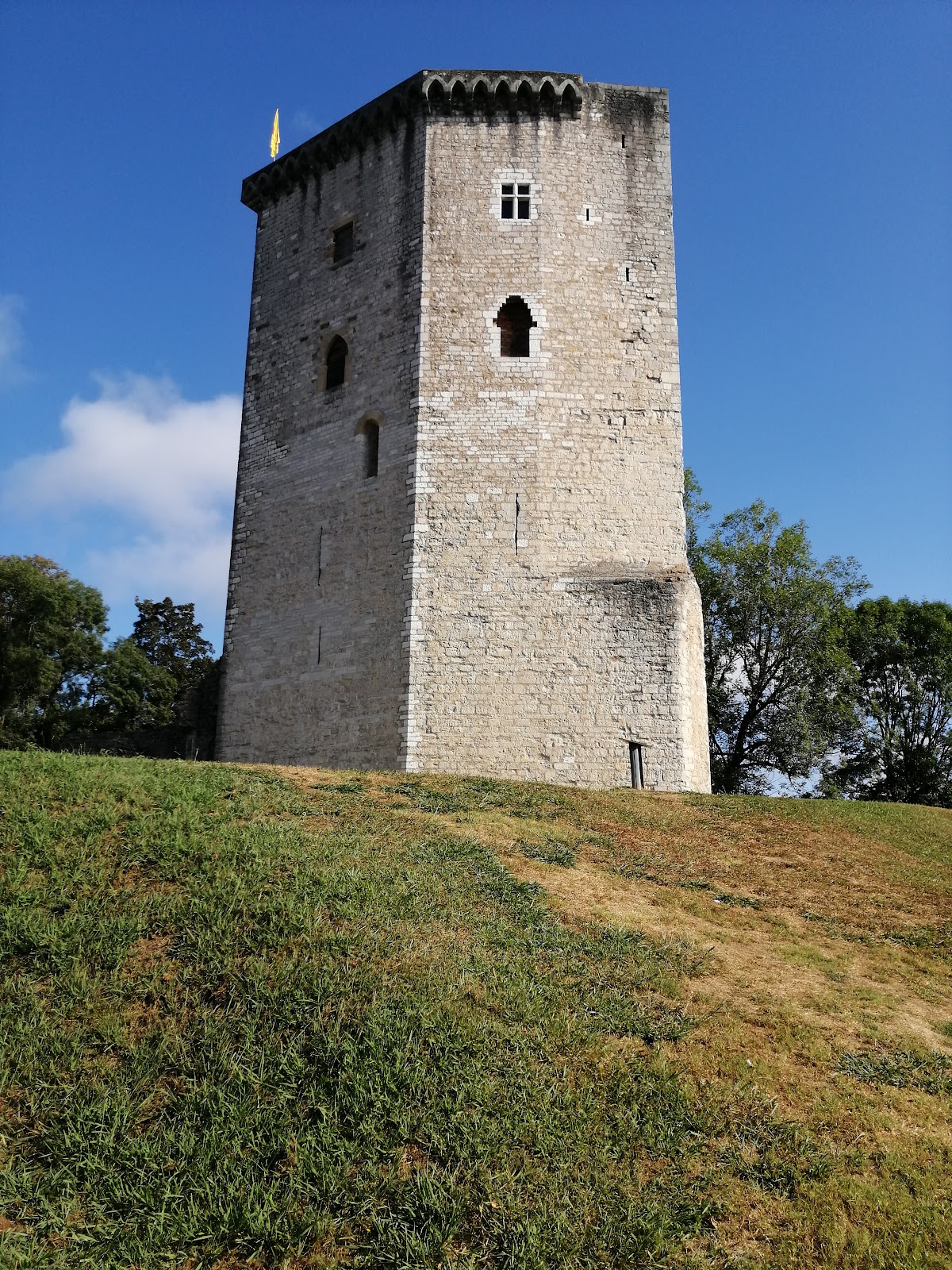
Château Moncade occupies a natural hill overlooking the town of Orthez, commanding extensive views over the surrounding valley for more than 30 kilometers. The fortress’s central and most prominent element is its pentagonal-shaped keep, dating from around 1250. Originally standing four stories tall, the keep today measures approximately 33 meters high, following the destruction of its uppermost floor in 1820. The keep’s stone walls form a sturdy defensive core that once combined residential and military functions.
Inside the keep, the upper floors served as living quarters for the viscount and his family. These chambers feature fireplaces from the 14th century or possibly later, highlighting the domestic purpose of these spaces. A spiral staircase was built within the thick buttress of the tower to connect all levels and provide access to the top platform; this addition is attributed to Gaston Fébus’s renovations in the late 14th century. The original main entrance to the keep was situated on the second-floor level, aligning with the third floor of the adjacent residential buildings, making access more secure. On the lowest level, arrow slits are set unusually high, too elevated to be effective for defense.
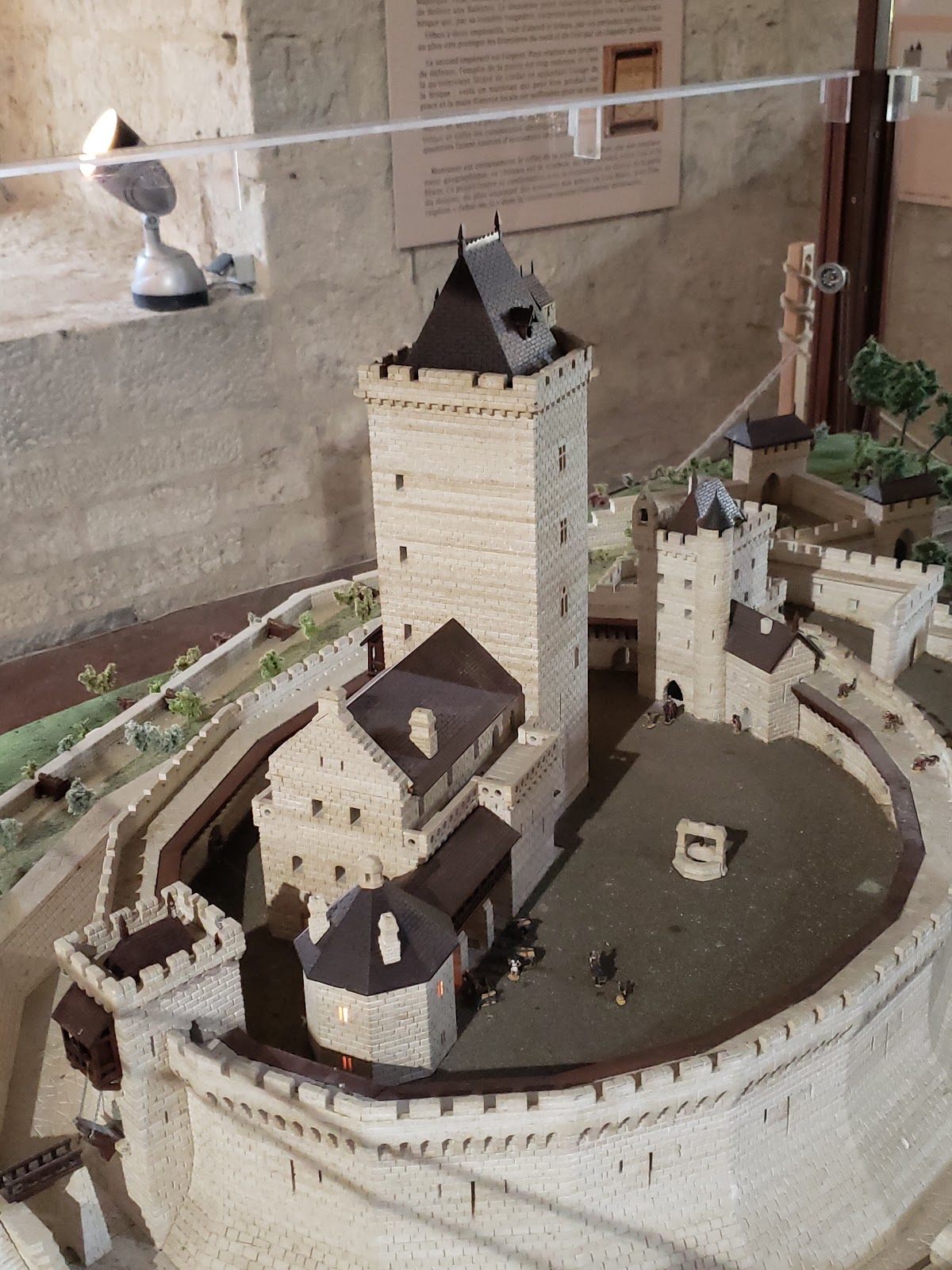
Surrounding the keep was a roughly circular curtain wall (enceinte), which was protected by a masonry-lined moat. Within this enclosure, a circular well supplied water, supporting the castle’s self-sufficiency during sieges. Attached to the keep was a rectangular residential building known as the corps de logis. This structure featured an impressive external staircase leading to the first floor, which contained the tinel, the castle’s great hall used for gatherings and official functions.
Defensive works extended beyond the main enclosure. A barbican—an outer fortified gate structure mentioned in records from 1347—once guarded the castle’s approach. Although only a remaining wall fragment survives today, it hints at the former strength of the entrance defenses. Access across the moat was provided by a drawbridge, a typical medieval feature enhancing protection from attackers. The castle was encircled by a double set of curtain walls, shaping a platform nearly 60 by 50 meters wide.
Beyond the castle’s main defenses lay the castral borough, or bourg castral, an area protected by three additional enclosures. These included the Lavignotte enceinte on the west side, the Moncade bourg enceinte, and a northern enceinte, each added after the initial construction to extend the defensive perimeter around the settlement associated with the castle.
In the 19th and 20th centuries, preservation efforts included reopening the keep’s ground floor entrance, which had long been sealed. Restoration introduced certain architectural features such as faux machicolations, which are decorative elements resembling medieval defensive openings. Wooden floors and a protective roof also were added during these campaigns. Archaeological excavations uncovered a paved courtyard within the castle, shedding light on its spatial organization. The castle’s walls display a mixture of stone types; modifications like later-installed windows and staircases used different stone than the original keep, reflecting changes over centuries.
Nearby sites