Castello di Montalto Pavese: A Historic Noble Residence in Italy




Visitor Information
Google Rating: 3.9
Popularity: Very Low
Google Maps: View on Google Maps
Official Website: fondoambiente.it
Country: Italy
Civilization: Unclassified
Remains: Military

History
The Castello di Montalto Pavese is situated within the municipality of Montalto Pavese in Italy. Its origins are connected to the medieval period, when the surrounding territory was controlled by local noble families.
During the early Middle Ages, the land was under the possession of a branch of the Belcredi family, an aristocratic house aligned with the Ghibelline faction originating from nearby Pavia. In the year 1164, the Holy Roman Emperor Frederick Barbarossa, recognizing their loyalty, awarded the land to the commune of Pavia, strengthening ties between the imperial authority and this northern Italian municipality.
Ownership shifted several times in the later Middle Ages. In 1406, the property was granted to Castellino Beccaria by Filippo Maria Visconti, the Duke of Milan. Later, in 1474, the castle passed to Francesco Strozzi di Benedetto by a donation from Galeazzo Maria Sforza, who held the ducal title in Milan during that period.
The present noble residence, now known as the Castello di Montalto Pavese, was primarily constructed beginning in 1593. An inscription at the main entrance indicates that Filippo Belcredi initiated this building phase, transforming the previous medieval fortification into a large palace. Prior to this, Ludovico Taverna had been the owner of the site but was required by the Spanish monarch to dismantle the defensive structures, removing military fortifications to prevent their use in conflict.
Following this period, the palace saw ongoing enlargement and stylistic updates over the following centuries. These modifications continued until the Napoleonic campaigns brought changes to the region’s political and social organization, halting further construction activities. Throughout its history, the site evolved from a fortified medieval stronghold into a grand noble residence reflecting the changing needs and tastes of its owners.
Remains
The Castello di Montalto Pavese, while commonly referred to as a castle, is essentially a large noble palace characterized by a symmetrical and well-organized floor plan. Constructed primarily from exposed stone and brick, the building stands on the site of earlier fortifications, with some masonry believed to incorporate parts of the medieval structure. Its style now presents a Baroque appearance, a reflection of the architectural trends during its major reconstruction phase in the late 16th century.
One of the most notable features is the original keep, or mastio, a substantial square tower that shapes the silhouette of the building and hints at its defensive past. This tower survives from the old medieval castle and remains a distinctive element within the complex.
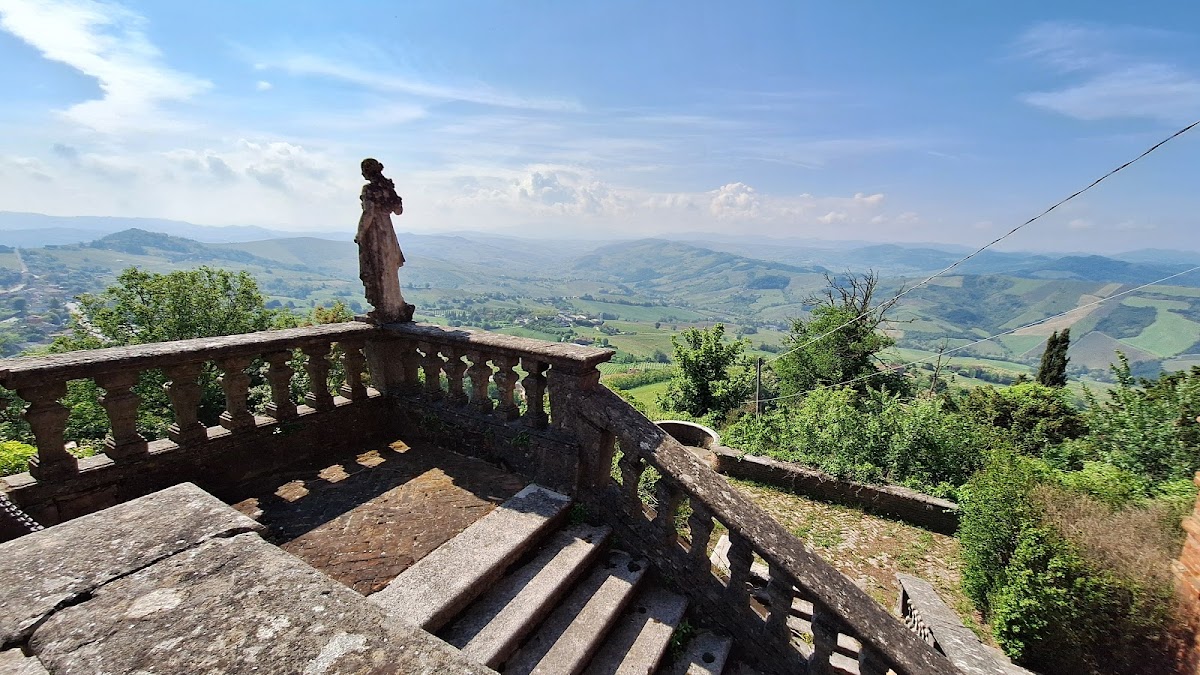
Surrounding the palace are two formal gardens that emphasize contrasting design traditions. The first is an Italian-style garden, laid out with strict geometric patterns and avenues aligned to create a sense of order and symmetry. Adjacent to this is an English-style garden, notable for its naturalistic arrangement and the presence of tree species such as larch, oak, and chestnut, which provide shaded groves.
Together, the architecture and landscape elements illustrate the castle’s transformation from a fortified seat to a noble residence with elegant and diverse outdoor spaces. The combination of medieval remnants integrated into a Baroque palace conveys the layered history embedded in the site’s fabric.
Nearby sites


