Castello di Cigognola: A Medieval Fortification in Italy




Site at a Glance
- Rating
- 4.4
- Popularity
- Low
- Country
- Italy
- Primary era
- Medieval
- External website
- Open
- Eras represented
- Medieval, Modern
- Civilizations
- Holy Roman Empire
- Site type
- Military
- Remains
- Castle
On this page7 sections
History
Castello di Cigognola is a medieval fortification in Italy, begun in the early thirteenth century on a strategic hill above the Scuropasso valley. Its position supported defense and commanded the opening of the valley onto the plain. The castle is recognized as part of Italy’s national heritage.
Medieval ownership and conflict
In 1372, Giovanni Acuto, the English mercenary commander also known as John Hawkwood, attacked and conquered the castle. It later passed through a succession of prominent families. The Sannazzaro family held it first, followed by the Beccaria family from 1406 and Giorgio Aicardi from 1415. Ownership subsequently passed to the Visconti Aicardi Scaramuzza family.
Later owners and present use
In the eighteenth century, the castle passed to Barbara D’Adda and then to her son, Alberico Barbiano di Belgiojoso. During the Napoleonic period, the era of Napoleon Bonaparte’s rule and influence in Europe, including Italy, the Gazzaniga family purchased the property. It later passed to the Arnaboldi Gazzaniga family and finally to the Brichetto Arnaboldi family.
The castle remains privately owned and houses a wine-producing company. Its long history of aristocratic ownership, military use, and later adaptation has preserved its place in the historical landscape of the Oltrepò Pavese.
Remains
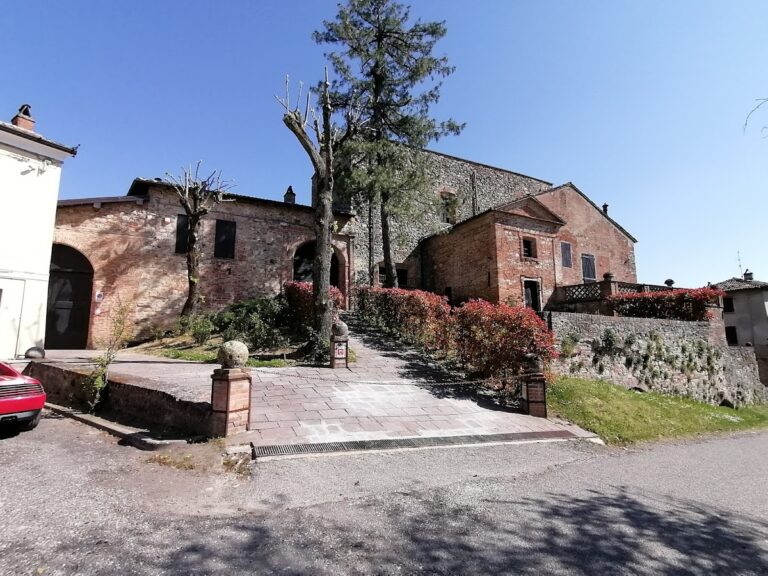
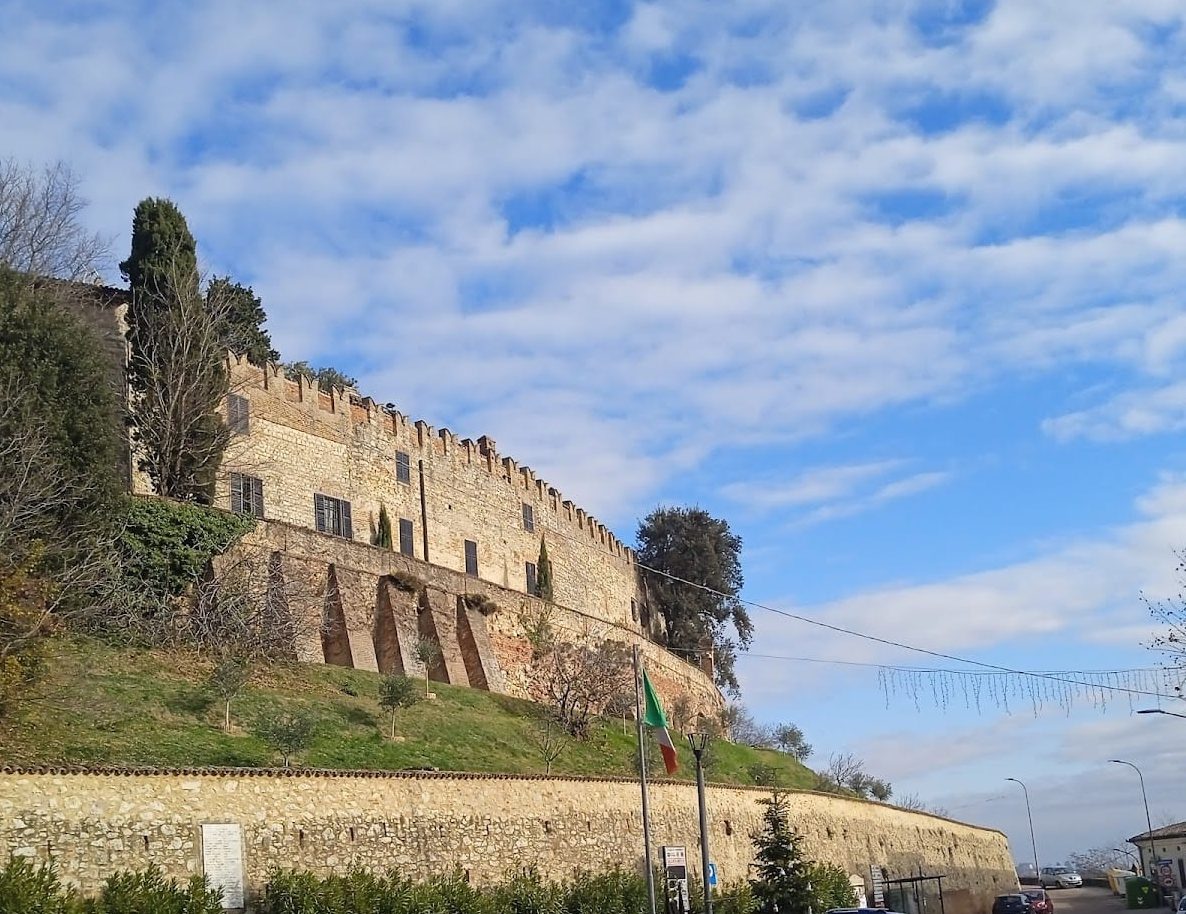
Castello di Cigognola stands at about 309 metres above sea level on the hill overlooking the point where the Scuropasso valley opens onto the Po Plain. The complex has an articulated plan made up of several connected building bodies. A surrounding wall and an earth embankment enclose the site, reinforcing its fortified character.
Principal fortified structures
Central tower
The central feature is a tall, square-based tower with crenellations along its upper edge. Long projecting corbels, which are masonry supports extending from a wall to carry an upper structure or defensive element, emphasize the tower’s vertical form. Its Ghibelline crenellations reflect the medieval imperial political cause opposed to the papal-aligned Guelphs. The tower’s present appearance reflects a nineteenth-century remodeling.
Courtyard and access
Inside the enclosure, a polygonal courtyard forms the central open space. A staircase rises from the courtyard and provides access to the castle buildings. Together with the surrounding wall, embankment, and tower, the courtyard organizes the several parts of the complex around its fortified core.
The castle is in good present condition. Its elevated position, defensive enclosure, and surviving arrangement of buildings retain the physical qualities that shaped its role above the valley entrance.