Burg Vlatten: A Historic Medieval Castle Complex in Heimbach, Germany



Visitor Information
Google Rating: 4.4
Popularity: Very Low
Country: Germany
Civilization: Unclassified
Site type: Military
Remains: Castle

History
Burg Vlatten is situated in the municipality of Heimbach, Germany. It was originally established by medieval European builders near an early royal palace related to the Carolingian dynasty.
The site’s history begins in the early 9th century when a Carolingian royal palace, known as a Königspfalz, stood here. This palace was significant enough to host Emperor Louis the Pious in 838 and later Emperor Lothar I in 846. During the Middle Ages, the royal palace gradually lost its prominence after Emperor Henry IV granted large tracts of the surrounding forest to Archbishop Anno of Cologne, affecting the region’s political landscape.
Two castles eventually arose along the Vlattener Bach stream near the royal palace, one to the north and another to the south. The southern castle, called the Oberburg, came under the ownership of Johann I of Vlatten-Merode in 1331. This family made the Oberburg their ancestral seat and constructed a fortified complex in the 14th century that included a main rectangular castle with towers and a surrounding outer bailey. The castle was enclosed by moats, emphasizing its defensive role.
Throughout the 15th century, the Oberburg passed through inheritance and marriage alliances, gradually dividing ownership between the von Vlatten and von Schwarz-Bongard families. Subsequent ownership transferred among several noble houses including von Gymnich, von Bocholtz zu Lobberich, von Mirbach-Harff, and von Bentinck. In 1787, these fragmented shares were consolidated again under Clemens August von Syberg zu Eicks.
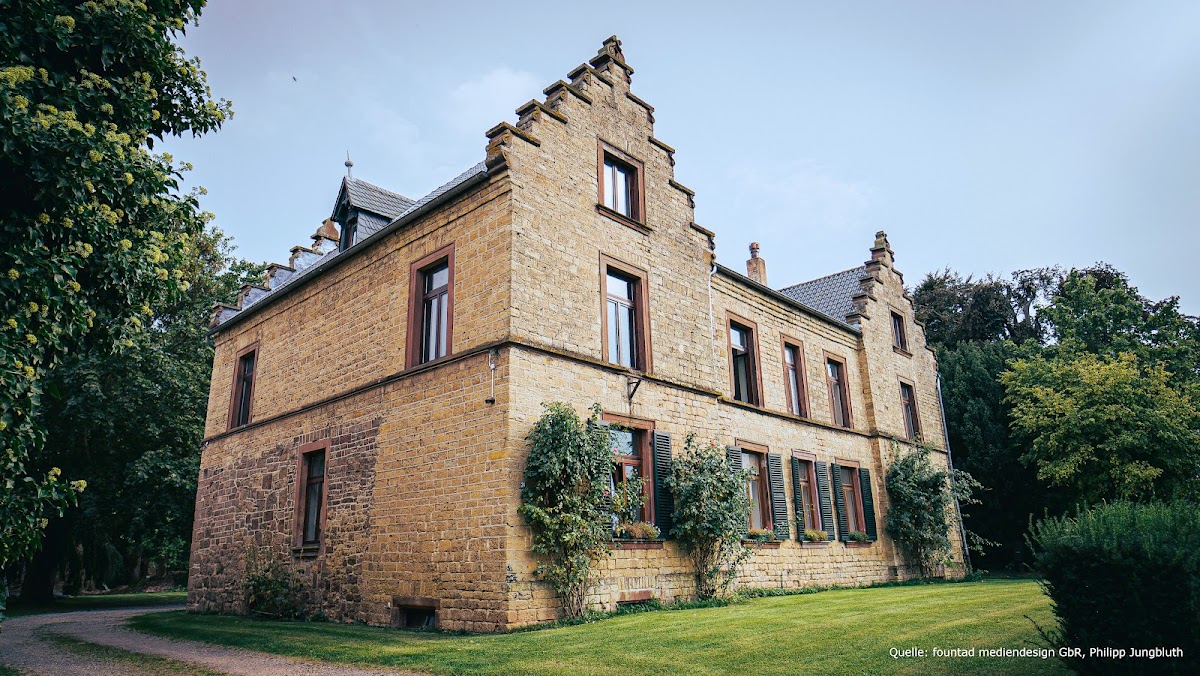
By the 19th century, the original medieval castle had largely fallen into disrepair and was converted into a manor farm. Parts of the outer bailey were absorbed into the new estate layout, with the main residential building established on the southwest side. Around the turn of the 20th century, the von Gagern family undertook restoration efforts, transforming the former tenant house into an elegant manor residence. They added a historicist square tower in 1908 and by 1913 created a division between the residential quarters and the economic areas, including constructing a new tenant house within the farmyard.
The second castle, known as the Unterburg, is first recorded in 1401 and is believed to have originated from partitioning the original estate. Ownership eventually passed to Adam von Gymnich in 1605, who also held the Oberburg. Over time, the Unterburg declined and fell into ruin during the 17th century. As of 2020, the Oberburg remains under the stewardship of the von Gagern family, having been passed down to Lydia Freifrau von Gagern and Oliver Freiherr von Gagern.
Remains
The Oberburg at Burg Vlatten was originally a fortified fortification built in the 14th century featuring a rectangular main castle surrounded by water-filled moats. Its layout included a central stronghold equipped with watchtowers and an irregularly shaped outer bailey that extended the defensive perimeter and housed auxiliary structures. The use of moats provided an important water barrier against attackers, typical of medieval fortifications in the region.
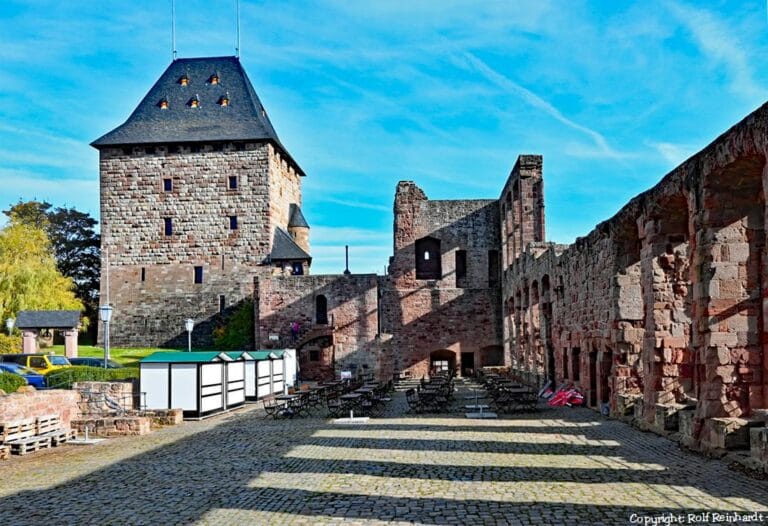
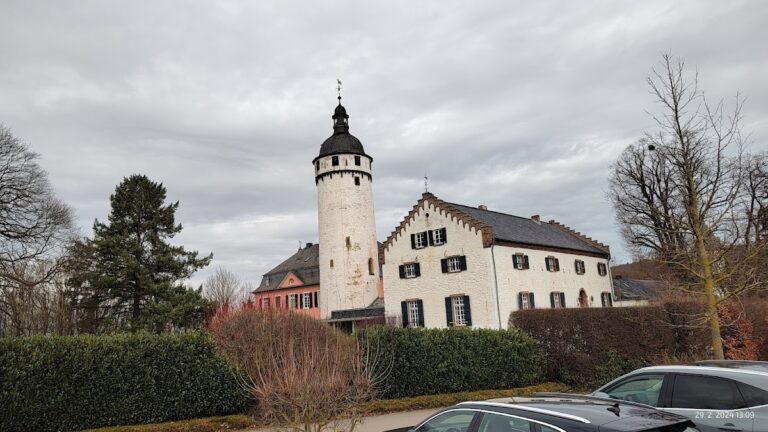
Today, portions of the enclosing walls still stand, showing the robust stone construction that once framed the castle’s defense. Several towers of moderate height remain visible, including a prominent two-story round tower that exemplifies medieval military architecture. On the west side of the site, the vaulted basement of a short wing has survived, offering insight into the castle’s multi-level design with vaulted cellars that may have been used for storage or protection.
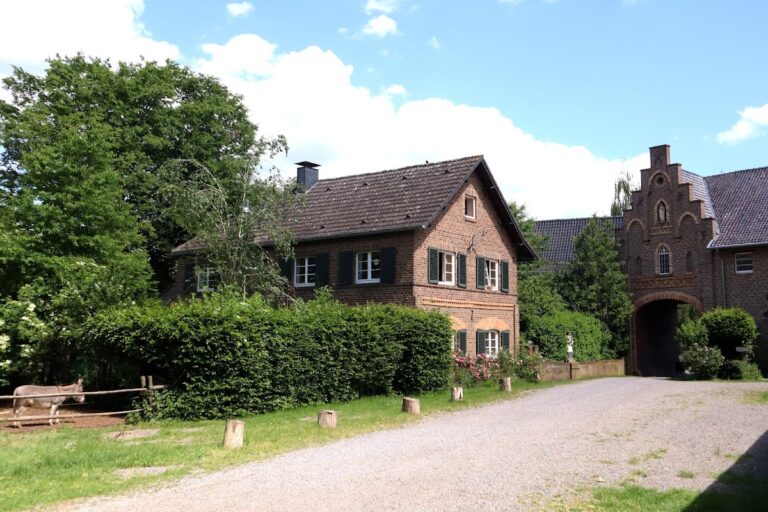
Following its decline as a fortress, the 19th-century conversion into a manor farm incorporated sections of the outer bailey into the agricultural estate. The main residential building was located in the southwestern corner of the castle complex, repurposing the space to fit the needs of a working manor rather than a defensive stronghold.
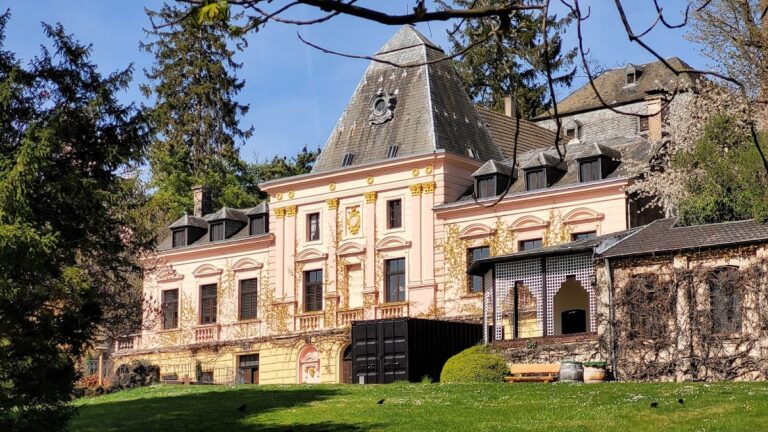
In the early 1900s, the von Gagern family introduced significant architectural changes intended to revive the site’s representative character. The tenant house was expanded into a two-winged residence, and in 1908, a square tower designed in a historicist style was added on the eastern side, blending medieval inspiration with contemporary aesthetics. By 1913, a separating wall was built to divide the residential courtyard from the economic areas, and a new tenant house was constructed within that farm courtyard, clearly delineating living spaces from agricultural functions.
Regarding the Unterburg, very limited remains survive today, consisting only of a fragment of a tower wall. This fragment does not provide precise details of the original layout or dimensions but serves as a tangible reminder of its existence before falling into ruin in the 17th century. The sparse remains reflect its diminished role compared to the Oberburg and its eventual abandonment.
Together, these surviving structures and modifications illustrate the site’s evolution from a medieval defensive castle to a 19th-century manor farm, and finally to a restored historic residence, integrating layers of regional history and architectural transformation.
Nearby sites