Burg Kommern: An Administrative Hilltop Castle in Germany


Site at a Glance
- Rating
- 4.2
- Popularity
- Very Low
- Country
- Germany
- Primary era
- Medieval
- Eras represented
- Medieval, Modern
- Civilizations
- Holy Roman Empire
- Site type
- Civic
- Remains
- Palace
On this page6 sections
History
Burg Kommern is a hilltop castle in Germany, located in Kommern, a district of Mechernich, and built around 1350. Rather than serving as an aristocratic residence, it functioned as the administrative headquarters of the Arenberg official governing the Imperial Lordship of Kommern, a territory within the Holy Roman Empire ruled directly by a lord. This role continued until 1794.
The Arenberg Administration
The official based at Burg Kommern was an Amtmann, an administrator responsible for governing an estate or territorial district on behalf of its lord. The Arenbergs belonged to the high nobility and traced their ancestral seat to Aremberg. Members of the family held the office of burgrave of Cologne during the twelfth and thirteenth centuries, and they attained ducal rank in the seventeenth century.
The family’s possessions included Roggendorf, Gehn, Strempt, Katzvey, and Weingarten. Their wealth came from regional mining, while Burg Kommern provided a base for administering their lordship rather than a private aristocratic household.
Protection and Ownership
Mechernich added Burg Kommern to its monument list on 5 December 1989. On 9 July 2019, the city also designated the castle and its surrounding landscape park in the land-use plan as a private green area comprising the historic park and castle complex. The Seul family still owned the castle in 2017.
Remains
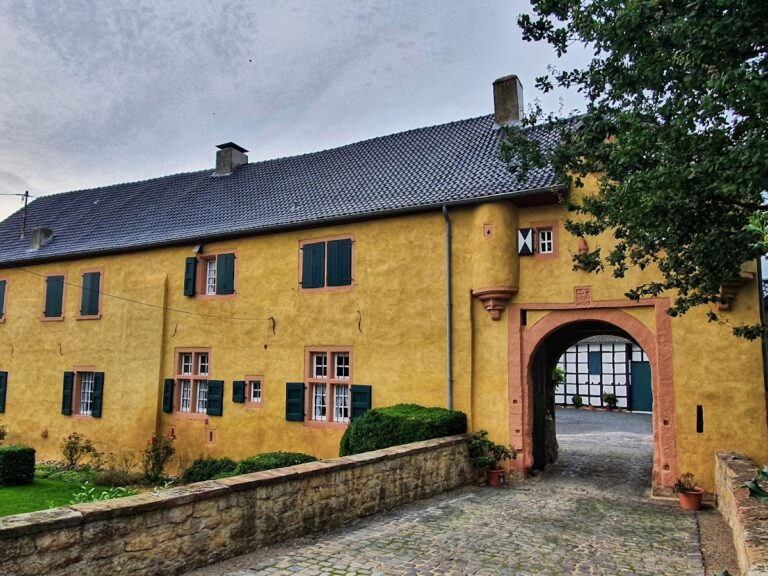
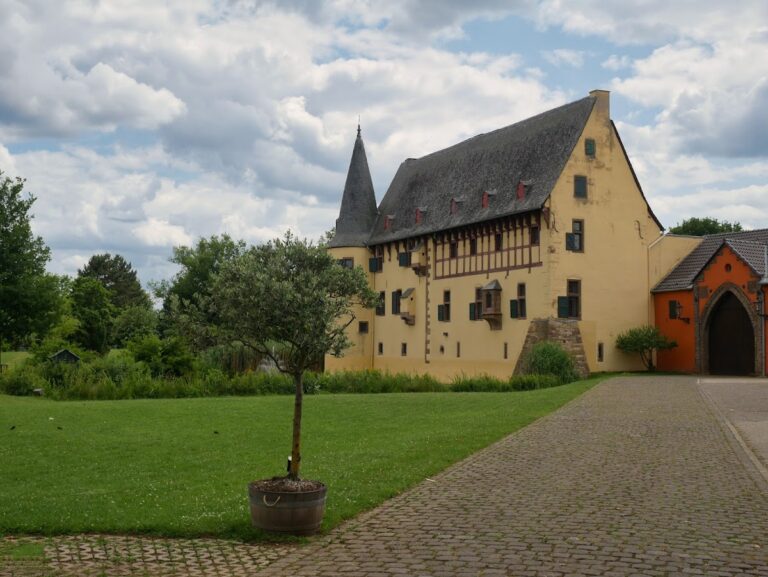
Burg Kommern stands within the settlement on a hilltop 263 metres above sea level. Substantial parts of the preserved complex survive. The buildings form an irregularly arranged group concealed behind an elaborate courtyard facade whose design is arranged symmetrically.
Buildings and Courtyard
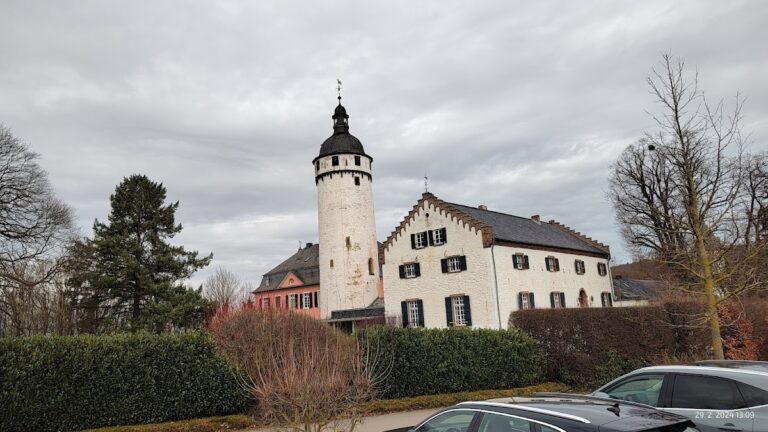
The residential tower probably belongs to the construction campaign around 1350. It forms part of the larger castle complex, whose irregular building arrangement contrasts with the ordered appearance of the courtyard facade. This combination gives the preserved structure both a compact internal plan and a formal exterior presentation.
Park and Interior Decoration
The castle grounds include a landscaped park with rare trees. Inside the hall, colored wallpaper made by Josef Dufour was printed in Mâcon in 1804. The wallpaper depicts the adventurous voyages of Captain Cook, the eighteenth-century British naval captain and explorer. Nine examples of this type survive worldwide, including six in manor houses in the American Southern states.