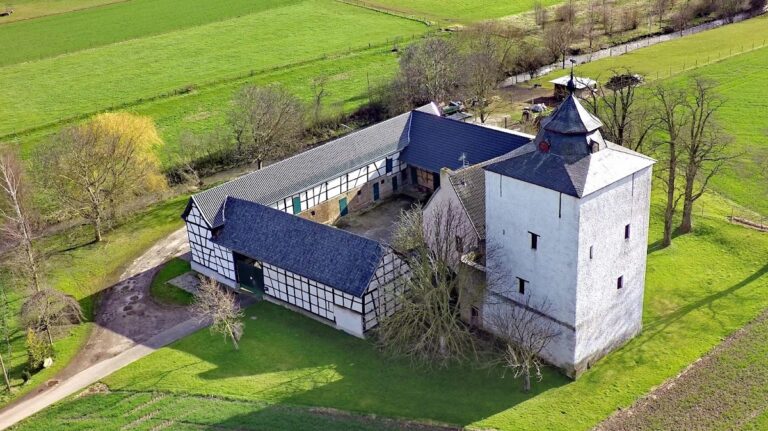
Burg Satzvey: A Medieval Water Castle and Aristocratic Residence in Germany

Site at a Glance
- Rating
- 4.5
- Popularity
- Medium
- Country
- Germany
- Primary era
- Medieval
- External website
- Open
- Eras represented
- Medieval, Modern
- Civilizations
- German, Holy Roman Empire
- Site type
- Military
- Remains
- Castle
On this page11 sections
History
Burg Satzvey is a medieval water castle in Germany, located in the Satzvey district of Mechernich at the northeastern edge of the Eifel. It originated in the twelfth century as a lightly fortified, moat-surrounded manorial estate built by the local ministerial nobility, and later became an important example of Rhenish castle building and aristocratic culture. Its Gothic castle house, constructed in 1396, formed the core of a complex whose medieval fabric remains unusually well preserved.
The von Vey stewardship
The estate was arranged on two islands and served as the seat of the von Vey family. Its lords administered extensive ecclesiastical lands as Vögte, appointed stewards responsible for managing church property, for the Benedictine convent of Dietkirchen. Archbishop Engelbert III von der Mark of Cologne granted Satzvey as a fief to Otto von Vey, who is first recorded as a steward under that name in 1368.
After the male line of the von Vey family ended, Otto’s granddaughter transferred the castle and the stewardship to her husband, Heinrich von Krauthausen, in 1391. Five years later, Heinrich established the first freestanding, two-storey Gothic castle house as a new administrative residence. This building provided the central form around which the later fortified complex developed.
Fortification and changing lordship
The castle was strengthened during the fifteenth century. A gatehouse with two towers was built, an additional fortified enclosure known as a Zwinger was laid out, and the outer bailey, the defended area beyond the principal castle, received heavier fortifications. In the second half of the century, Satzvey belonged to the von Meller family.
After 1512, ownership passed through several noble families. In 1561, the castle came to Wilhelm Spies von Büllesheim through expropriation supported by the archbishop of Cologne. Duke Wilhelm V of Jülich, known as “the Rich,” occupied Satzvey in 1578. Three years later, its lord, Spies von Büllesheim, was required to swear allegiance both to the duke and to Gebhard I von Waldburg, the archbishop of Cologne.
At the end of the sixteenth century, the Satzvey stewardship became an imperial-immediate lordship, held directly from the Holy Roman Emperor rather than through an intermediate territorial ruler. In 1747, Johann Spies von Büllesheim sold the castle to Karl Otto von Gymnich. Satzvey then entered the possession of the Rhenish noble family von und zu Gymnich.
From lordship to aristocratic residence
In 1794, Satzvey lost its status as a lower lordship. It thereafter remained a knightly estate with the right to representation in the regional assembly, a form of limited political standing for a noble estate.
When the principal Gymnich line ended in 1882, Burg Satzvey passed to Count Dietrich Wolff-Metternich zur Gracht. At the end of the nineteenth century, he undertook extensive renovation and enlargement. The work transformed a largely medieval and badly deteriorated castle into a representative aristocratic residence, while also reshaping parts of its surrounding buildings and defenses.
The castle had largely escaped military destruction over earlier centuries, but it suffered severe damage during the Second World War. In 1942, Reichsgräfin Adeline Wolff-Metternich zur Gracht inherited the estate after her brother Dietrich was killed in the war. Her marriage in 1944 to Franz Josef Graf Beissel von Gymnich zu Frens transferred Burg Satzvey into the Beissel von Gymnich family.
Adeline and Franz Josef moved into the castle and repaired its most important structural elements in the years that followed. Their four sons were born there. In 1977, the property passed to their eldest son, Franz Josef Graf Beissel von Gymnich. To preserve the castle and traditions associated with earlier periods, he opened the complex to the public with his wife Jeannette and their daughter. In 1981, they began organizing historical knight festivals at Satzvey, including a tournament described as the first historical knight tournament held in modern Germany.
On 19 April 2020, a bakery attached to the castle burned down. Burg Satzvey is recorded as an architectural monument in North Rhine-Westphalia and is regarded as the best-preserved water castle in the Rhineland in terms of its original fabric.
Remains
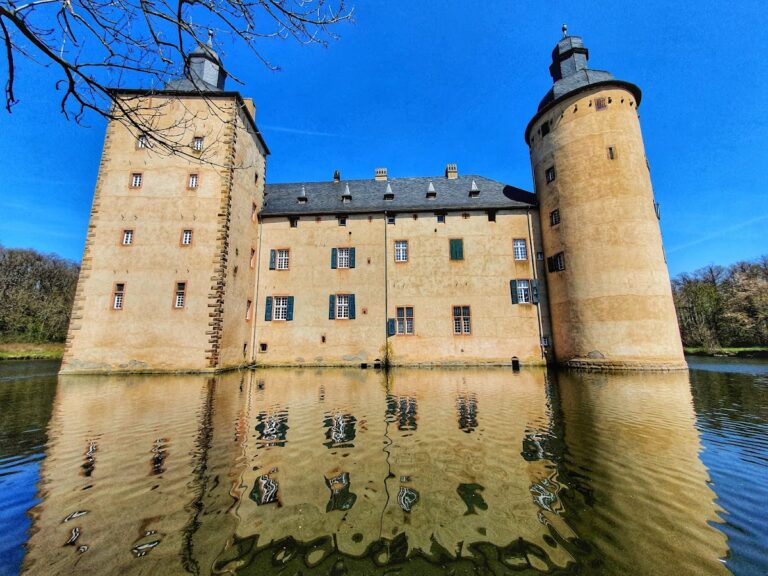
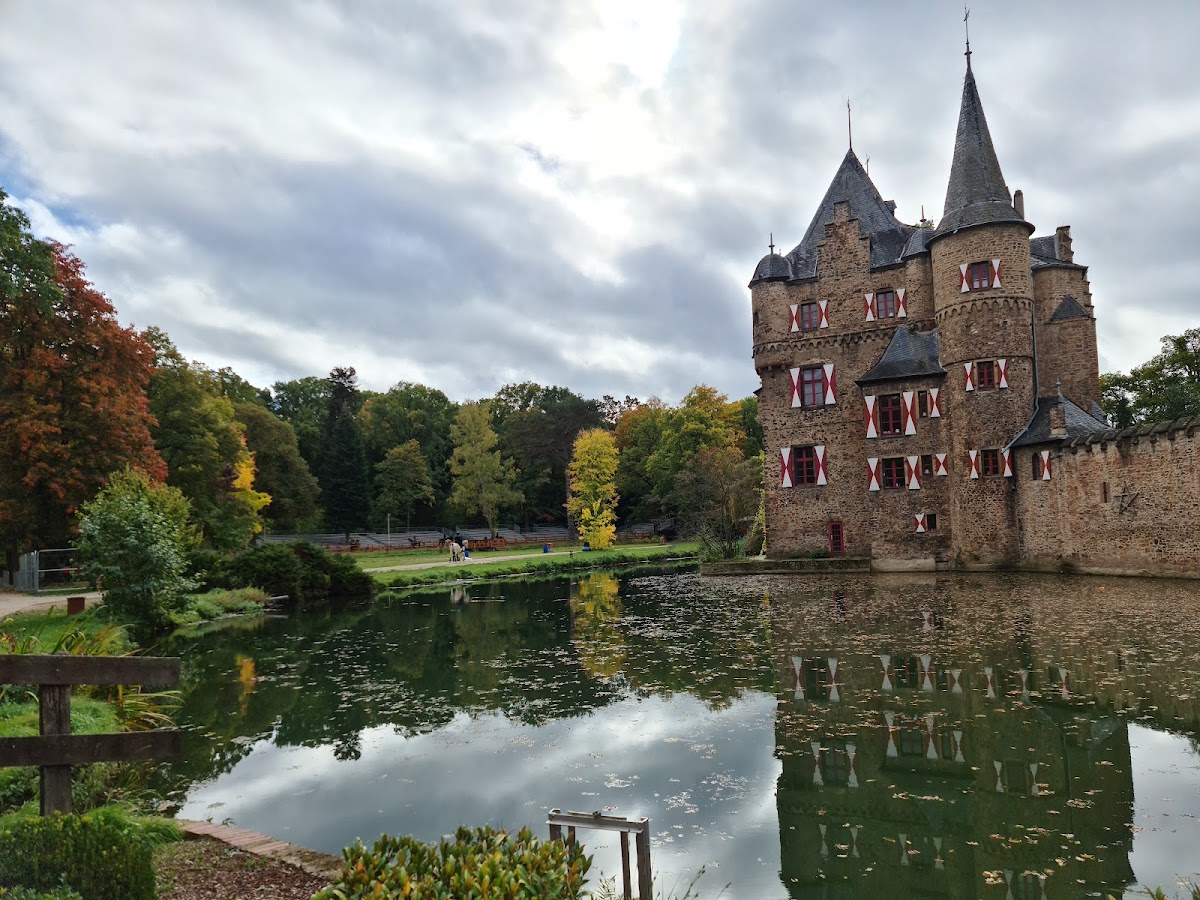
Burg Satzvey occupies two islands in a lowland water-castle layout. Moats supplied by the nearby Veybach surround the complex, providing the defensive barrier that a hill supplied at castles built in elevated terrain. The principal castle stood on one island, while the outer bailey occupied the second. Rubble stone is the principal building material, and the surviving structures retain an exceptional amount of their original fabric.
Medieval castle core
Castle house
The original castle house dates from 1396. It was built as a freestanding, two-storey Gothic residence and initially stood at the heart of the island complex. Its early-fifteenth-century fabric became the core and model for later construction. The house was enlarged during the late nineteenth century, when the castle was adapted into a representative aristocratic residence.
Twin-towered gatehouse
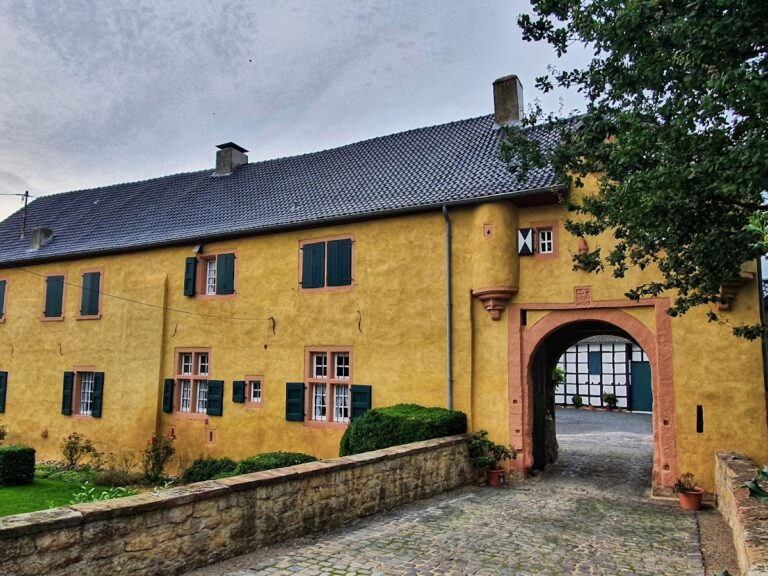
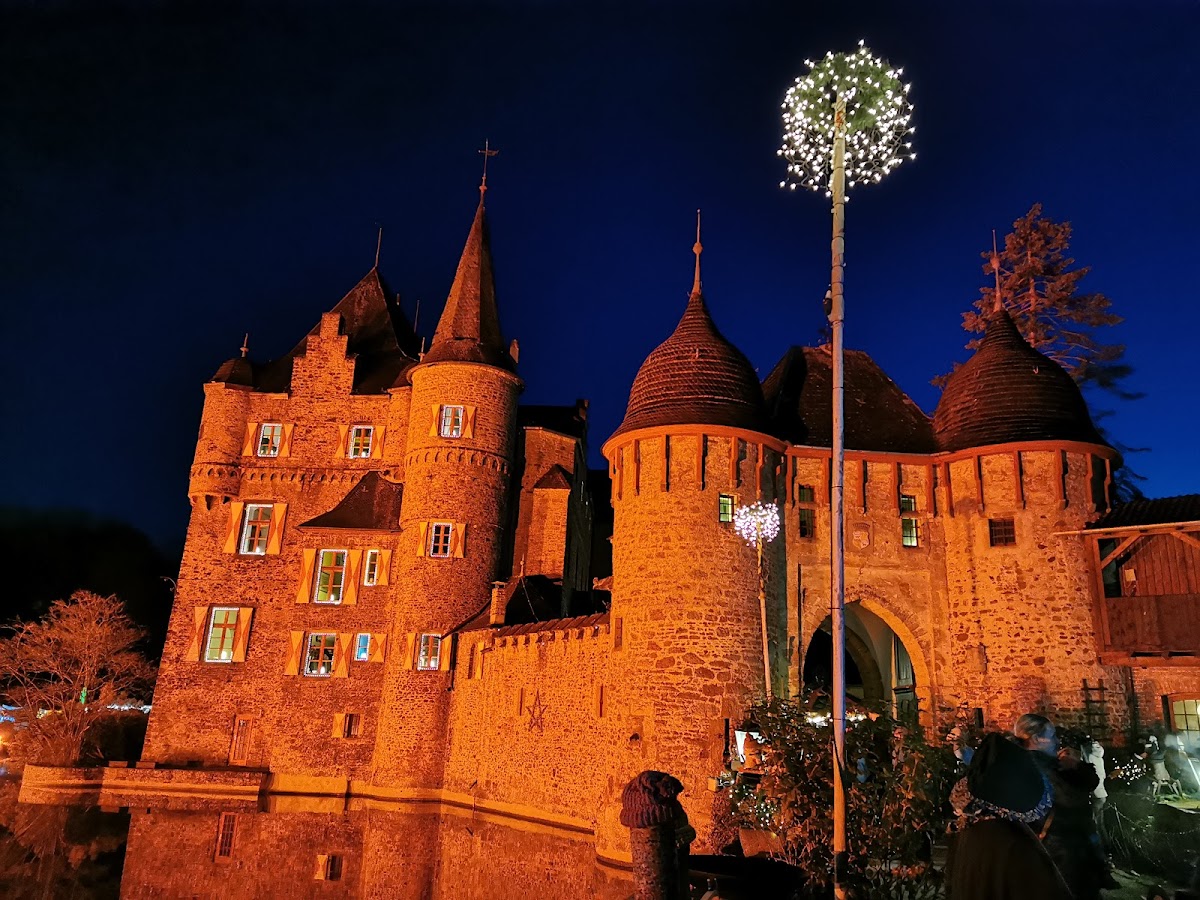
The gatehouse forms the principal fortified entrance and has twin towers. The arms of the Wolff-Metternich zur Gracht family are displayed above its arch. Together with the original castle house, the north wall, and the north tower, it belongs to the oldest surviving part of Burg Satzvey. These elements have remained in place for approximately six centuries.
Nineteenth-century buildings and memorial features
Outer-bailey buildings
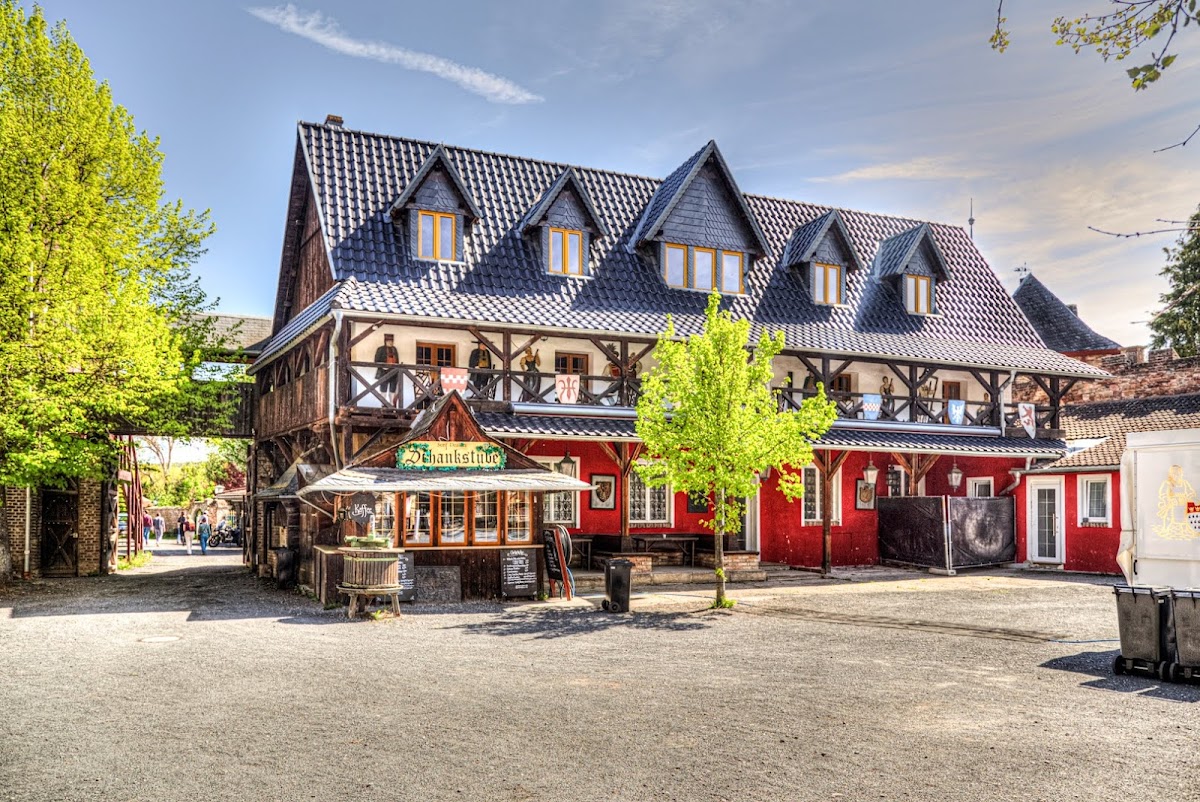
The late-nineteenth-century building campaign altered the wider arrangement of the castle. The moats were drained, the castle house was enlarged with additions, and new towers were introduced. Buildings in the style of English stables were erected on the former outer bailey, alongside a manor and agricultural buildings. The southwestern agricultural building bears an alliance coat of arms for Dietrich Wolff-Metternich zur Gracht and his wife, Mechtildis Berghe von Trips. The building is dated 1882.
Funeral shields
Two diamond-shaped funeral shields hang on the gallery beside the gate complex. They commemorate Adeline Helene Huberta Maria Gräfin Beissel von Gymnich, née Reichsgräfin Wolff-Metternich, and her husband, Franz Josef Hubert Maria Graf Beissel von Gymnich. The shields form part of the surviving commemorative features associated with the later Beissel von Gymnich ownership.