Assos Archaeological Site: An Ancient Coastal City in Western Türkiye
Table of Contents



Visitor Information
Google Rating: 4.5
Popularity: Medium
Google Maps: View on Google Maps
Official Website: muze.gov.tr
Country: Turkey
Civilization: Byzantine, Greek, Roman
Remains: City

Context
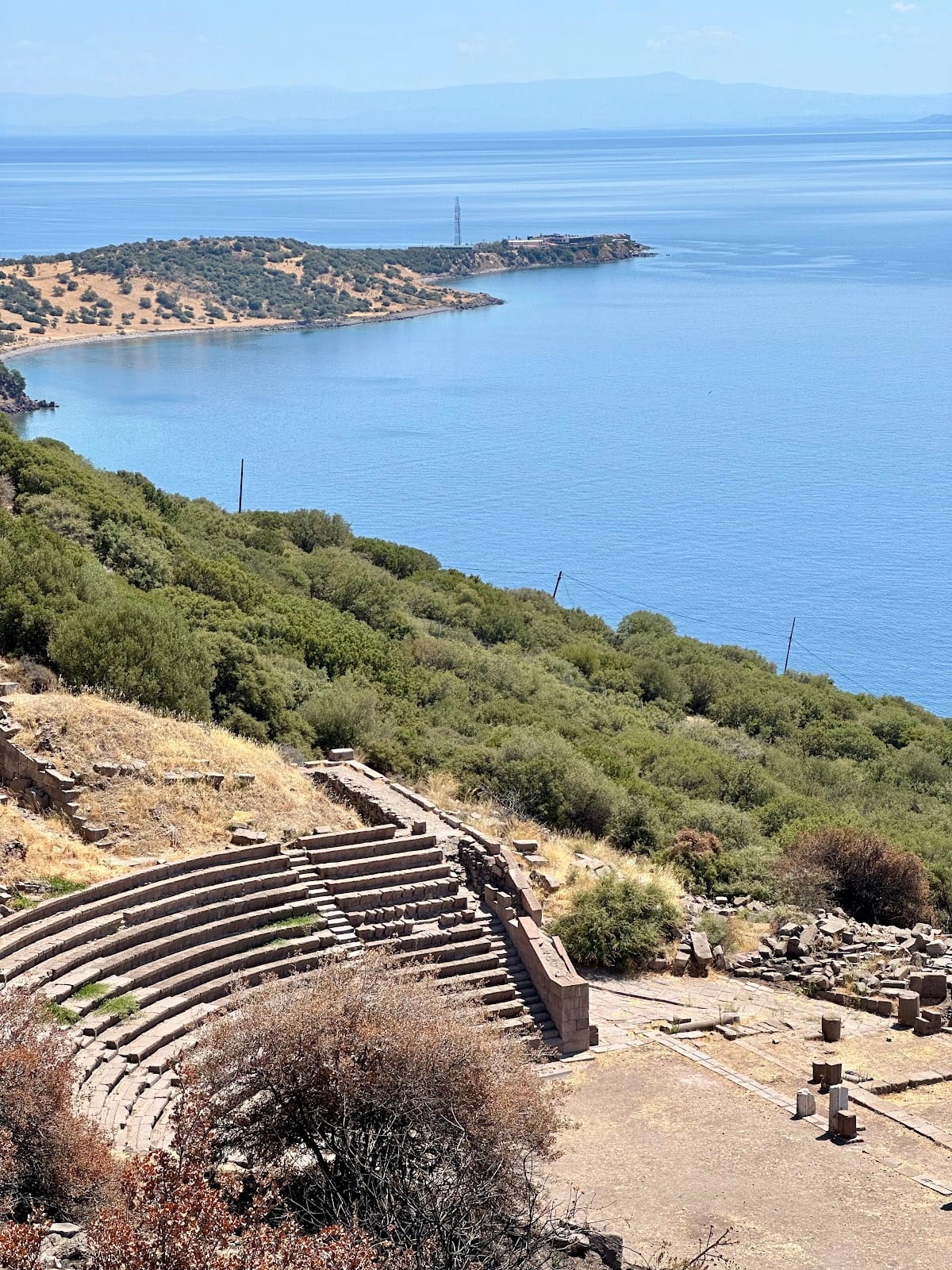
The Assos Archaeological Site is situated at Behramkale Köyü within the Ayvacık district of Çanakkale province in western Türkiye. It occupies a prominent coastal headland and an adjoining plateau overlooking the Aegean Sea, directly facing the island of Lesbos across a narrow maritime channel. The site’s topography is characterized by steep coastal slopes and a constrained coastal plain, which influenced the spatial organization of the settlement.
Archaeological investigations have documented continuous occupation from the Archaic Greek period through to the late Byzantine era. The city’s foundation is dated to the seventh century BCE, attributed to Aeolian Greek colonists. In the Classical period, Assos gained philosophical prominence as the residence of Hermias of Atarneus and Aristotle. Subsequent Hellenistic and Roman phases saw sustained urban development and architectural modifications. Medieval occupation persisted into Byzantine times, eventually transitioning into the modern village. The site preserves extensive surface remains across the acropolis and lower town, with conservation managed under national heritage legislation and local museum authorities. The archaeological record provides a detailed sequence of long-term habitation without evidence for a singular, abrupt abandonment event.
History
Assos represents a significant archaeological and historical locus reflecting a complex trajectory from the Bronze Age through the late Byzantine period. Its strategic position on the Aegean coast opposite Lesbos established it as a maritime node and cultural interface. Over time, Assos experienced successive political dominions, including Aeolian Greek colonization, Lydian and Persian imperial control, Hellenistic governance under Pergamon, Roman provincial administration, and Byzantine ecclesiastical authority. The city’s historical importance is underscored by its role in regional power dynamics, its association with Classical philosophy, and its transformation during Christianization. Archaeological and epigraphic evidence attest to the city’s adaptability through multiple imperial transitions.
Bronze Age Settlement
Material remains attest to human presence at the site of Assos during the Bronze Age, although the cultural identity of these earliest inhabitants remains undetermined. Located within the ancient region known as Troas, the settlement occupied a volcanic hilltop and adjacent slopes near the Aegean coastline. While no written records survive from this era, stratigraphic evidence indicates continuous occupation that provided a foundation for later Greek colonization and urban development.
Aeolian Greek Colonization (7th–6th century BCE)
In the seventh century BCE, Aeolian Greeks originating from Methymna on the island of Lesbos established Assos as a polis. Ancient literary sources corroborate this foundation narrative. The city’s location on a coastal promontory with two adjacent harbors, protected by constructed breakwaters, rendered it the principal maritime center in the Troas region. Defensive fortifications, including acropolis walls enclosing approximately 55 hectares, were erected by the fourth century BCE, with earlier archaic fortifications also attested. Circa 540–530 BCE, the Doric temple dedicated to Athena Polias was constructed atop the acropolis, utilizing local volcanic andesite. The temple’s architectural program integrated Doric and Ionic elements, with sculpted metopes depicting mythological iconography. Numismatic evidence from the fifth and fourth centuries BCE demonstrates the city’s political autonomy and economic activity through the minting of silver and bronze coinage bearing ethnonyms such as Assius and Asseus.
Lydian and Persian Rule (6th–5th century BCE)
By the mid-sixth century BCE, Assos fell under the expanding dominion of the Lydian kingdom, which sought control over coastal Greek settlements. This period concluded in 546 BCE when the Achaemenid Persian Empire conquered Lydia, incorporating Assos into its imperial structure. Despite Persian sovereignty, local Greek administrators retained responsibility for internal governance and tax collection, with minimal disruption to civic operations. During the fifth century BCE, Assos became a tributary member of the Athenian-led Delian League, contributing an annual tribute of one talent, reflecting its integration into broader Greek political and economic networks while under Persian overlordship.
Classical Period and Tyranny of Eubulus and Hermias (4th century BCE)
The Peace of Antalcidas in 387 BCE reaffirmed Persian hegemony over the region, including Assos. Within this geopolitical framework, a local merchant named Eubulus proclaimed himself ruler of Assos and the neighboring city of Atarneus. Following Eubulus’s death, his eunuch servant Hermias assumed power circa 355 BCE, ruling until 344 BCE. Hermias, a disciple of Plato, fostered an intellectual environment by inviting philosophers, most notably Aristotle, who resided in Assos for approximately three years. During this period, Aristotle established a philosophical school and conducted research in ethics and biology, marrying Hermias’s niece, Pythias. In 345 BCE, Persian general Memnon of Rhodes recaptured Assos, executed Hermias by crucifixion in Persepolis, and reinstated Persian control. Aristotle departed in 344 BCE to tutor Alexander the Great. Subsequent to Alexander’s death, Assos experienced brief occupation by Galatian forces.
Hellenistic Period (3rd–2nd century BCE)
Following the disintegration of Alexander the Great’s empire, Assos was incorporated into the Pergamon Kingdom in 241 BCE and renamed Apollonia in honor of King Attalus’s mother. The city underwent extensive fortification, with walls and towers reaching heights of up to 20 meters. Urban development included the construction or renovation of key public buildings such as the agora, bouleuterion (council house), gymnasium, and theater. The theater, integrated into the natural hillside, accommodated approximately 5,000 spectators. The gymnasium, dating to the second century BCE, featured a Doric colonnaded courtyard and remained operational into the Roman period, later partially converted into a church during Byzantine times. Assos continued to issue coinage and maintained religious cults dedicated to Athena Polias, Zeus Soter, and Asklepios, reflecting continuity in civic and religious traditions.
Roman Period (133 BCE – 3rd century CE)
In 133 BCE, the Pergamon Kingdom was bequeathed to the Roman Republic, incorporating Assos into the Roman provincial system. The city flourished as a commercial port and agricultural center, competing with nearby Alexandria Troas. The establishment of imperial cult worship, including veneration of Emperor Augustus and his wife Livia, complemented traditional Greek religious practices. Apostle Paul’s visit around 56–57 CE during his missionary journeys underscores Assos’s early Christian significance. The city continued minting coins throughout the Roman period. Public infrastructure included the Lollian Baths, a substantial Roman bath complex situated west of the theater. From the late third century CE, Assos experienced a decline in prominence, consistent with broader regional transformations.
Late Antiquity and Christianization (4th–7th century CE)
By the fourth century CE, Assos had become an episcopal see, reflecting the spread of Christianity within the Roman Empire. Imperial Christian policies between 381 and 390 CE led to the closure or destruction of many pagan temples, including the Athena Temple. Marble from these structures was repurposed in nearby lime kilns to produce mortar for ecclesiastical and domestic construction. The city’s fortifications, including the acropolis walls, underwent repairs during this period. Christian architecture, such as the Ayazma Church with apsidal chapels and baptismal fonts, was erected, occasionally reusing earlier Roman funerary monuments as foundations. Funerary practices evolved to include child burials in small stone sarcophagi within church chapels, with remains dating to the ninth century CE. Despite continued occupation, Assos was largely abandoned by the seventh century CE.
Byzantine, Seljuk, and Ottoman Periods (11th–14th century CE)
Throughout the Byzantine era, Assos retained its status as a bishopric and fortified settlement. In 1080 CE, the city fell under Seljuk Turkish control for approximately seventeen years before Byzantine forces reasserted authority. By the fourteenth century, Assos was incorporated into the Karesi Beylik and subsequently sold to the Ottoman Empire in 1359 by Sultan Murad I. During these medieval and Ottoman periods, the acropolis and city walls underwent multiple restorations, indicating continued strategic importance despite diminished urban activity.
Modern Rediscovery and Archaeological Excavations (19th century – present)
The ruins of Assos were first documented by Ottoman admiral Piri Reis in 1521 and later visited by European travelers during the seventeenth and eighteenth centuries. Systematic archaeological excavations commenced in 1881 under the auspices of the American Archaeological Institute, revealing major structures including the Athena Temple, agora, theater, and city fortifications. Numerous artifacts and architectural elements were removed to museums in Boston, Paris (Louvre), and Istanbul. Excavations resumed in 1981 under Turkish scholars and have continued into the twenty-first century, with restoration efforts on the Athena Temple initiated in 2009. Surface surveys and targeted excavations have elucidated the site’s stratigraphy from the Bronze Age through Byzantine times. Since 2017, Assos has been included on the UNESCO World Heritage Tentative List. Annual philosophical symposia commemorate Aristotle’s school founded at the site, underscoring its enduring cultural legacy.
Daily Life and Importance by Period
Aeolian Greek Colonization (7th–6th century BCE)
Following its Bronze Age habitation, Assos developed into a structured Aeolian Greek polis founded by settlers from Methymna on Lesbos. The population was predominantly Greek-speaking Aeolians, organized into a social hierarchy likely comprising local elites, merchants, artisans, and laborers. Defensive fortifications on the acropolis and harbor areas indicate concerns with maritime security. Although direct epigraphic evidence of civic officials is lacking, the city’s coinage bearing local ethnonyms attests to organized political autonomy.
The economy centered on maritime trade and agriculture, supported by two protected harbors. Subsistence activities included fishing, olive cultivation, and grain farming, supplemented by artisanal crafts such as pottery and stone carving, utilizing local andesite. Residential areas on the acropolis slopes were terraced and supported by retaining walls, suggesting modest but functional housing clusters. Dietary staples likely included bread, olives, and fish, consistent with regional Aegean patterns. Artistic expression is evidenced by sculpted metopes on the Athena Polias Temple. Local markets probably facilitated the exchange of imported goods via sea routes, including pottery and luxury items from Lesbos and other Aegean centers. Transportation relied heavily on maritime vessels, complemented by coastal paths connecting to inland settlements.
Religious life centered on the worship of Athena Polias, as reflected by the prominent Doric temple on the acropolis, alongside cults of Zeus and Asklepios. Festivals and rituals likely reinforced civic identity. Assos functioned as a key maritime polis within Troas, controlling local trade and serving as a cultural link between Lesbos and the Anatolian mainland.
Lydian and Persian Rule (6th–5th century BCE)
Under Lydian and subsequently Persian sovereignty, Assos maintained its Greek ethnic composition and local governance structures, with Greek administrators overseeing tax collection. The social hierarchy remained stable, with local elites adapting to imperial overlordship. The city’s membership in the Athenian-led Delian League during the fifth century BCE reflects its integration into wider Greek political and economic networks despite Persian dominance.
Economic activities continued to revolve around maritime commerce and agriculture, with no significant disruption recorded. The city’s coinage persisted, indicating ongoing economic vitality. Workshops and small-scale production likely continued, though large-scale industrial facilities are not documented. Trade goods included local agricultural produce and imported items from Aegean and Persian markets. Diet and domestic life probably remained consistent with earlier periods, emphasizing Mediterranean staples. The agora and harbor areas served as focal points for commerce and social interaction. Transportation combined sea travel with overland routes linking to neighboring cities under Persian control.
Religious practices likely persisted with traditional Greek cults, though Persian influence may have introduced new elements or administrative oversight. Assos retained its civic role as a maritime hub and tributary member of the Delian League, balancing local autonomy with imperial obligations.
Classical Period and Tyranny of Eubulus and Hermias (4th century BCE)
The fourth century BCE witnessed political upheaval with the rise of tyrants Eubulus and Hermias, who ruled as local autocrats under Persian suzerainty. The population remained predominantly Greek, with a notable intellectual elite emerging during Hermias’s reign. Hermias’s court attracted philosophers, most famously Aristotle, who established a philosophical school, indicating a vibrant cultural milieu.
Economic life under the tyrants likely emphasized mercantile and administrative functions, supporting the ruling elite and their intellectual circle. The city’s strategic location continued to facilitate maritime trade, though military conflicts, including Memnon’s siege, introduced instability. Household structures for elites may have included spaces for philosophical gatherings and education. Diet and domestic decoration during this period are not extensively documented but can be inferred to align with upper-class Greek norms, including consumption of bread, olives, wine, and fish, with homes possibly adorned with painted walls or mosaics as seen in contemporary Greek cities. Transportation remained focused on sea routes, with the harbor serving as a critical asset.
Religious life remained centered on traditional Greek deities, though the tyrants’ patronage may have influenced cult practices. The city’s civic role shifted from a polis to a tyrannical regime with intellectual prominence, briefly interrupted by Persian reconquest and later Galatian incursions.
Hellenistic Period (3rd–2nd century BCE)
Following the fragmentation of Alexander’s empire, Assos was incorporated into the Pergamon Kingdom and renamed Apollonia, reflecting political realignment. The population remained largely Greek-speaking, with a stratified society including royal administrators, local elites, artisans, and merchants. Civic officials operated within a structured urban framework, evidenced by the bouleuterion and other public buildings.
Economic activities expanded with enhanced fortifications and urban development. The agora, gymnasium, and theater attest to a flourishing civic life combining commerce, education, and entertainment. Workshops for pottery, stone carving, and possibly textile production operated at household or small workshop scale. The city minted coins, supporting local and regional trade. Diet included Mediterranean staples supplemented by agricultural produce from fertile hinterlands. Domestic interiors likely featured mosaic floors and painted walls, as suggested by parallels in Pergamon and other Hellenistic cities. The gymnasium served as a center for physical and intellectual training, reflecting social values.
Markets in the agora offered local and imported goods, facilitated by maritime transport via the fortified harbors. Religious life incorporated cults of Athena Polias, Zeus Soter, and Asklepios, with festivals and rituals reinforcing communal identity. Assos functioned as a municipium within Pergamon’s realm, balancing local traditions with Hellenistic royal patronage.
Roman Period (133 BCE – 3rd century CE)
With incorporation into the Roman Empire, Assos retained a predominantly Greek population alongside Roman settlers and administrators. The city prospered as a commercial port and agricultural center, with social stratification including Roman officials, local elites, merchants, artisans, and possibly slaves. Inscriptions attest to civic offices, though specific titles at Assos remain limited.
Economic life flourished through agriculture, notably grain and olives, and maritime trade competing with nearby Alexandria Troas. The presence of the Lollian Baths indicates public investment in leisure and hygiene. Workshops for pottery and stone sarcophagi production operated at a scale sufficient for local use and export. The city continued minting coins, reflecting economic vitality. Diet remained Mediterranean, with archaeological finds supporting consumption of bread, olives, fish, and wine. Domestic spaces likely featured mosaic floors and painted decorations. The agora and bath complexes served as social hubs, while transportation combined sea vessels and overland routes.
Religious practices included traditional Greek cults alongside imperial cult worship of Augustus and Livia. The visit of Apostle Paul marks Assos’s early Christian significance, with the city becoming a bishopric by the late Roman period. Assos functioned as a municipium within the Roman provincial system, maintaining local governance and religious institutions.
Late Antiquity and Christianization (4th–7th century CE)
Transitioning from pagan to Christian dominance, Assos’s population included Greek-speaking Christians under episcopal leadership. Social hierarchy incorporated clergy, local elites, and common citizens. The closure of pagan temples and reuse of marble for church construction reflect religious transformation and resource adaptation.
Economic activities shifted toward sustaining the Christian community, with reduced emphasis on large-scale trade. Agricultural production continued at a modest scale. The repair of fortifications suggests ongoing defensive concerns. Domestic interiors adapted to Christian needs, with churches such as Ayazma featuring apsidal chapels and baptismal fonts. Diet likely remained consistent with Mediterranean staples, though archaeological evidence is limited. Markets and transport diminished in scale, reflecting regional decline. Funerary customs evolved, including child burials within church chapels, indicating changing social and religious practices.
Assos served as a bishopric, integrating ecclesiastical governance with residual civic functions. The city’s role contracted from a commercial hub to a fortified religious center before largely being abandoned by the seventh century.
Byzantine, Seljuk, and Ottoman Periods (11th–14th century CE)
During Byzantine control and subsequent Seljuk and Ottoman periods, Assos maintained a small fortified population under ecclesiastical and military administration. Social structure was limited, with clergy and garrison personnel predominating. The city walls and acropolis were restored multiple times, reflecting strategic importance despite diminished urban life.
Economic activity was minimal, focused on local subsistence and defense. Domestic architecture likely consisted of simple dwellings adapted to the fortified environment. Trade and markets were reduced or absent compared to earlier periods, with transportation limited to local routes. Christian worship persisted under Byzantine bishopric authority, with churches maintained or repurposed. Following Seljuk occupation and Ottoman acquisition, Assos’s role was primarily military and administrative within regional power structures rather than economic or cultural prominence.
Modern Rediscovery and Archaeological Excavations (19th century – present)
Although not a period of habitation, modern archaeological work has revealed extensive evidence of Assos’s daily life across periods. Excavations have uncovered civic buildings, temples, and domestic structures, illuminating the city’s evolving economic, social, and religious fabric. Conservation efforts and scholarly symposia continue to highlight Assos’s historical importance as a cultural and philosophical center, especially during the Classical period with Aristotle’s school.
Remains
Architectural Features
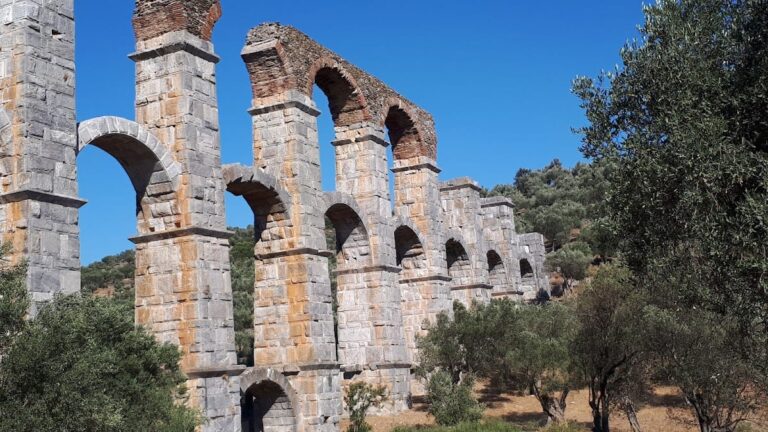
The Assos Archaeological Site preserves extensive architectural remains spanning from the Archaic Greek period through Byzantine times. The city was primarily civic and religious in character, with fortifications enclosing an area of approximately 55 hectares. The defensive walls, predominantly dating to the fourth century BCE, extend roughly five kilometers, encompassing the city hill and descending to the sea, where they protected two harbors with artificial breakwaters, remnants of which remain visible. The fortifications include two principal gates on the west and east sides, each flanked by towers of both square and round designs. Some wall sections survive up to nine meters in height, with towers reaching between eighteen and twenty meters. The acropolis featured its own inner fortifications, established by at least 365 BCE, which underwent repairs and reinforcements during Roman and medieval periods.
The urban layout comprises a volcanic hilltop acropolis with terraces and retaining walls supporting residential and public buildings. Streets paved with andesite blocks approximately 6.5 meters wide have been documented, incorporating drainage channels directing rainwater to cisterns. The architectural fabric reflects multiple phases of construction, remodeling, and reuse from the Archaic through Byzantine eras.
Key Buildings and Structures
Athena Temple
Dominating the acropolis summit, the Athena Temple was constructed circa 540–530 BCE in the Doric order using local volcanic andesite stone. The temple measures approximately 14 by 30 meters and features a peristyle with six columns on the short sides and thirteen on the long sides. Its crepidoma comprises two steps, with the natural rock of the hill forming part of the foundation (euthynteria). The interior includes a pronaos with two columns in antis and a cella but lacks an opisthodomos.
Architectural decoration includes metopes depicting sphinxes, centaurs, and Europa riding a bull, exhibiting Ionian influences in the architrave sculptures. Originally, the temple had thirty-four frieze blocks, of which fifteen are well preserved, displaying a blend of Lydian, Lycian, Athenian, and Corinthian motifs. Some columns have been re-erected during restoration, with andesite column drums initially replaced without fluting; fluting is planned post-placement. The temple and its altar suffered damage and partial destruction in the late fourth century CE during Christianization, with marble burned in a nearby lime kiln for mortar production. Byzantine-era wall remains were uncovered on the temple’s south facade during recent excavations. Restoration efforts initiated in 2009 have included removal of earlier concrete and iron reinforcements and replacement of stylobate blocks with original material, with plans to re-erect the eastern frieze, metopes, and pediment.
City Walls and Gates
The city’s fortifications primarily date to the fourth century BCE, with remnants of earlier Archaic walls also extant. The walls extend approximately five kilometers, enclosing about 55 hectares, covering the city hill and descending to the sea on the south side. They protected two harbors with artificial breakwaters, remains of which are still visible. The fortifications include two main gates on the west and east sides, each flanked by towers, and seven smaller gates. Towers vary in shape, including square and round forms. Some wall sections survive up to nine meters in height, with towers reaching eighteen to twenty meters. The acropolis had its own inner fortifications, extant by at least 365 BCE, with repairs and reinforcements during Roman and medieval periods. Cleaning and documentation in 2010 revealed additional strengthening walls added to the eastern gates and towers, though their exact construction dates remain under study.
Agora
The agora is situated on the southern slopes of the city hill, measuring approximately 150 meters east-west by 60 meters north-south. Constructed mainly during the Pergamene period (third–second century BCE), it featured gates at its western and eastern ends connecting to main city roads. The south and north sides are lined with stoas (covered colonnades). The southern stoa measures about 69.1 meters in length, 10.6 meters in width, and approximately 24.9 meters in height due to terracing. It is single-storied facing the agora but has lower stories on the hillside side. A heroon (shrine) is located at its western end. The northern stoa is two-storied, approximately 111.5 meters long, 12.4 meters wide, and 11.3 meters high on the facade. Its lower story contains thirty-seven columns facing the agora, with a central row dividing the interior into two aisles. Excavations revealed an earlier Hellenistic foundation beneath the northern stoa, likely an earlier stoa aligned with the bouleuterion.
A small prostyle temple on the west side of the agora dates to circa 200–100 BCE. It is Doric in style, with a cella opening east and a pronaos with four columns. A lime kiln approximately two meters wide was discovered on a terrace south of the agora. It has thick walls and two doors and contained partially burned marble fragments. The kiln overlies a Hellenistic foundation running east-west and was later filled and paved over. Finds from the agora include numerous well-preserved coins and ceramics dating to the Roman period.
Bouleuterion
The bouleuterion, serving as the city council building, is a square structure measuring 20.60 by 20.60 meters. Constructed in the Doric order during the fourth century BCE, it is surrounded on three sides (except the west) by 0.60-meter-thick crown walls. The interior roof was supported by four square pillars. Seating for council members was likely wooden. The building remained in political use during the Roman period, with inscriptions and statues placed along the north wall.
Gymnasion
The gymnasion is located north of the road connecting the West Gate to the agora. It consists of a square courtyard measuring 52 by 52 meters, surrounded by a Doric colonnaded portico (stoa) with a roof supported by columns. Built in the second century BCE during the Hellenistic period, it continued in use during the Roman era. An inscription on the architrave records that Quintus Lollius Philetaerus funded a stoa addition. In the Byzantine period, part of the gymnasion was converted into a church. The gymnasion at Assos is among the earliest known in the Troas region.
Theatre
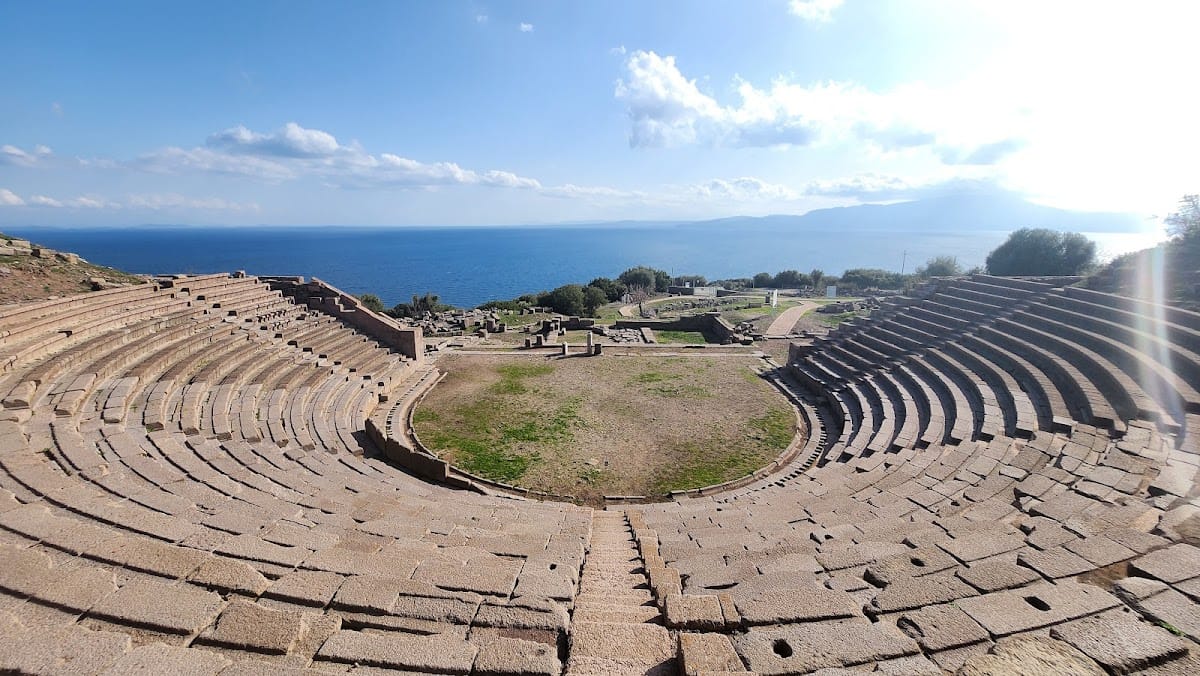
The theatre is situated on the southern slope of the acropolis, south of the agora. Constructed in the third century BCE, it is carved into natural rock. The theatre has a semicircular seating area (cavea) with a horseshoe-shaped orchestra. It could accommodate approximately 5,000 spectators. From the theatre, there is a view towards the island of Lesbos.
Baths (Lollian Baths)
The Lollian Baths, a large Roman bath complex, lie west of the theatre and south of the agora. The bathhouse was a multi-story building with four floors, containing a large hall with twenty-six chambers. Above the baths was a water reservoir surrounded by stone partitions, designed to be invisible from the market square. Another reservoir for water collection was also present. These baths are among the few known Greek-style baths in the city.
Necropolises and Burial Sites
Major burial areas are located along roads leading to the west and east gates. Tombs and sarcophagi date from the sixth to third centuries BCE. Some sarcophagi exceed three meters in length. The necropolises include both Hellenistic and Roman period burials. The city is noted for andesite sarcophagi made from local stone, known for rapid decomposition of bodies inside; these were exported to Lebanon, Syria, Greece, and Rome. Near the Ayazma Church, excavations uncovered early Christian child burials in small stone or slab coffins, with ages ranging from newborn to three years old. A baptismal font made of reused marble slabs with inscriptions was found near the church apsis.
Ayazma Church and Associated Chapels
The Ayazma Church, located west of the city, is an apsidal building from the Byzantine period. It was constructed over the podium of an Early Roman monumental tomb. Beneath the church floor, a tiled floor was found, dated by a well-preserved coin to the late ninth century CE. Two chapels east of the apsis contained rectangular rooms ending in apses, identified as chapels with child burials. After their religious function ended, the church and chapels were later used as a cemetery.
Other Remains
The city had two harbors protected by artificial breakwaters, with remains still visible. A stone bridge crossing the Satnioeis River about one kilometer north of the city dates to the fourth century BCE. Residential buildings and terraces with retaining walls are present within the city walls, especially on the acropolis. Surface surveys have identified remains of various structures, including a possible lime kiln and early Hellenistic foundations beneath later buildings. Streets paved with andesite blocks about 6.5 meters wide have been documented, with drainage channels directing rainwater to cisterns.
Archaeological Discoveries
Excavations at Assos have uncovered numerous inscriptions, coins, ceramics, and architectural fragments spanning from the Bronze Age through Byzantine times. Coins minted at Assos include silver and bronze issues from the fifth century BCE onward, bearing local ethnonyms and imperial portraits from the Pergamon Kingdom and Roman Empire. Ceramics found include Hellenistic and Roman tableware and storage vessels. Inscriptions include dedicatory texts and official decrees, some placed along the bouleuterion’s north wall during Roman times. Architectural fragments include sculpted metopes, frieze blocks, and column drums from the Athena Temple, some distributed to museums in Boston, Paris (Louvre), and Istanbul. Finds from the agora include well-preserved coins and ceramics dating to the Roman period. Early Christian artifacts include baptismal fonts and child burial coffins near the Ayazma Church.
Preservation and Current Status
The Athena Temple is partially restored, with some columns re-erected and original stylobate blocks replaced during restoration efforts begun in 2009. Earlier restoration materials such as concrete and iron reinforcements have been removed. The city walls and towers survive in varying conditions, with some sections up to nine meters high and towers reaching eighteen to twenty meters. The agora’s stoas and bouleuterion remain visible, though some structures are fragmentary. The gymnasion and theatre retain substantial remains, with the theatre carved into natural rock. The Lollian Baths survive as a multi-story complex with chambers and reservoirs. Necropolises and burial sites are preserved along ancient roads. Byzantine remains, including the Ayazma Church, survive in partial form. Ongoing excavations and conservation are directed by Turkish scholars, with systematic surface surveys and documentation continuing since 2009. The site is protected under national heritage frameworks and local museum authorities.
Unexcavated Areas
Surface surveys and small-scale test trenches have been conducted near the West Gate and gymnasion, revealing early Hellenistic foundations beneath later buildings. Some areas within the city walls, including residential quarters and terraces on the acropolis, remain only partially excavated. The exact construction dates and purposes of some fortification reinforcements, especially around the eastern gates and towers, remain under study. Future excavations are ongoing under the direction of Çanakkale Onsekiz Mart University, with research focusing on clarifying construction phases and urban development. No information indicates that modern developments currently obstruct further excavation.
Nearby sites