Alexandria Troas Ruins: Hellenistic and Roman Port City



Site at a Glance
- Rating
- 4.4
- Popularity
- Low
- Country
- Turkey
- Primary era
- Classical
- External website
- Open
- Eras represented
- Classical
- Civilizations
- Ancient Greek, Roman
- Site type
- City
On this page9 sections
History
Alexandria Troas Ruins are the remains of a Hellenistic and Roman city in Türkiye, southeast of modern Dalyan in Çanakkale Province. Around 306 BC, Antigonus I, a Hellenistic ruler of the Antigonid dynasty, refounded and expanded the earlier settlement of Sigia as Antigonia Troas by bringing in populations from five nearby towns, including the formerly influential Neandreia.
Hellenistic foundation and growth
In 301 BC, Lysimachus, one of Alexander the Great’s successors, renamed the city Alexandria Troas in honor of the Macedonian king. Some communities incorporated into the new foundation later returned to their former settlements and recovered their independence, while Alexandria Troas continued to develop under Lysimachus. The city subsequently became part of the Kingdom of Pergamon.
Alexandria Troas became a free and autonomous city in 188 BC. It later developed into the principal port of northwestern Asia Minor, and its population may have approached 100,000 at its height. Its position in the Troad, south of Tenedos, now Bozcaada, helped make it an important maritime connection between Anatolia and Europe.
Roman city and maritime center
During the reign of Augustus, the first Roman emperor, a Roman colony was established at Alexandria Troas under the name Colonia Alexandria Augusta Troas. The city was also known simply as Troas. Augustus, Hadrian, and Trajan, as well as Herodes Atticus, a wealthy second-century Greek patron and grammarian, contributed to its restoration and embellishment. Julius Caesar and Constantine I each considered Troas as a possible capital of the Roman Empire. From about AD 130, the city formed part of the Roman province of Asia.
Alexandria Troas also appears in early Christian history. The Acts of the Apostles associates the city with Paul of Tarsus’s first voyage to Europe and with his return journey. It also places there the episode in which Paul restored Eutychus to life. Ignatius of Antioch stayed at Troas while traveling to Rome for martyrdom.
Christian administration and later decline
Bishops of Troas include Marinus in 325, Niconius in 344, Sylvanus in the early fifth century, Pionius in 451, Leo in 787, and Peter in the ninth century. In the tenth century, Troas was a suffragan see of Cyzicus, meaning that its diocese was subordinate to a metropolitan bishopric, and it was distinguished from Troy. The date when the city was destroyed and its diocese disappeared is unknown.
Troas remains a titular see of the Catholic Church, a title preserving the name of a former bishopric without an ordinary territorial diocese, and it is also a titular see under the Ecumenical Patriarchate of Constantinople. Savas Zembillas served as bishop of Troas from 2002 to 2011 before becoming Metropolitan of Pittsburgh in the Greek Orthodox Archdiocese of America.
Ottoman-era reuse and archaeological work
Karasid Turkomans settled in the Troad during the fourteenth century, and their beylik was conquered by the Ottoman Empire in 1336. The ruins became known in Turkish as Eski Stambul, meaning “Old City.” Ancient stone was reused for later construction, including columns taken by Mehmed IV for the Yeni Valide Mosque in Istanbul. By the middle of the eighteenth century, the ruins were described as a hiding place for bandits.
By 1911, dense vegetation and extensive plundering had affected the site, although sections of the ancient walls remained comparatively well preserved. German archaeologists conducted excavations and surveys in the early twenty-first century, revealing a large stadium dated to approximately 100 BC. The archaeological site lies in the historical region of the Troad and covers about 400 hectares.
Remains
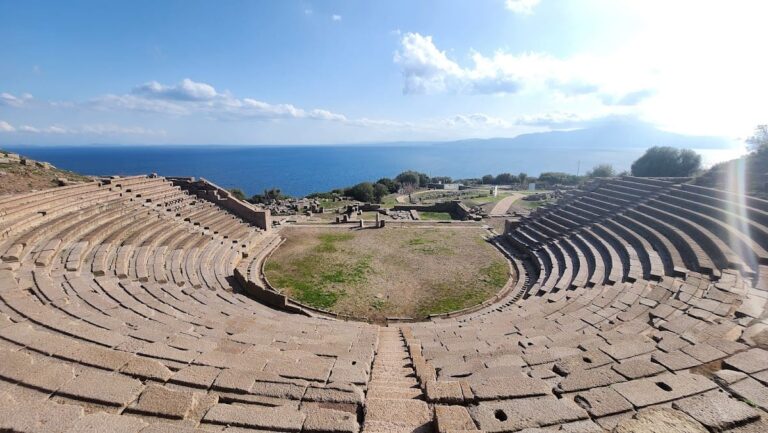
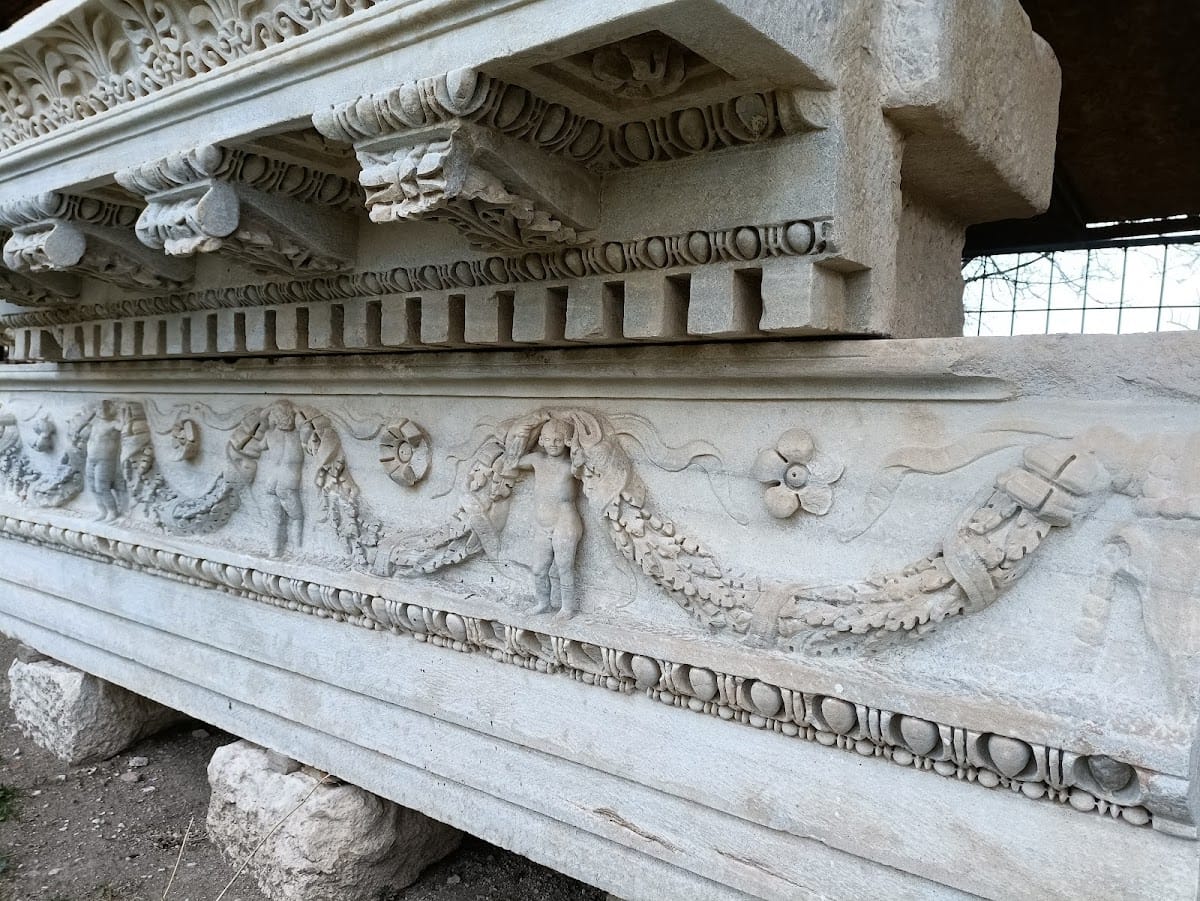
The remains of Alexandria Troas are dispersed across approximately 400 hectares. The surviving archaeological landscape includes Roman baths, an odeon used chiefly for musical performances and other events requiring a smaller covered venue, a theatre, a gymnasium complex associated with physical training and education, a stadium, aqueducts, harbor basins, and traces of the city walls.
City walls and civic buildings
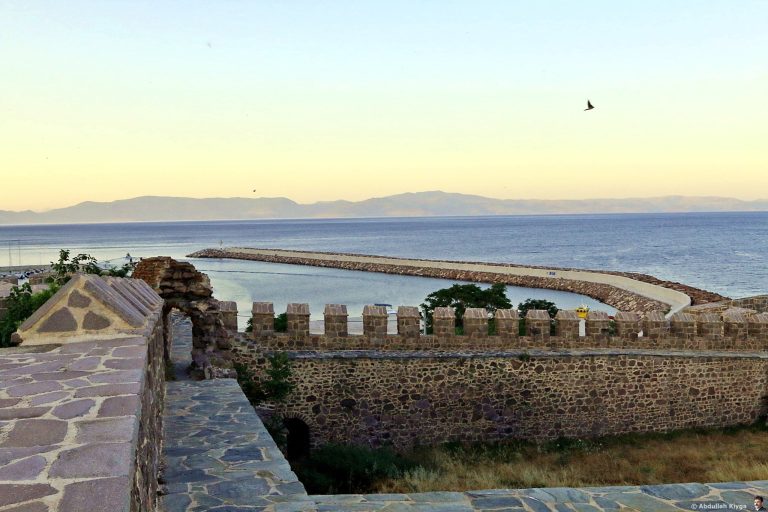
The city walls formed a circuit of approximately 10 kilometres and were reinforced by towers set at regular intervals. Their route can still be followed across the site, and sections survived in comparatively good condition by 1911. The civic remains also include an odeon, a theatre, and a gymnasium complex, while early twenty-first-century excavations exposed a large stadium dating to around 100 BC. A stadion was a long running track and athletic venue, so the stadium provides physical evidence of the city’s Hellenistic athletic facilities.
Baths, gymnasium, and aqueducts
The ancient bath and gymnasium complex is locally called Bal Saray, or “Honey Palace.” Herodes Atticus endowed the complex in AD 135. An ancient aqueduct remains traceable across the site. Its surviving work is associated with Herodes Atticus, and another route attributed to Trajan can also be followed.
Harbor
The harbor contained two large basins. Both are now almost filled with sand, but their presence reflects the scale of the port that connected Alexandria Troas with maritime routes between Anatolia and Europe.