Château de Brie-Comte-Robert: A Medieval Fortified Castle in France



Site at a Glance
- Rating
- 4.2
- Popularity
- Medium
- Country
- France
- Primary era
- Medieval
- External website
- Open
- Eras represented
- Medieval, Modern
- Civilizations
- French
- Site type
- Military
- Remains
- Castle
On this page20 sections
History
Château de Brie-Comte-Robert is a medieval fortified castle in France, founded and built around 1160 by Robert I of Dreux, brother of King Louis VII, when he was lord of Brie. The fortress stood on part of the former Braia estate, a possession of the bishops of Paris, and its position in Brie placed it within the political orbit of the French monarchy.
Foundation and the Dreux lordship
In 1137, Louis VI acquired part of the Braia estate for his son Robert I, a member of the Capetian royal family who became the first lord of Brie-Comte-Robert. Although the castle later acquired direct royal connections, its holders continued to owe fealty and homage to the Bishopric of Paris. The domain remained with the Dreux family until 1254, when it passed to the Châtillon family.
Through dowries and inheritances, the lordship later came to Marguerite d’Artois and then to her daughter Jeanne d’Évreux. Jeanne was a French royal heiress who became queen consort through her marriage to Charles IV, the last direct Capetian king. After Charles died in 1328, the revenues from her many fiefs in Brie and Champagne financed substantial maintenance and improvement at the castle.
Jeanne d’Évreux and the royal residence
Under Jeanne d’Évreux, Brie-Comte-Robert became a prestigious seigneurial residence visited by major nobles, including the dukes of Burgundy. The marriage of Philip VI of Valois and Blanche d’Évreux-Navarre took place there in the mid-fourteenth century. Jeanne died at the castle in 1371.
At the end of the fourteenth century, the castle returned to the royal domain and later passed to the Orléans family, a powerful branch of the French royal house. Louis I de Valois, Duke of Orléans, held tournaments and receptions at Brie-Comte-Robert. Growing insecurity led him to order the castle’s armament in 1405.
Conflict during the Hundred Years’ War
After Louis of Orléans was assassinated by John the Fearless, Duke of Burgundy, in 1407, the castle came under Burgundian control. Its position on the road between Paris and Burgundy made it a secure stage during the rivalry between the Armagnac and Burgundian factions, two opposing political parties during the French civil conflict associated with the later stages of the Hundred Years’ War.
The passage of the English army toward Troyes and the later siege of Melun in 1420 disturbed the town but did not damage the castle. From 1429, however, Brie-Comte-Robert was captured and recaptured several times by French and English forces. An English siege begun in September 1430 under the command of Humphrey Stafford caused extensive damage to both the town and the fortress.
French forces recovered the place in 1434 and returned it to Charles of Orléans. When his son became King Louis XII, the castle re-entered the royal domain.
Royal grants and deterioration
From the reign of Francis I, the crown entrusted the castle and its lands to close associates through temporary grants or conditional sales that retained rights of repurchase. Holders included Louis de Poncher, Philippe de Chabot, Balthazar Gobelin, and Claude de Bullion, superintendent of the finances of Louis XIII.
During the mid-sixteenth century, Italian families associated with Catherine de’ Medici, including the Aquaviva, Pierrevive, and Gondi families, held the castle while allowing its condition to decline. Floors and parts of the roof frameworks burned, and an order issued by the Parliament of Paris in 1567 was needed to halt the damage. Balthazar Gobelin later undertook repairs, allowing the castle to receive the young Louis XIII in 1609 and 1611.
War, reduction, and private ownership
During the Fronde, a series of rebellions and civil conflicts in France from 1648 to 1653, royal troops commanded by the Count of Grancey captured the town and castle in 1649. The fortress was pillaged and bombarded by an artillery battery for more than five hours. The southeastern tower was destroyed in the assault.
Later repairs were limited. By 1681 the castle was considered uninhabitable, its ditches were filled with refuse, and its garden was overgrown. Jean-Antoine de Mesmes arranged repairs to the roofs and access bridges, after which private individuals occupied the buildings.
In 1750, Germain-Louis de Chauvelin, lord of the castle from 1734, received permission to reduce the towers and curtain walls to first-floor level because of their deterioration. The Saint-Jean Tower was spared as a surviving sign of seigneurial authority.
Louis XV repurchased the Brie-Comte-Robert domain in 1766 and exchanged it with his cousin, the Count of Eu. The count’s heirs, the Duke of Penthièvre and later his daughter, the Duchess of Orléans, were the castle’s last lords.
Revolution, rediscovery, and restoration
During the French Revolution, the castle served as a prison for Pierre Victor, Baron de Besenval de Brünstatt, colonel of the Swiss Guards and military commander of Île-de-France. It was later sold as national property. The municipality bought it in 1803 and resold it in 1813.
In 1879, a private owner demolished the remaining Saint-Jean Tower to build a modern house. Large deposits of topsoil later transformed the courtyard and lists into a vegetable garden. The municipality repurchased the castle in 1923, converted it into a public garden, and had it classified as a historic monument on 25 June 1925.
Since 1982, the municipality and the association Les Amis du Vieux Château de Brie-Comte-Robert have carried out archaeological excavation, archival research, and conservation. Their work has traced the architecture of the late twelfth century through the early twenty-first century and has recovered evidence of medieval and Renaissance daily life.
A major restoration programme began in 2003. It included the partial rebuilding of the curtain walls to more than six metres high, restoration of the Brie Tower, demolition of the nineteenth-century house, and partial reconstruction of the Saint-Jean Tower from archaeological surveys. Jacques Moulin directed the restoration of the curtain walls and gate towers, following the principles of the Venice Charter. A Heritage Interpretation Centre was built inside the enclosure and inaugurated on 10 September 2005. Its permanent exhibition addresses the castle’s history and restoration.
Remains
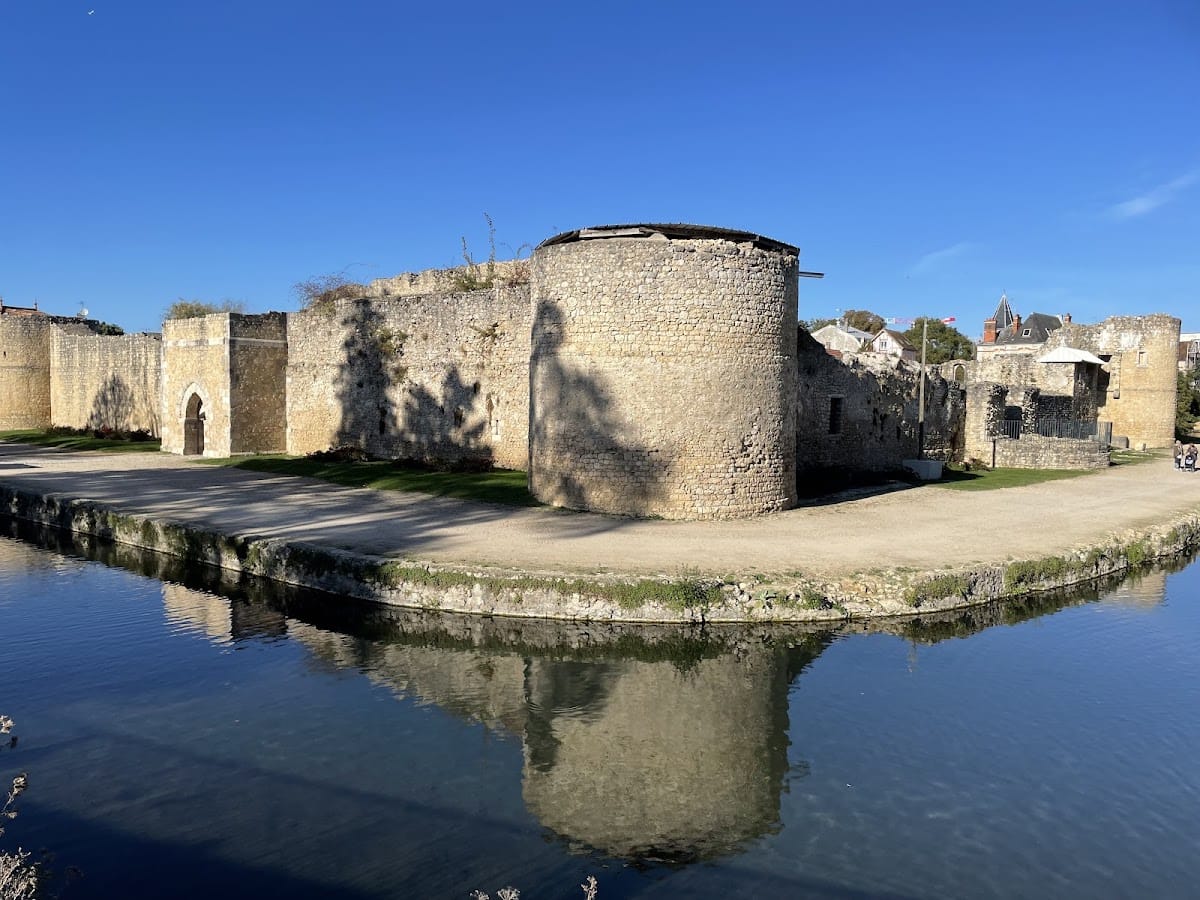
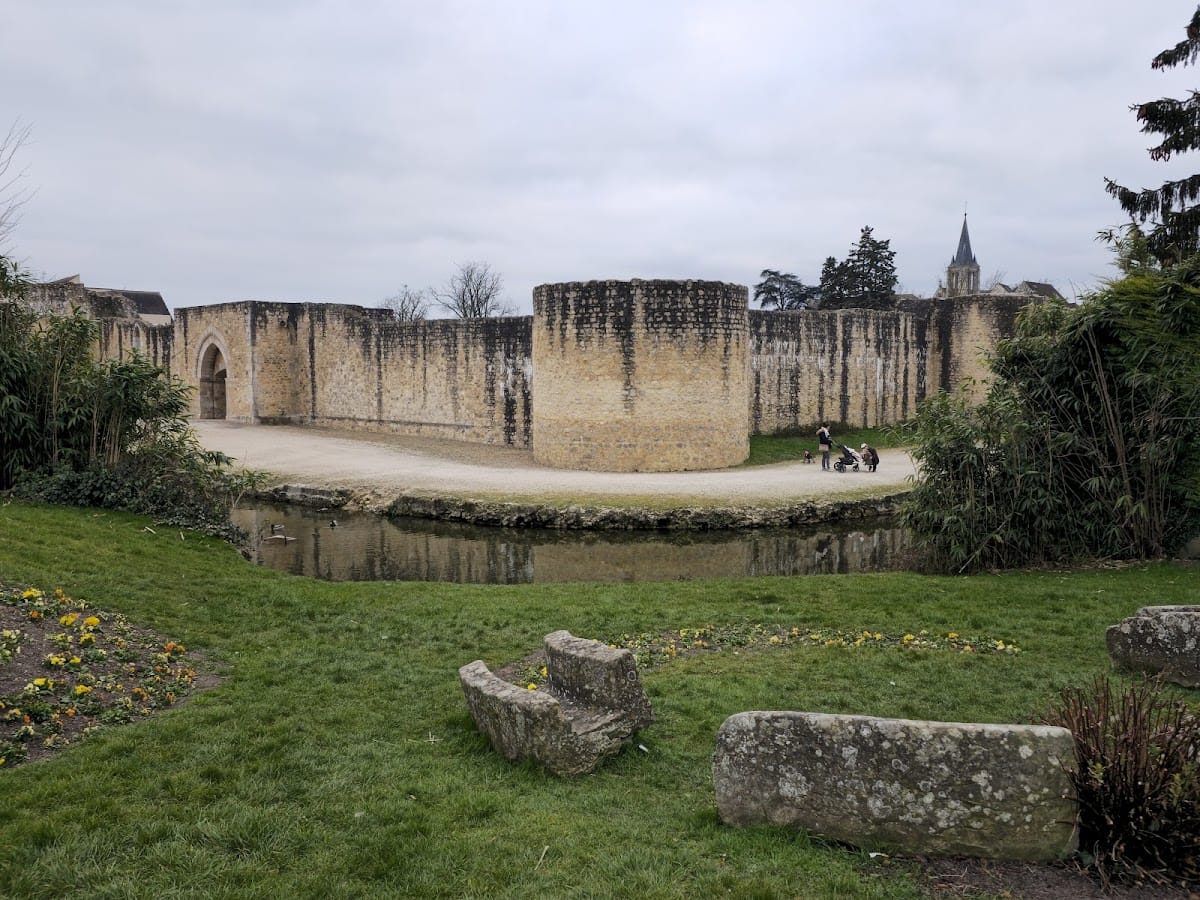
The castle is a lowland fortress covering approximately 2,500 square metres. Its enclosure forms a square about 58 metres on each side and occupies a geographic depression at the lowest point of the town. This position allowed the builders to excavate broad surrounding moats. Round towers mark the four corners, aligned toward the cardinal directions, while two additional round towers are engaged in the northwest and southeast curtain walls.
Enclosure and defensive works
Curtain walls and moats
The curtain walls, the main defensive walls linking the towers, were designed to reach about 9 to 10 metres. Outside them, the lists formed the space between the walls and the moat. The escarp wall separating the lists from the moat stood no more than about four metres high. The water-filled moats were approximately 15 metres wide and five metres deep, supplied by streams, and lay about 12 metres from the enclosure walls. Later destruction left only foundations of parts of the moats.
In the fourteenth century, the lists near the two entrances were arranged as walled gardens. Since the twentieth-century restoration, these areas have been covered with gravel. The wall walk, a passage along the top of a fortification, ran around the entire castle and connected with the first floors of the two gate towers. It remained separate from the rooms of the round towers. A crenellated section between the Brie and west towers was reached by a small stair turret.
Bridges and entrances
Two square gate towers stand midway along the southwest and northeast curtains, creating opposing entrances. This arrangement is described as unique in Île-de-France, although it also created a potential defensive weakness. A drawbridge with a counterweight rested on a wooden bridge when lowered, and large oak posts supporting it remain visible beneath the present footbridge. The drawbridge machinery occupied a small lean-to building. A postern opened through the escarp wall toward the moat.
The two gate towers contain passageways equipped with late-twelfth-century defensive devices, including portcullises, vertically sliding fortified gates, murder holes, openings above an entrance for attacking people below, and barred doors. The Saint-Jean entrance had two arches between which a portcullis moved, a murder hole, two heavy inward-opening doors, and a second double door that created a protected gate chamber.
Brie Tower and Saint-Jean Tower
The Brie Tower is rectangular and opens toward the town and its market. Its entrance has a pointed arch, a two-roll arrangement of wedge-shaped arch stones, and late-twelfth-century moulding composed of alternating flat surfaces and prismatic teeth. The curved decorative band around the arch is moulded. The tower was restored in 2003.
The northeast gate tower, known as the Saint-Jean Tower, served as the castle’s keep even though the fortress had no separate freestanding keep. It originally rose about 33 metres. In the fourteenth century, the Saint-Denis, also called Saint-Louis, Chapel was built above its entrance passage and connected with the first floor of the residential buildings. The tower was demolished in 1879 and partially reconstructed in 2003 from archaeological surveys.
Round towers
North and northwest towers
The round towers were built from rubble limestone, with dressed limestone around windows and at the corners. The stone came from local Brie limestone quarries worked since the early Middle Ages. Their ground floors generally have groin vaults, formed by the intersection of two barrel vaults, few openings, and no direct outside view. Except in the west tower, entry was through a door with a pitched lintel.
The north tower contains a groin-vaulted lower room reached through a bent corridor. Its lightly paved and beaten-earth floor, limited opening, and lack of communication with the upper level indicate a probable food-store function. The first-floor plan remains legible, and it housed a dovecote in the seventeenth century. The northwest tower has a lower room beneath groin vaults, reached through the exhibition area, with one opening for light. Its upper room was accessible from the wall walk and through the vault.
South and southeast towers
The south tower has an external diameter of 8.44 metres and two entrances, one direct and one through a narrow passage in the southwest curtain wall. Its ground floor contains an ovoid basin connected to three underground channels and an outlet channel. A ribbed vault divides the room into four compartments. The tower functioned as a latrine tower, with several levels using rainwater circulation as a flushing system.
The southeastern tower was destroyed to ground level, but a basin in its foundations identified its function as another latrine tower. A bent corridor with three steps led to the ground-floor entrance and a landing above the basin. Two underground vaulted channels drained it. The tower served the upper levels and was probably destroyed in the seventeenth century. Its removal created a large breach in the southeast curtain wall, later filled with reused materials. Excavation of the buried structures and infill allowed the ground-floor arrangement, entrance, and two-channel latrine pit to be partially restored.
East and west towers
The east tower retains two levels. Its ground floor served for storage, while the restored first floor contains a slightly ovoid room improved in the fourteenth century with a window seat and fireplace. A passage leads to latrines on stone corbels above a masonry cesspit in the lists, with a water-based emptying system. One ground-floor arrow slit supplied light, while two upper openings were blocked in the fourteenth century in favour of a larger east-facing window.
The west tower has a semi-subterranean lower room paved with carefully fitted dressed limestone slabs. A small washbasin drains through the wall, and a sharply rising arrow slit provides ventilation. The room probably served as a food store protected from rodents. Its upper room, lit by another arrow slit, gave the only access to the lower room through a square opening covered by a trapdoor. The original access was through a masonry manhole in the vault; the present ground-floor opening was cut later through the wall.
Residential ranges and chapel
Seigneurial residence
Buildings were constructed against the curtain walls, leaving a square central courtyard with a well. Their load-bearing walls were carefully bonded to the enclosure using dressed-stone blocks, showing that the residential buildings were constructed alongside the fortress walls.
The seigneurial residence consisted of three ranges with one upper floor beneath attic spaces. Rooms had one or two pillars supporting longitudinal beams and transverse joists. Timber boards formed the floors, laid over smaller supports. Each room had a fireplace set centrally into the curtain wall, and one fireplace incorporated a bread oven.
Excavation revealed the ground-floor plan, internal communications, and changing functions of the residential buildings from the twelfth century onward. The fourteenth-century great ground-floor room had a beaten-earth floor. Its surviving elements include column bases, beam supports, a doorway threshold, a window sill, and the base and hearth of a fireplace.
Great hall and chapel remains
The ceremonial great hall, or aula, occupied the first floor. This was the principal hall of the medieval lord’s residence, where guests were received and justice was administered. Its floor was probably decorated with tiles, and an exterior courtyard staircase reached it through a landing at the angle of the southeast and northeast residential ranges.
Jeanne d’Évreux’s fourteenth-century renovation used stamped bichrome pavement tiles measuring 11 by 11 centimetres. Their designs included a royal coat of arms with fleurs-de-lis and a lion rampant. Painted plaster bearing Jeanne’s coat of arms was also recovered. Fragments of moulded stone window tracery, the stone framework dividing a Gothic window, and stained glass came from the chapel.
The chapel’s eaves wall and gable wall were stabilised by buttresses whose foundations form a cross-shaped plan. Excavation exposed further fragments of window tracery that held stained glass. The remains are incorporated into the restored and reconstructed castle complex.
Courtyard and ancillary buildings
In the fourteenth century, a partition wall divided the inner court into a southeastern noble court and a northwestern service court, with a passage opposite the well. The surviving traces of this division now have a symbolic form. A paved sandstone path from the beginning of the seventeenth century crosses the courtyard, which slopes slightly toward the Brie Tower. Lateral channels carried rainwater away.
Excavation along the southwest and northwest curtains revealed foundations of ancillary buildings made from rubble masonry bonded with clay. They included barns or storehouses and servants’ quarters. Coins, tokens, a small identification or accounting token known as a méreau, and many fragments of decorated pavement tiles were also recovered. The tiles had been mixed with demolition rubble and used as fill before being restored for the pavement of the seigneurial residence.
Sections of the twelfth-century curtain walls, the gate towers, the Brie Tower, the Saint-Jean Tower, round towers, fireplaces, chapel remains, and excavated residential and service structures have been restored or reconstructed. The work relies on masonry and stone dressing guided by building archaeology, including stone-by-stone surveys, photographs, and material sampling.