Arch of Trajan in Canosa di Puglia: A Roman Triumphal Monument


Visitor Information
Google Rating: 4.4
Popularity: Very Low
Google Maps: View on Google Maps
Country: Italy
Civilization: Roman
Remains: Civic

History
Trajan’s Arch stands in Canosa di Puglia, a town in the province of Barletta-Andria-Trani, southern Italy. It was built by the Romans during the early 2nd century AD, a period marked by significant infrastructure development under Emperor Trajan.
The arch likely dates to around 109 AD, coinciding with the construction of the Via Traiana, a road commissioned by Trajan between 108 and 110 AD to improve connections in southern Italy. Some scholars suggest the arch may have been completed or modified during the reign of Hadrian, Trajan’s successor. The monument served as a triumphal arch, celebrating Roman achievements and possibly marking an important gateway along the new road.
Over time, the arch became known by several names. It was called Porta Romana, reflecting its function as a city gate. Other names, Porta Varrone and Porta Varrense, arose from a traditional but incorrect association with Gaius Terentius Varro, a Roman consul defeated at the Battle of Cannae in 216 BC. This misattribution linked the arch to earlier Roman history, though no direct connection exists.
The arch underwent several restorations in the 19th century and again in 1911. These efforts included modern reconstruction, which altered parts of the original structure. Fragments of marble reliefs found nearby, depicting military scenes and a Dacian figure, date to Trajan’s reign and suggest the arch was richly decorated to commemorate Roman military victories.
Remains
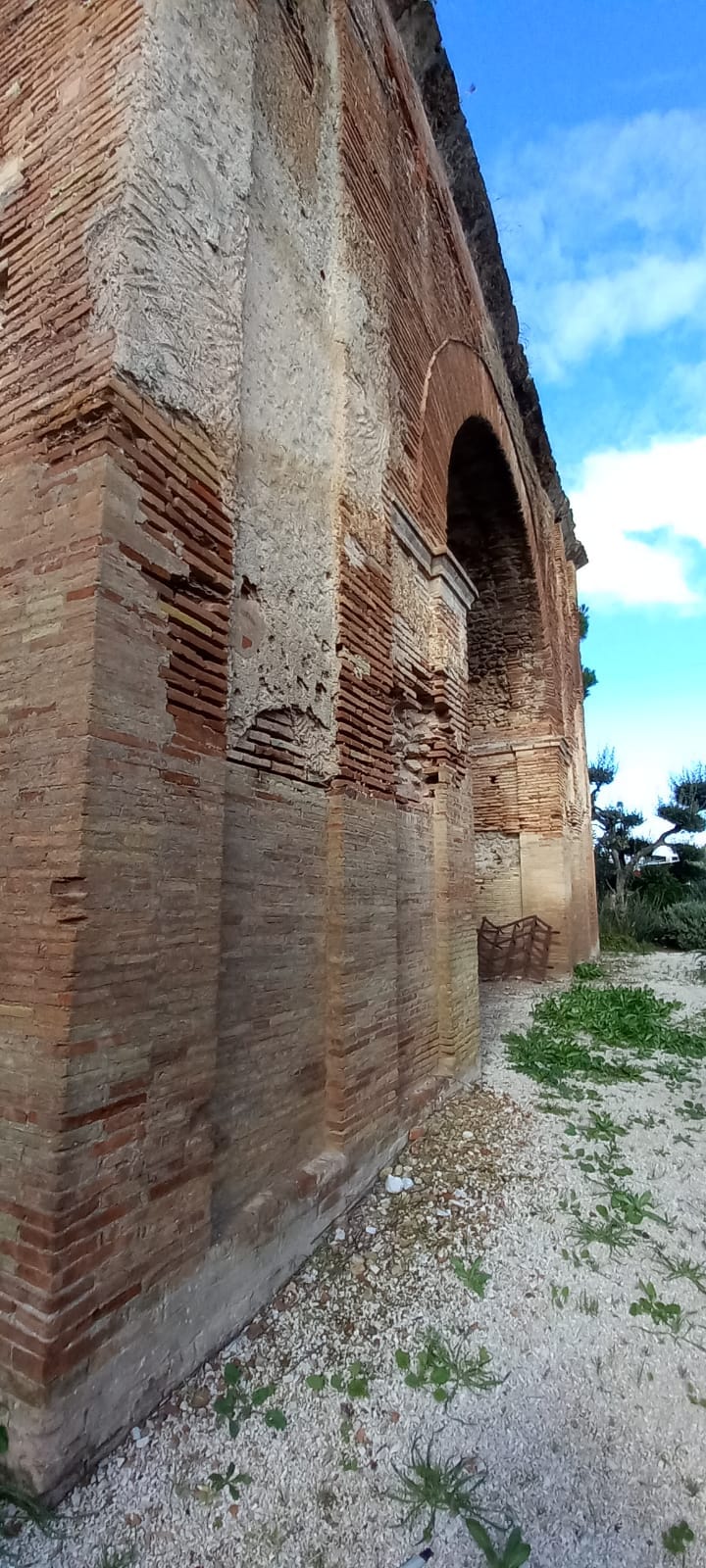
The Arch of Trajan is a single-vaulted structure built primarily of brick. It originally stood about 13 meters tall, 12 meters wide, and 5 meters deep. Today, the lower section is partially buried, affecting the full visibility of its base.
The arch’s brick core was likely covered with marble facing, now mostly lost. Architectural features include lesenes, which are flat, vertical strips resembling pilasters. These are positioned on the outer corners of the arch’s supporting pylons and in the center of each pylon’s front face. These elements probably supported an entablature, a horizontal structure above the arch.
Fragments of marble reliefs once decorating the arch have been found reused in nearby buildings. One relief, likely showing a Dacian figure, was discovered as spolia in the crypt of the Church of Santa Maria de Russis. Another fragment with a military scene was incorporated into Castel del Monte. These pieces are preserved today in the Diocesan Museum of Trani.
The arch’s current condition reflects both its ancient origins and later restoration efforts. While parts of the original marble facing and decorative reliefs survive only in fragments, the brick structure remains largely intact, offering insight into Roman construction techniques and commemorative architecture.
Nearby sites