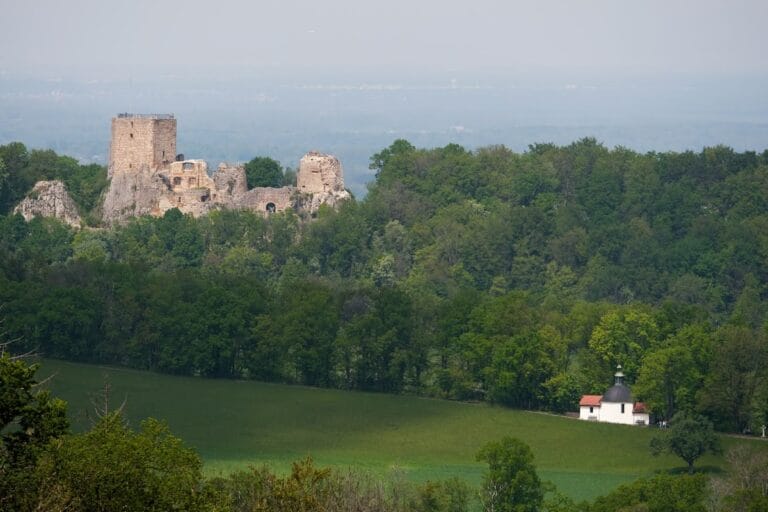
Pleujouse Castle: A Medieval Fortress in Switzerland


Visitor Information
Google Rating: 4.6
Popularity: Low
Official Website: mymenuweb.com
Country: Switzerland
Civilization: Unclassified
Site type: Military
Remains: Castle

History
Pleujouse Castle is situated in the municipality of Pleujouse, Switzerland. It was originally constructed around the year 1100 by Lutfridus, who gave his name to the site and established the fortified stronghold around which the village later grew. This early medieval fortress formed the nucleus of the settlement and served defensive and administrative functions during its initial centuries.
Starting from the 13th century, the castle came under the jurisdiction of the Bishopric of Basel, reflecting the religious and feudal influence in the region. Over the following centuries, ownership passed through several noble families, including the Mörsberg family and the counts of Fribourg, Neuchâtel, and Ortenburg. Each transition of control illustrates the castle’s role within shifting feudal networks typical of medieval Europe.
In 1380, a notable change in possession occurred when Jean d’Ulrich d’Asuel acquired the castle. His rule was cut short by his death in the Battle of Sempach, after which ownership reverted to his lord Jean de Vienne. This link to a significant military conflict highlights the castle’s involvement in broader regional power struggles of the late medieval period.
The 17th century marked the beginning of the castle’s decline. Following the death of the last Ortenburg widow around 1660, the castle was abandoned and gradually fell into ruin. Its deterioration reflects the changing political and military landscape that rendered such fortifications less vital.
During the French Revolution, the property was confiscated and sold as national property, a fate common for many noble estates in that era. In the 20th century, the site gained new protection when the Association for the Conservation of the Château de Pleujouse (ACCP) acquired it in 1924, signaling growing interest in preserving historic heritage.
In January 1980, a fire caused severe damage, consuming parts of the structure along with valuable interior features. Since then, restoration efforts have been undertaken to repair and stabilize the castle. From 1988 onward, the site found a new role as a restaurant, combining preservation with adaptive reuse.
Local folklore enhances the castle’s identity through the story of Alie d’Asuel, known as the “White Lady,” and her lover Huson de Pleujouse. According to legend, they were killed while fleeing the castle. Their final resting place is said to be beneath a mound marked by a wooden cross near the road between Pleujouse and Charmoille, embedding the castle within regional cultural memory.
Remains
Pleujouse Castle presents the characteristics of a medieval fortified residence, its layout designed for defense and oversight of the surrounding area. The remaining structure includes a prominent tower, which is accessible via a staircase consisting of 37 steps leading to an observation platform. This elevated vantage point once allowed inhabitants to monitor the nearby villages of Pleujouse and Fregiécourt, underscoring the castle’s strategic location.
Constructed with typical building methods of the medieval period, the castle’s fabric consists of substantial masonry walls designed to withstand attacks and endure through centuries. Though specific construction materials are not detailed, the surviving portions indicate robust stonework suited for military purposes.
The fire that struck in January 1980 resulted in the loss of sections of the castle and destroyed precious furnishings within its interior. Restoration has since reconstructed these damaged segments, with photographic records confirming the preservation of key structural components such as the tower and its platform.
One notable spatial relationship at the site is its proximity to the local legend’s reputed burial place. Near the road to Charmoille, a mound marked by a wooden cross recalls the story of the “White Lady” and her lover, connecting the physical structure to intangible heritage.
Today, the castle remains a visible landmark with its fortified tower standing as testimony to its medieval past and ongoing efforts to maintain its historical and cultural presence in the landscape.
Nearby sites