Lillebonne Gallo-Roman Theater: A Historic Monument in Normandy, France




Visitor Information
Google Rating: 4.3
Popularity: Low
Google Maps: View on Google Maps
Official Website: www.theatreromaindelillebonne.fr
Country: France
Civilization: Roman
Remains: Entertainment

History
The Lillebonne Gallo-Roman theater is located in the town of Lillebonne, in the Normandy region of northern France. This ancient monument was built by the Romans in the 1st century CE within the city then known as Juliobona. The name Juliobona reflects its Roman origins, combining the family name Julius with a local Gallic term.
Initially constructed as a modest theater, the structure was expanded and rebuilt during the 2nd and 3rd centuries CE. These changes reflect the evolving needs of the community, adapting the theater to accommodate larger audiences and a wider variety of public spectacles. By the late 3rd century, the theater’s role shifted dramatically due to increasing Germanic invasions. It ceased functioning as a venue for performances and was transformed into a defensive fortress. Many entrances and passageways were sealed to strengthen its protective capabilities.
During this military phase, baths were installed within the arena space, using stones taken from funerary monuments. The exact purpose of these baths and their users remain unknown. The theater’s defensive role during this turbulent period is clear, though it is uncertain whether it was integrated into the city’s main fortifications or served as an independent outpost.
The site was first recognized as a Roman theater in 1764 by the Comte de Caylus. Archaeological excavations began in 1812, often causing damage to the remains. In 1818, the Seine-Inférieure department acquired the theater, and it was officially protected as a historical monument in 1840, making it one of the earliest such designations in France. Excavations have taken place intermittently since then, with major campaigns in the early 20th century, mid-century, and from the 1970s onward. The most recent significant work occurred between 2007 and 2009 under Vincenzo Mutarelli, who sought to clarify the theater’s construction phases and better integrate it into the modern town.
During World War II, the body of the German commander responsible for the Lillebonne sector was buried within the theater ruins, marking a somber chapter in the site’s long history.
Remains
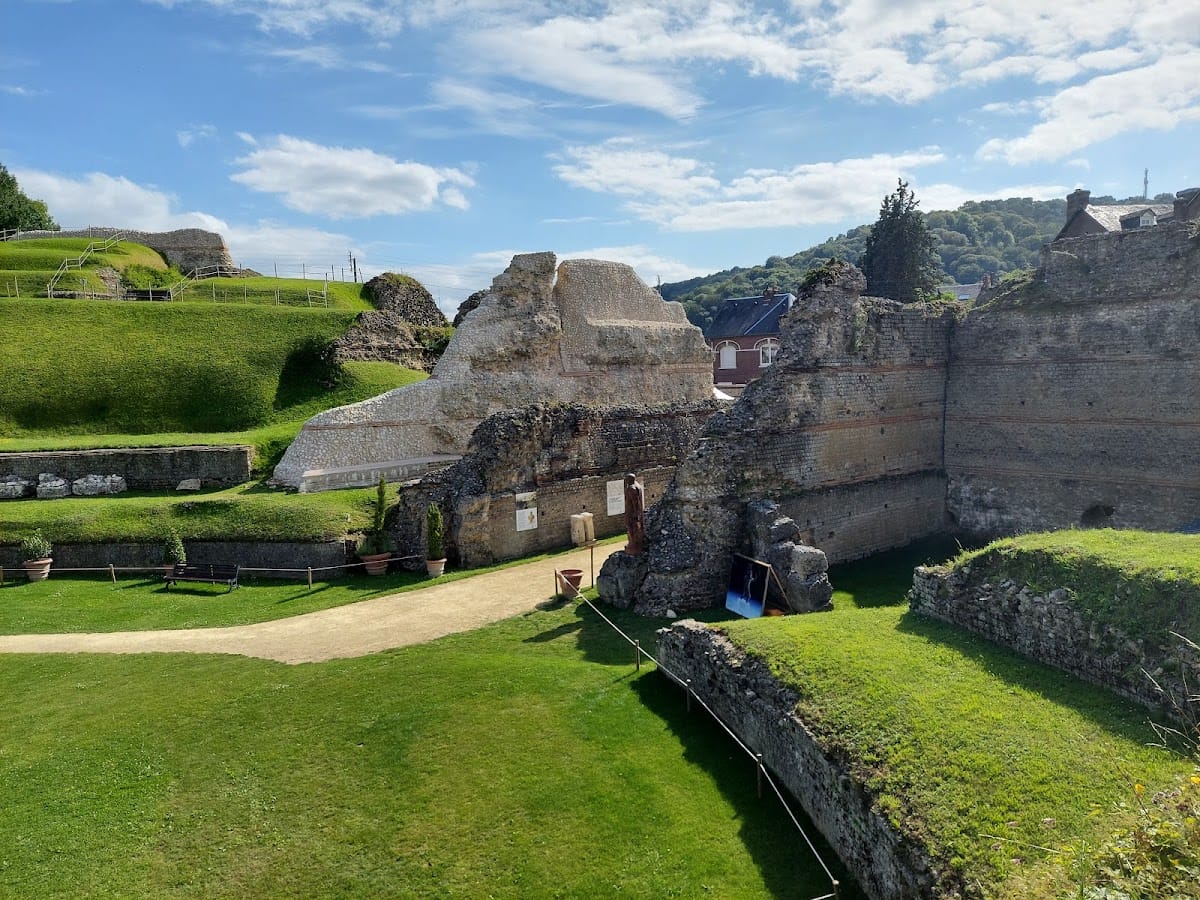
The Lillebonne theater covers an area approximately 106.5 meters long from east to west and about 94.7 meters wide from north to south. The central arena measures roughly 47.3 by 35.5 meters. Its seating area, called the cavea, is partly built against a hill to the south. The middle seats rest directly on the terraced slope, while the upper seats are constructed with masonry boxes filled with rubble. The lower seats extend the hill’s incline toward the arena using additional masonry and fill. This design allows the theater to hold over 5,000 spectators.
The theater faces north, which prevents sunlight from shining directly into the eyes of the audience during performances. It combines features of both a traditional Roman theater and an amphitheater. The orchestra area is large enough to serve as an arena for animal hunts and gladiatorial contests, while a stage was built for dramatic shows. The stage building itself remains mostly unexcavated, lying beneath a modern road and plaza to the north, with an estimated depth of 12 to 13 meters.
Construction materials include small travertine blocks arranged in a mixed style known as opus mixtum, which alternates stone and brick layers. Bricks form the arches of doors and the vaulted passageways called vomitoria, which allowed spectators to enter and exit efficiently. The theater underwent four main construction phases. The earliest phase was a small Roman theater, evidenced by an internal wall made of small blocks found in the arena. This was replaced by a larger hybrid theater-amphitheater with an ellipsoidal arena and supporting walls for the seating. A third phase added a peripheral gallery to support more seating tiers. The final phase converted the theater into a fortress, sealing many entrances and vomitoria.
During its military conversion, baths were installed within the arena using reused stones from funerary monuments. The function and users of these baths remain unclear. The northern part of the monument has not been excavated, and the stage area lies beneath modern infrastructure, limiting full archaeological study. Despite partial preservation, the theater remains an important example of Roman architectural adaptation and reuse over several centuries.
Nearby sites