Lillebonne: Roman Juliobona and Its Medieval Castle


Site at a Glance
- Rating
- 4.4
- Popularity
- Low
- Country
- France
- Primary era
- Classical
- External website
- Open
- Eras represented
- Classical, Medieval, Early Modern, Modern
- Civilizations
- French, Roman
- Site type
- City
On this page18 sections
History
Lillebonne is a historic town in France that preserves the remains of Juliobona, a Roman administrative and commercial center established in the late first century BC. Founded during Rome’s reorganization of territories conquered in the Gallic Wars, it became the capital of the civitas of the Caletes, a Gallic people whose territory broadly corresponded to the later Pays de Caux. The earliest archaeological evidence from the settlement dates no earlier than the reign of Tiberius, who ruled Rome from AD 14 to 37.
Juliobona under Roman rule
The name Juliobona appears from the second century in Ptolemy’s Geography, and later in the Antonine Itinerary and Peutinger Table. Its identification with present-day Lillebonne was made in the eighteenth century and remains generally accepted. The name combines Iulio-, probably referring to Augustus and the Julio-Claudian imperial family, with the Celtic element -bona, which may have meant an inhabited place, spring, village, or foundation.
Juliobona prospered from the first century through the first half of the third century. As the administrative capital of the Caletes, it also developed as a commercial center and possibly as a military center. Roads connected it with Harfleur, Etretat, Dieppe, Evreux, and Rouen. A port on the Seine was once proposed as the reason for its growth, but the existence of port infrastructure at Lillebonne has not been established.
The town included affluent urban domus, or Roman houses associated with wealthy households, more modest residential areas, and substantial rural villae, which were estates or country residences. Most of the ancient settlement now lies below the modern town center, while discoveries made during development work since the early nineteenth century have gradually clarified its extent and character.
The late Roman transformation
In the second half of the third century, invasions, civil wars, and economic instability brought major changes to Juliobona. The urban area was greatly reduced, and a fortified enclosure was built on a rocky promontory overlooking the rest of the town. The enclosure covered about four hectares and incorporated building materials taken from earlier Roman structures.
The ancient theatre was adapted during this period as a fortress. Its exits were blocked, wells were dug, and bathing installations were placed in the arena. Materials from the building were also reused in the walls of the later town enclosure. Still later, Roman materials from the fortifications were used in the construction of Jumièges Abbey.
Medieval Lillebonne and the Norman dukes
Lillebonne Castle became one of the preferred residences of the dukes of Normandy during the eleventh century. William the Conqueror is traditionally said to have gathered Norman nobles there to discuss the conquest of England in 1066. In 1080, a council at Lillebonne brought together regional clergy to address moral, doctrinal, and liturgical rules. Under William, it also confirmed ducal authority over the Norman Church. Henry II Plantagenet held another council at the castle in 1162.
Henry II gave the castle to Renaud de Dammartin around 1187. Philip Augustus confiscated it in 1211 and commissioned its circular keep. In 1226, Philip Hurepel of Clermont confirmed that he had received the castle from King Louis VIII. Around 1275, Lillebonne passed by marriage into the House of Harcourt.
The town capitulated to Henry V’s forces after the fall of Rouen on 19 January 1419. The castle was captured by the English in 1418 and was assigned first to Thomas Beaufort, Duke of Exeter, and then, in 1422, to John of Lancaster, Duke of Bedford. Bedford was governor of Normandy and regent of France during the English occupation. Charles VII recovered Lillebonne in 1449, after which the castle returned to the Harcourt family.
In 1517, the church of Notre-Dame was consecrated outside the Roman enclosure, placing it within the growing built-up area. It replaced Sainte-Marie-du-Château, which had been destroyed at the end of the Hundred Years’ War. In 1532, Louise de Rieux brought Lillebonne to René of Lorraine, Marquis of Elbeuf and Count of Brionne. The viscounty, and later the county, subsequently belonged to the Dukes of Elbeuf.
In 1593, the religious conflicts known as the French Wars of Religion ended in Lillebonne when Captain Bois-Rosé brought the town over to Henry IV after the king’s conversion to Catholicism. In 1701, creditors of the Dukes of Elbeuf sold the county to Marie-Angélique Fabert, Marquise de Mailleraye, the wife of François d’Harcourt, Marquis of Beuvron. The county remained with the Harcourt family during the eighteenth century.
From the eighteenth century to modern investigation
Louis XVI and Marie-Antoinette visited Lillebonne in 1778. In 1790, during the early years of the French Revolution, the local priest M. Catel became the town’s first mayor. After the Duke of Harcourt emigrated, his estate was sold as national property, meaning that it was confiscated and sold by the revolutionary state. Its lands were used for factories, while the municipality took possession of the castle and leased it to a farmer from Valasse.
The castle was occupied by the local schoolteacher in 1802 and returned to the descendants of François-Henri d’Harcourt in 1808. It was sold to Pierre-Abraham Levesque, a manufacturer of printed cotton and calico, in 1829. A landing-port project approved in 1856 was named Port-Jérôme.
Violent clashes between workers and National Guards on 29 and 30 March 1848, following the French Revolution of 1848, caused ten deaths. Prussian forces occupied Lillebonne in 1871, and German troops occupied it during the Second World War. British aircraft bombed the town in 1944.
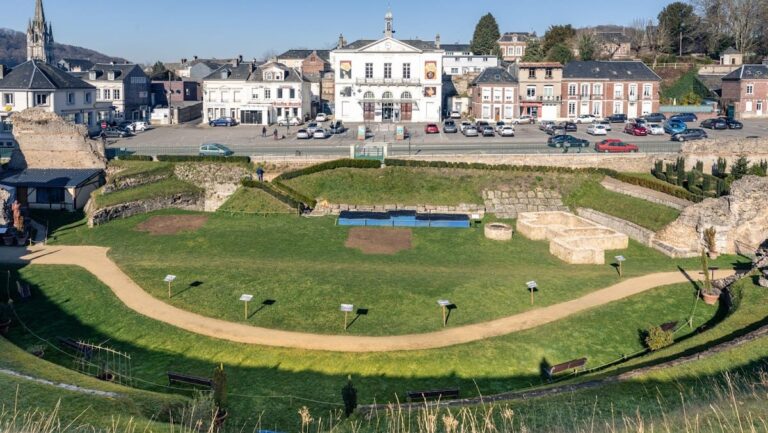
Archaeological work has expanded knowledge of Lillebonne since the early nineteenth century. Departmental excavations between 2007 and 2010 examined the ancient theatre-amphitheatre, which is the best-preserved ancient spectacle building in northern France. Since 2018, Caux Seine Agglo has pursued the Juliobona project to research and interpret the ancient city. Programmed excavations have taken place approximately annually since 2021, including investigations at Place Félix-Faure in 2021 and 2023 and, from 2024, in the town-hall gardens at the Saint-Denis domus. The principal surviving tower of the castle has been protected as a historic monument since 1862, while the bell tower of Notre-Dame was classified in 1846.
Remains
Most of Juliobona lies beneath the modern center of Lillebonne. The ancient settlement was organized around residential districts, public buildings, and roads leading toward neighboring centers. Physical remains of the Roman baths and theatre-amphitheatre survive or have been brought to light, while the later fortified enclosure occupied a rocky promontory above the reduced late Roman town.
Roman spectacle building and fortifications
Theatre-amphitheatre
The ancient theatre-amphitheatre passed through three construction states between the first and third centuries AD. The earliest, only partly excavated, appears to have been a small Roman theatre. It was soon replaced by a larger building that combined theatrical and amphitheatrical functions.
The later structure retained a stage building while possessing an unusually large orchestra, the central area in front of a Roman theatre’s stage. Its size allowed the space to function partly as an arena. The building could hold approximately 3,000 people. Its stage building lies beneath a modern road and is currently inaccessible, while visible remains survive near Place Félix-Faure.
In the late Roman period, the building was converted for defensive use. Exits were blocked, wells were installed, and bathing facilities were placed in the arena. Parts of the theatre were then incorporated into the walls of the late Roman enclosure, linking the spectacle building to the defensive reorganization of Juliobona.
Late Roman enclosure
The fortified enclosure was built on a rocky promontory overlooking the rest of the ancient town. It enclosed an urban area of approximately four hectares and was constructed partly with reused Roman building materials. Its walls formed the core of the reduced settlement created during the political, military, and economic disturbances of the third century.
Medieval castle
Circular keep
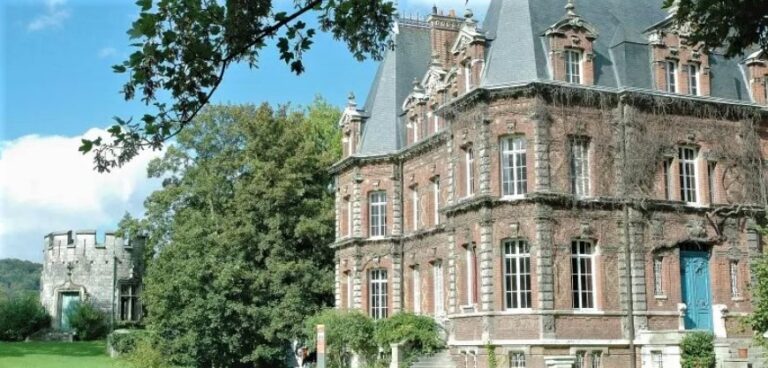
The medieval ducal castle stands at the corner of the former Gallo-Roman town. Its principal surviving feature is a circular keep, or main fortified tower, associated with Philip Augustus and dating from the early thirteenth century. The upper parts were modified in the fifteenth century.
Octagonal and Chartrier towers
An octagonal tower dates from the end of the thirteenth century and is attributed to Jean II of Harcourt. The thirteenth-century Chartrier Tower was altered around 1870. Together, these surviving elements reflect the castle’s development after Lillebonne passed into the hands of the Harcourt family.
Later residential buildings
A Romanesque residential building, probably dating from the period of Henry II, once stood within the castle complex but was demolished in 1832. Around 1870, Théodore Huchon built a manor house inside the enclosure for Pierre Gustave Lauger. Its design followed the model of the Château des Aygues at Etretat.
Notre-Dame church
Notre-Dame preserves a Gothic portal and a sixteenth-century tower. The tower was completed in 1537 by the mason Michel Delafosse and the carpenter Antoine Cachedieu, using limestone from Plaimbosc. Delafosse completed the window tracery and tower vault in 1540 with the mason Michel Combart, while Henry Deshayes rebuilt the portal in 1553.
Protestant damage to the church’s stained glass in 1562 was repaired by Joseph Gueroult. Richard and Jehan Lemarchand repaired or remade windows in 1594, and Jean Lemarchand produced a surviving window in 1622. The side chapels of the nave were built at the end of the sixteenth century.
The sacristy was built in 1729 with materials taken from the former rood screen, and the nave’s barrel vault was renewed at the same time. Louis Vessel rebuilt the south side of the nave in 1825 using demolition material from Saint-Denis church. Architect Simon reconstructed the choir in 1873, and the bell tower was restored in 1884.
Objects, mosaics, and museum collections
Juliobona Gallo-Roman Museum
The Juliobona Gallo-Roman Museum presents pottery, glass, funerary furnishings, and Roman coins from Lillebonne and the surrounding area. Its collections include an apparently unpublished denarius of Galba, a Roman silver coin found in the region.
Bronze sculpture
A larger-than-life-size bronze statue of Apollo was discovered accidentally at Lillebonne in 1823. Probably a cult statue, it dates from the second century, stands 1.94 metres high, and is covered with gold leaf. It is now displayed in the Louvre. The circumstances of its discovery are unknown, so the statue cannot establish whether a temple stood northeast of the Roman town or whether it had been moved before burial.
A bronze head representing a Roman god or an ephebe, a youthful male figure, was also found at Lillebonne. It is held by the Rouen Museum of Antiquities.
Mosaics
The “Deer Hunt” mosaic was accidentally discovered in 1870 in a domus at Lillebonne. It was initially interpreted as having come from a suburban villa. Exceptionally large for the region, it depicts a hunt during the rutting season and is displayed at the Rouen Museum of Antiquities.
Another mosaic from Lillebonne is identified as an Orpheus mosaic and is held by the same museum. The Deer Hunt mosaic is attributed to T. Sen Filix of Pozzuoli in Italy and his local apprentice Amor.