Libarna Archaeological Area: A Roman Municipium in Northern Italy
Table of Contents

Visitor Information
Google Rating: 4.4
Popularity: Low
Official Website: polomusealepiemonte.beniculturali.it
Country: Italy
Civilization: Roman
Site type: Burial, City, Civic, Domestic, Economic, Entertainment, Infrastructure, Religious

Context
The Libarna Archaeological Area is situated near the modern town of Serravalle Scrivia in the Piedmont region of northern Italy. Positioned on a gently sloping plain adjacent to the Scrivia River, the site benefits from access to freshwater and fertile soils conducive to agriculture. Its location along the ancient Via Postumia—a major Roman consular road constructed in 148 BCE linking the Ligurian coast at Genua (modern Genoa) to Aquileia in the northeast—placed Libarna at a strategic crossroads between the Apennine foothills and the expansive Po Valley. This setting facilitated both commercial exchange and military movement within the broader region of Cisalpine Gaul and later Roman Italia.
Established during the late Republican period, Libarna developed into a municipium by the 1st century BCE and experienced significant urban growth through the 1st and 2nd centuries CE. Archaeological investigations reveal a gradual decline in occupation during Late Antiquity, culminating in abandonment by the early medieval period. The absence of evidence for violent destruction or natural catastrophe suggests a protracted depopulation process. Rediscovered in the 19th century during infrastructure works, the site preserves substantial elements of Roman urban planning, including street grids and public buildings, which continue to inform studies of provincial Roman cities in northern Italy.
History
Libarna’s historical trajectory exemplifies the Roman expansion and urbanization of northern Italy. Founded as a Roman colony in the mid-2nd century BCE, the city emerged along the Via Postumia, serving as a municipium within the province of Cisalpine Gaul and later integrated into Roman Italia. Its development reflects the administrative, economic, and social transformations characteristic of Roman provincial centers. Libarna flourished during the early Imperial period but underwent decline in Late Antiquity, with abandonment by the mid-5th century CE. The site’s rediscovery and subsequent archaeological research have provided valuable insights into Roman colonial urbanism and regional dynamics in northern Italy.
Pre-Roman and Iron Age Period
Prior to Roman colonization, the territory surrounding Libarna was inhabited by the Ligurian Dectunini tribe, part of the broader ancient Ligurian cultural group. Archaeological evidence from the 6th and 5th centuries BCE, including material culture and settlement traces, has been identified on the hills overlooking the site, notably in the area later occupied by the medieval borgo of Serravalle Scrivia and its castle. Despite these findings, no direct Iron Age settlement has been uncovered beneath the Roman city itself, indicating that Libarna’s foundation was a new urban initiative rather than a continuation of an earlier indigenous center.
Roman Conquest and Republican Period (2nd–1st century BCE)
Following Rome’s military campaigns in northern Italy, Libarna was established as a Roman colony in the mid-2nd century BCE, contemporaneous with the construction of the Via Postumia in 148 BCE. This consular road connected the Ligurian port of Genua to Aquileia, facilitating military logistics and commercial traffic. Historical accounts, such as those by Livy, record that Libarna was among the fifteen Oppida that capitulated to the consul Quintus Minucius Rufus in 191 BCE, marking its incorporation into Roman administrative structures.
By 89 BCE, the inhabitants of Libarna had been granted Latin rights, which subsequently evolved into full Roman citizenship, reflecting the city’s integration into the Roman political framework. Functioning as an autonomous municipium, Libarna administered a territory bounded by Velleia to the east, Genua to the south, Aquae Statiellae to the west, and Derthona to the north. The city’s urban design adhered to the Roman orthogonal grid system, with a prominent cardo maximus aligned north-south along the Via Postumia and a decumanus maximus running east-west. Monumental gates at the northern and southern termini of the cardo maximus demarcated the city’s symbolic boundaries, although no defensive walls enclosed the settlement, indicative of a relatively pacified regional context during this period.
Imperial Roman Period (1st–3rd century CE)
Under the Julio-Claudian emperors and subsequent early Imperial rulers, Libarna attained its zenith in economic vitality and urban development. Archaeological evidence documents extensive construction of public amenities, including a theatre with seating for approximately 3,800 spectators and an amphitheatre capable of accommodating up to 7,000 individuals. These entertainment venues, situated in the northern sector of the city, underscore Libarna’s role as a local center for social and cultural activities.
The forum, located near the intersection of the principal streets, functioned as the civic nucleus for political, commercial, and judicial affairs. Epigraphic sources attest to local benefactors, such as Caius Atilius Bradua, who financed public works including the paving of the forum square. The city’s infrastructure encompassed a complex of baths featuring hot, cold, and tepid pools, supplied by an aqueduct and supplemented by springs and wells. Residential quarters comprised a heterogeneous mix of modest and affluent dwellings, some incorporating commercial spaces and private bathing facilities. Notably, one large domus contained surgical instruments, suggesting the presence of specialized medical services, potentially associated with the nearby amphitheatre and its gladiatorial events.
Religious life at Libarna is evidenced by votive inscriptions dedicated to deities such as Jupiter, Diana, and Hercules, alongside the imperial cult. Although no temples have been definitively identified, these inscriptions indicate active participation in Roman religious practices. The absence of defensive walls during this period likely reflects the region’s stable integration within the Roman Empire.
Late Antiquity and Decline (4th–5th century CE)
From the 4th century CE onward, Libarna experienced a gradual decline in the context of the broader political and military upheavals affecting the Western Roman Empire. Increasing insecurity due to barbarian incursions and administrative fragmentation contributed to the contraction of urban life. By 452 CE, archaeological and historical evidence confirms that Libarna was fully abandoned. Its inhabitants relocated to more defensible hilltop settlements such as Serravalle Scrivia, Arquata Scrivia, and Precipiano, reflecting a widespread pattern of urban contraction and rural resettlement during Late Antiquity.
The absence of destruction layers or evidence of catastrophic events suggests that the city’s abandonment was a protracted process rather than the result of sudden violence or disaster. This decline corresponds with the dissolution of Roman authority in northern Italy and the reorganization of settlement patterns in the early medieval period.
Daily Life and Importance by Period
Roman Conquest and Republican Period (2nd–1st century BCE)
During its foundation and early development, Libarna’s population comprised Roman colonists and indigenous Ligurian inhabitants, gradually integrated through the extension of Latin and later full Roman citizenship. Civic administration likely followed the municipium model, with local magistrates such as duumviri overseeing governance, although specific individuals remain unidentified in the epigraphic record.
The economy was predominantly agrarian, focusing on viticulture and cattle breeding, supported by the fertile plains adjacent to the Scrivia River. Artisanal production included ceramics and brickmaking, indicative of household and small-scale workshop activities. The city’s orthogonal street plan facilitated commercial exchange, particularly along the cardo maximus, which coincided with the Via Postumia, enabling the movement of goods and people.
Dietary evidence suggests consumption of cereals, olives, and freshwater fish, supplemented by imported commodities transported via the road network. Clothing adhered to Roman styles, including tunics and cloaks adapted to local climatic conditions. Domestic architecture featured houses organized around central atria or courtyards, with modest decorative elements. Public spaces such as the forum served as focal points for political, commercial, and judicial functions. Religious practices included the veneration of Jupiter, Diana, and Hercules, as indicated by votive inscriptions, though no dedicated temples have been conclusively identified.
Imperial Roman Period (1st–3rd century CE)
In the early Imperial era, Libarna’s population expanded and diversified, encompassing local elites, artisans, merchants, and likely enslaved individuals. Inscriptions reference benefactors such as Caius Atilius Bradua, who contributed to public infrastructure. Social organization conformed to Roman norms, with households centered on the paterfamilias and women managing domestic affairs.
Economic activities broadened to include specialized crafts, such as fulling, evidenced by laundries (fullonicae) within large domus. The discovery of surgical instruments in a residence near the amphitheatre suggests the presence of medical practitioners, possibly attending to gladiators. The city’s economy was sustained by local agricultural production and trade facilitated by the Via Postumia.
Residents’ diet comprised bread, olives, wine, and fish, with archaeological finds indicating the use of olive oil and locally produced ceramics. Clothing remained consistent with Roman fashion. Domestic interiors featured mosaic floors, painted walls, and private baths, reflecting social stratification. Public amenities, including the theatre and amphitheatre, served as centers for entertainment and social interaction. Markets likely operated near the forum and amphitheatre, with shops selling food and beverages adjacent to these venues. Transportation relied on road traffic, including carts and animal caravans. Religious life incorporated the imperial cult alongside traditional Roman deities, as confirmed by votive inscriptions. Civic governance was conducted in the forum and basilica, where magistrates and councils administered local affairs.
Late Antiquity and Decline (4th–5th century CE)
During Late Antiquity, Libarna’s population diminished in response to increasing insecurity and political fragmentation. The urban fabric contracted, with reduced public works and diminished services. Agricultural production likely persisted at a subsistence level, sustaining the remaining inhabitants prior to complete abandonment by the mid-5th century.
Domestic life became simpler, with fewer luxury goods and less elaborate decoration. Trade and market activities declined as the city lost regional prominence. Religious practices may have shifted toward Christianity, although direct evidence at Libarna is limited; comparable sites in northern Italy indicate gradual Christianization during this period. The municipium’s civic functions ceased, reflecting broader settlement reorganization. The absence of destruction layers supports a gradual abandonment rather than violent collapse.
Remains
Architectural Features
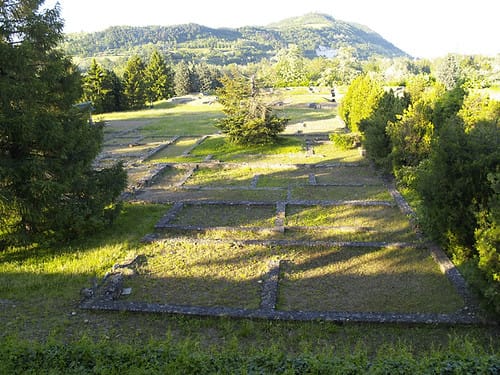
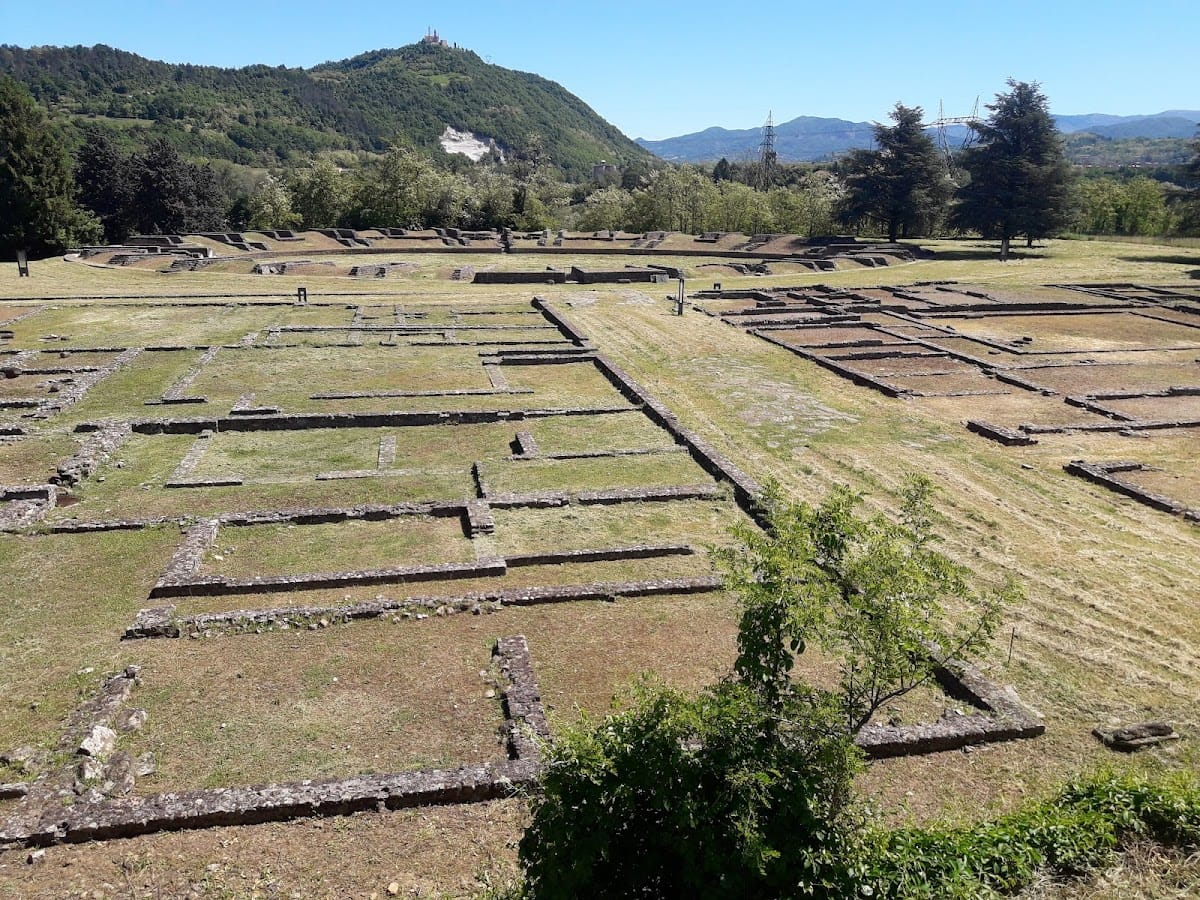
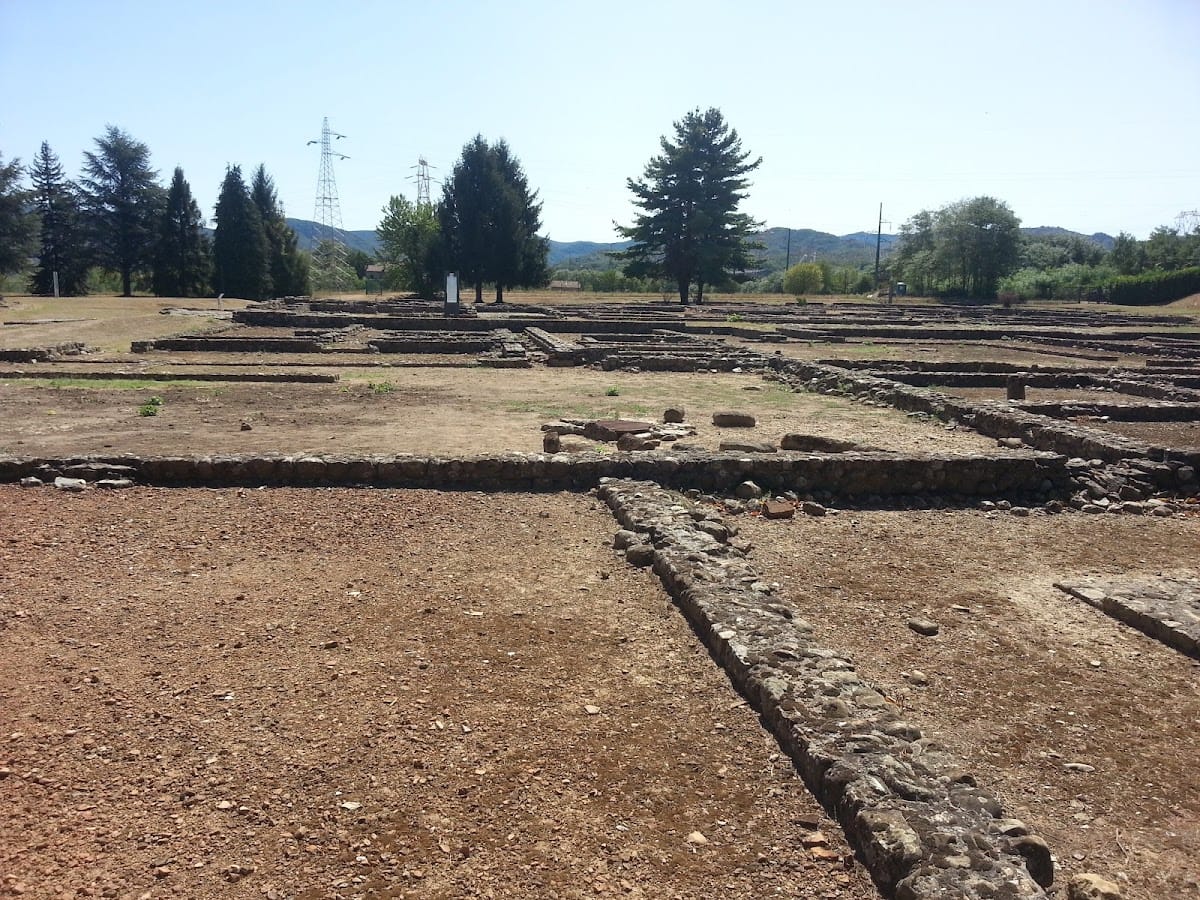
Libarna’s urban plan is characterized by a well-preserved orthogonal grid aligned along two principal axes: the cardo maximus running north-south and the decumanus maximus running east-west. The cardo maximus corresponds to a segment of the Via Postumia, constructed in 148 BCE, measuring approximately 14 meters in width and paved with stone slabs to accommodate heavy traffic. The decumanus maximus is about 10 meters wide and similarly paved, while smaller streets range from 5 to 9 meters in width and are surfaced with pebbles or gravel. Sidewalks, drainage channels, wells, fountains, and votive aedicules line the streets, with some roads featuring porticoes. This network integrates urban and territorial routes, extending main roads into the city’s interior. The city occupies a flat plain near the Scrivia River and lacks defensive walls, though monumental gates mark its northern and southern limits.
Construction techniques include ashlar masonry and Roman concrete (opus caementicium), with many buildings featuring vaulted rooms and porticoes. The city expanded notably during the 1st and 2nd centuries CE, with residential, civic, and entertainment structures concentrated within the grid. Residential quarters exhibit a mixture of modest and affluent houses, typically two stories high, arranged around atria or small gardens. The absence of city walls allowed outward expansion, preventing the development of tall apartment blocks. The city contracted gradually in Late Antiquity, with abandonment by the mid-5th century CE.
Key Buildings and Structures
Theatre of Libarna
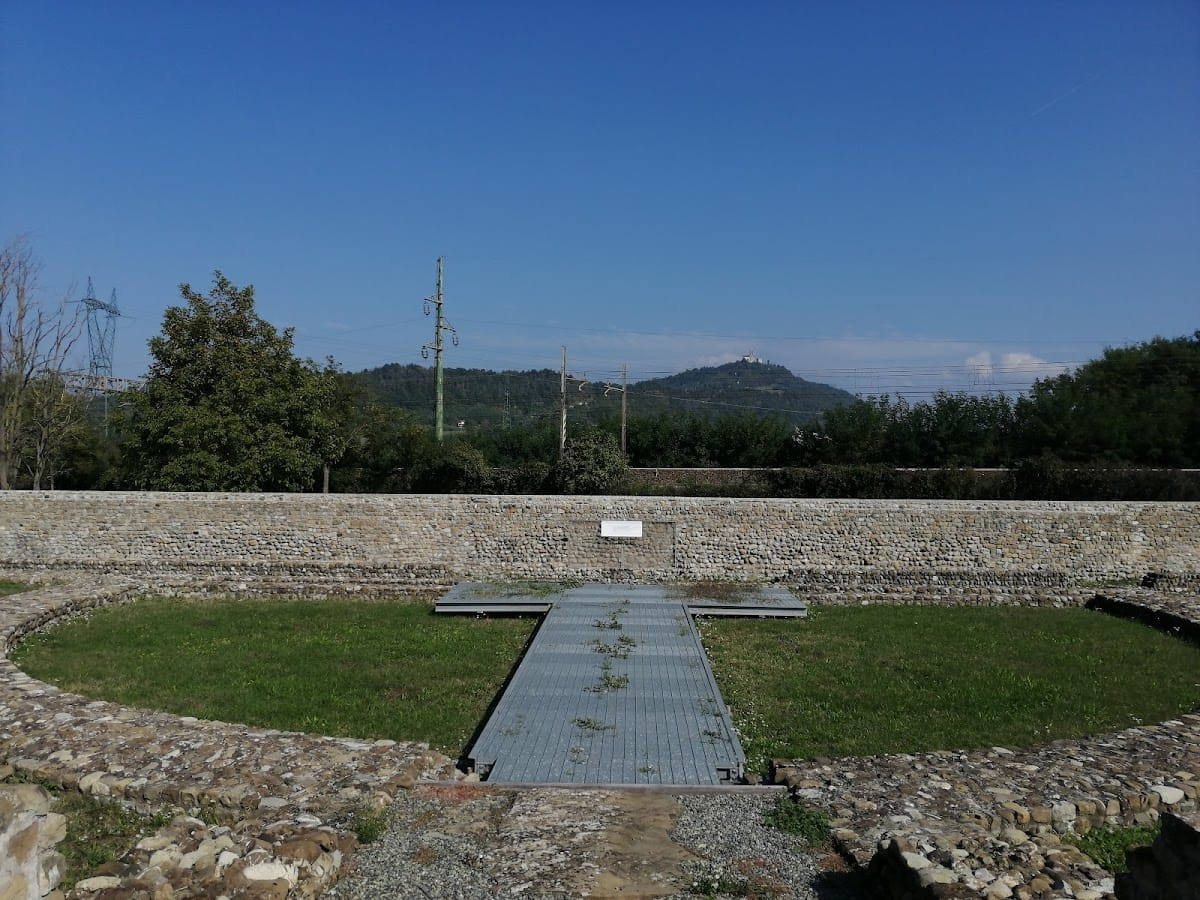
Constructed in the 1st century CE near the northern boundary of the city, the theatre could accommodate approximately 3,800 spectators. The remains include a partially preserved orchestra, stage, and seating tiers (cavea). Built using stone and Roman concrete, the structure’s foundations and masonry attest to its role as a venue for theatrical performances and public gatherings within the urban entertainment district.
Amphitheatre of Libarna
Located on the city’s outskirts and built in the 2nd century CE, the amphitheatre served as a venue for gladiatorial combats and other spectacles. It had an estimated capacity of 7,000 spectators. The elliptical structure is enclosed by walls designed to regulate crowd movement and protect adjacent residential areas. Along one side of the amphitheatre, three distinct buildings likely functioned as shops selling food and beverages, including alcoholic drinks, contributing to the social environment surrounding events. The amphitheatre’s masonry and layout remain visible, with partial preservation of seating and entrance corridors.
City Gates
Although Libarna lacked defensive walls, monumental gates were constructed at the northern and southern ends of the cardo maximus. These gates follow the “porta a cavedio” architectural model, consisting of curtain walls with one or two large vehicular openings flanked by towers. Behind each gate lies a guard courtyard with a second façade wall facing the city, forming a fortified enclosure. The southern gate is situated on the southern stretch of the Via Postumia, with a corresponding gate at the northern entrance. Over time, these gates assumed a primarily symbolic function, reflecting civic identity rather than military defense.
Forum of Libarna
The forum occupies a roughly square area near the intersection of the cardo maximus and decumanus maximus, extending over four city blocks. Excavations conducted in 1911 identified the forum’s location, revealing a large southern portico that may have functioned as a basilica. A quadrifrons arch, likely marking the northern road junction, regulated vehicular traffic. Adjacent to the southern portico, a rectangular foundation probably supported a temple. Inscriptions record that Caius Atilius Bradua financed the paving of the forum in the mid-1st century CE. The forum complex likely included a comitium (assembly area), curia (local senate house), a Capitolium temple dedicated to Jupiter, Juno, and Minerva, and possibly a temple for the imperial cult. Shops (tabernae) surrounded the square, and straight porticoes bordered the forum from the 2nd century BCE onward.
Domus D and Associated Workshops
Located in Insula I, Domus D was originally a large aristocratic residence dating to the late 1st century BCE. In the late 1st century CE, it was reduced in size and reconfigured with a productive-commercial function. The southwestern section included a shop facing the Decumanus Maximus, adjacent to a fullonica (laundry) used for degreasing, washing, and dyeing textiles. A larger workshop adjoined the laundry. The residence occupied approximately two-thirds of its original area and featured two symmetrical entrances: the main entrance at the southeast corner led past a custodian’s room and service areas, possibly including an animal shelter; the northeast entrance accessed service rooms such as a kitchen.
A large hall exceeding 100 m² had a marble floor, now surviving only in fragments, and connected to a triclinium (dining room) with a black-and-white mosaic floor. The mosaic includes a polychrome central depiction of the myth of Lycurgus and Ambrosia. The dining room opened onto a small garden (viridarium) adjoining the master bedroom and antechamber. Three interconnected rooms north of the courtyard functioned as baths. The northernmost room contained two mortars and numerous surgical instruments, indicating use as a medical ambulatorium, possibly linked to the nearby amphitheatre and its gladiatorial activities.
Aqueduct and Water Supply
Libarna was supplied with water through an aqueduct system. Within the urban area, numerous springs, wells, and fountains provided additional water sources. Drainage channels along streets directed rainwater towards the Rio della Pieve. These hydraulic features supported both domestic and public needs, including the baths complex and private residences.
Baths Complex
Situated in the extreme northeast sector of the city, the baths complex was excavated in the mid-19th century by Gianfrancesco Capurro. It comprised hot, cold, and tepid baths, with the tepid bath being the largest and comparable in size to a modern swimming pool. The complex served both hygienic and social functions, with patrons mingling in the baths and adjacent spaces. Structural elements such as hypocaust heating systems, pools, and service rooms have been documented and confirmed by recent geophysical surveys.
Houses and Domestic Architecture
Excavations in the 1970s and 1980s uncovered two entire city blocks (insulae) containing houses dating to the late 1st century BCE. These dwellings follow traditional Roman layouts, with small rooms arranged around central atria or gardens. Front rooms faced the street and were more public, while rear rooms were private. Modest and luxurious houses were intermixed without clear spatial segregation of wealth. Some street-facing rooms likely functioned as shops rented by property owners. Houses were typically two stories high, with no evidence of tall apartment blocks due to the absence of city walls.
Forum Basilica
North of the forum, a basilica building has been identified through drone imagery and geophysical surveys. Constructed in the 1st century CE, it functioned as a law court and space for public activities. The basilica lies adjacent to one of two probable temples near the forum. Its architectural remains include foundations and wall traces consistent with a rectangular hall featuring aisles.
Other Public Buildings
Geophysical surveys have identified a possible macellum (marketplace) within the city, potentially the first such structure discovered in Piedmont. Monumental gateways at the northern and southern city entrances were uncovered during excavations in the late 2000s, confirming the symbolic urban perimeter. These structures complement the known civic and entertainment buildings within Libarna.
Other Remains
Surface traces include votive aedicules along roads, wells, fountains, and drainage channels. Porticoes have been identified along some streets. Near the amphitheatre, three small structures likely served as food and beverage shops. Roadside infrastructure such as sidewalks and drainage channels remain visible in parts of the city. The orthogonal street grid divides the urban area into square blocks of varying sizes.
Archaeological Discoveries
Excavations and surveys have yielded numerous inscriptions dedicated to deities including Jupiter, Diana, Hercules, and the imperial cult. These inscriptions provide evidence of religious practices within the city. Artefacts recovered include mosaic floors, marble statues, bronze busts, figured amber, pottery, oil lamps, keys, and surgical instruments. A notable marble statue from the second half of the 1st century CE depicts a man reclining on a dining couch with a Gallic-style moustache, indicating cultural exchange.
Surgical instruments found in Domus D near the amphitheatre suggest the presence of a medical practitioner, possibly attending to gladiators. Pottery and domestic objects have been recovered from residential and workshop contexts, reflecting local production and trade. Coins and tools have also been documented, though specific emperors or dynasties represented are not detailed here. Religious artefacts include votive offerings and altars found along roads and within public spaces.
Preservation and Current Status
Only a small portion of Libarna’s ancient city remains visible above ground, preserved as an archaeological park. The theatre, amphitheatre, city gates, and sections of the orthogonal street grid are among the most discernible features. Many structures survive as foundations or fragmentary walls. Some buildings, such as the baths complex and residential blocks, have been stabilized but not fully restored. Conservation efforts focus on preserving exposed ruins and preventing further deterioration.
Environmental factors such as vegetation growth and erosion pose ongoing challenges. Modern development overlies parts of the ancient city, limiting excavation and preservation in some areas. The site is managed by the Soprintendenza Archeologia Belle Arti e Paesaggio per le province di Alessandria Asti e Cuneo (SABAP-AL), which oversees conservation and research. Recent geophysical surveys have enhanced understanding of buried structures without intrusive excavation. Some areas remain stabilized in situ to preserve archaeological integrity.
Unexcavated Areas
Significant portions of Libarna remain unexcavated or insufficiently studied, particularly in the southern and eastern sectors. Geophysical surveys have identified buried remains of public buildings, residential quarters, and possible market areas. The full extent of the macellum and additional temples remains to be explored. Modern infrastructure and agricultural use restrict excavation in some zones.
Future targeted excavations are planned to investigate cultural and economic activities and to document urban changes over time. Conservation policies prioritize non-invasive methods where possible. Historic maps and recent drone imagery continue to guide research into unexcavated districts, though large-scale excavation is limited by preservation concerns and land use.
Nearby sites