Castello della Pietra: A Medieval Fortress in Italy


Site at a Glance
- Rating
- 4.7
- Popularity
- Low
- Country
- Italy
- Primary era
- Medieval
- Eras represented
- Medieval
- Civilizations
- Holy Roman Empire
- Site type
- Military
- Remains
- Castle
On this page12 sections
History
Castello della Pietra is a medieval rock-built fortress in Italy, located in Val Vobbia near Vobbia in the Metropolitan City of Genoa. Its construction date is uncertain, although it was probably built around 1100 or earlier. The castle served as both a residence and a defensive centre for the surrounding territory, and is regarded as a principal monument of the Genoese hinterland.
Early religious and feudal history
During the Lombard period, when the Lombards ruled much of Italy between the sixth and eighth centuries, the surrounding area was held by monks of the Abbey of San Colombano at Bobbio. San Colombano, also known as Columbanus, was an Irish missionary and monastic founder whose religious tradition influenced important abbeys and landholding institutions in medieval Italy. The monks established hermitages in caves and other inaccessible places in the mountains, including the Hermitage of San Colombano.
Documents from 1252 name Opizzone della Pietra as lord of the territory. His family took the name della Pietra either from its settlement in the area or from its connection with the stone-built fortress. The medieval chronicler Caffaro di Rustico da Caschifellone described the castle as having essentially the same structural and architectural character in the thirteenth century as it has today. Its jurisdiction extended across the Alta Val Borbera beyond San Fermo Hill.
Spinola and Adorno rule
After the death of Guglielmo della Pietra, the castle passed to the noble Spinola family, which retained it until 1518. A testament dated 7 June that year transferred the fief to the brothers Antoniotto and Gerolamo Adorno at the request of Tolomeo Spinola. Prospero Adorno received formal investiture on 17 January 1565, and ownership passed to his brother Girolamo Adorno in 1575.
In 1579, a band of criminals seized the castle. Giorgio Centurione recaptured it on the orders of the Senate of the Republic of Genoa. The episode reflects the fortress’s continuing military importance within a territory where control of routes and local jurisdictions remained closely connected.
Loss of autonomy and abandonment
In 1620, Emperor Matthias of Habsburg annexed the castle to the Pallavicino fief in the Val Borbera. The annexation ended its autonomous jurisdiction, although it remained a partly autonomous enclave until the end of the eighteenth century among the larger Fieschi and Spinola fiefs. Its jurisdiction included Torre di Vobbia, Pareto in Val Brevenna, and Gordena in the Alta Val Borbera.
The castle later became the property of the Botta Adorno family. In 1797, French forces reached the Apennines and Napoleon Bonaparte ordered the abolition of the Imperial Fiefs, territories of the Holy Roman Empire that were governed by feudal lords with varying degrees of local autonomy. The last castellan, Michele Bisio, abandoned Castello della Pietra. A fire several years later caused major damage and began the fortress’s progressive ruin. Bronze from its cannons was removed by the bishop of Tortona and melted down for bells for Santa Croce Church in Crocefieschi.
Ownership, restoration, and protection
The ruins remained with the Botta Adorno family until 1882, when they passed to the Cusani Visconti family. On 21 May 1919, Luigi Riva Cusani sold the property to Giovanni Battista Beroldo of Vobbia. The Beroldo family donated it to the Municipality of Vobbia in 1979.
In 1981, two years after the municipal transfer, the Province of Genoa began extensive restoration and research at the ruins. The initiative came from the Historical Studies Centre for the Alta Valle Scrivia in Busalla. The work recovered ancient masonry and included surveys intended to clarify the castle’s overall structure. Since 2008, the Antola Regional Park authority has managed the castle. Castello della Pietra forms part of the Antola Regional Natural Park and is included on Italy’s list of national monuments.
Remains
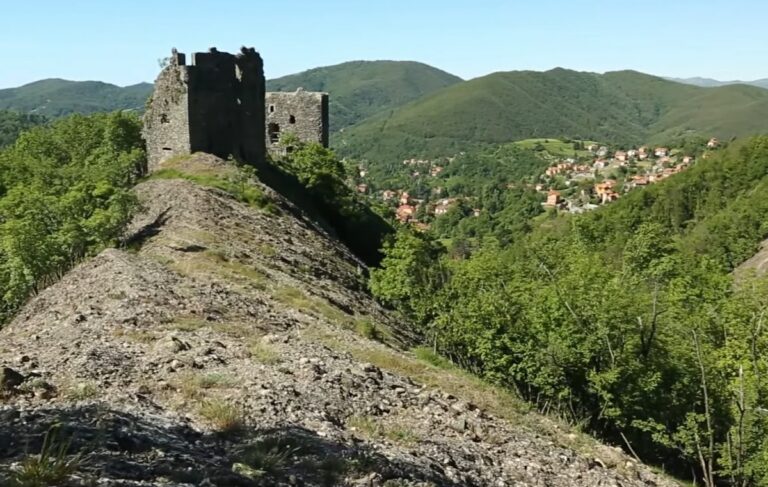
Castello della Pietra occupies an elevated natural position in Val Vobbia between two steep spurs of conglomerate rock. These formations serve as natural defensive bastions, while the fortress overlooks the road beside the Vobbia stream toward Isola del Cantone. The surviving fortification consists of two structural bodies placed at different elevations, and its present condition is described as good.
Fortification and central spaces
Entrance forebuilding
Access begins through a forebuilding arranged on three floor levels. The floors were restored with a metal grid structure, allowing the entrance block to remain part of the visible surviving fabric while supporting its present form.
Central hall and roof
The upper level of the forebuilding leads into a large central hall with a square plan and a vaulted ceiling. Renewal of the roof restored an attic above the hall. The attic can be reached from the central space and from the patrol walk, a passage along the fortifications used for movement and observation.
Water collection system
Western rock-cut cistern
A major part of the castle’s self-sufficiency was a cistern, a reservoir for collecting and storing water, cut into the rock at the foot of the tower on the western natural spur. Rainwater from the roofs flowed into the reservoir through collection channels carved into the rock. Sections of these channels remain visible.
Cistern beneath the hall
A second cistern lies beneath the floor of the central hall and supplements the reservoir beside the hall. Together, the two water-storage features formed part of the fortress’s provision system, while the surrounding rock formations and the stone-built fabric strengthened its defensive setting.