Leibniz Center for Archaeology: Preserving Roman and Germanic Heritage in Mainz
Visitor Information
Google Rating: 5
Popularity: Very Low
Google Maps: View on Google Maps
Official Website: www.leiza.de
Country: Germany
Civilization: Roman
Remains: Museum

History
The Roman-Germanic Central Museum, now known as the Leibniz Center for Archaeology, is located in Mainz, Germany. The city of Mainz itself has ancient roots as a Roman military and administrative center. The museum was established in the 19th century to study and preserve artifacts from the Roman and Germanic past of the region.
The museum was founded in 1852 after meetings in Dresden and Mainz aimed to unify German historical and antiquarian societies. Ludwig Lindenschmit the Elder, a prominent historian and archaeologist, played a central role in its creation and became its first director. The institution initially focused on the study of Roman and Germanic pagan antiquities. From 1853, it occupied three rooms in the Electoral Palace in Mainz and opened its first exhibition in 1854, displaying 388 objects.
World War II caused severe damage to the museum’s buildings, destroying exhibition halls, the armory, and workshops. After the war, Mainz was occupied by American and French forces, which affected the museum’s operations. From 1977 onward, the museum received funding from both federal and state governments, stabilizing its financial situation. In 2002, it joined the Leibniz Association, a network of research institutions.
The current archaeological center, completed in 2022, is situated at the southern edge of Mainz’s city center, adjacent to the Museum of Ancient Seafaring. This modern facility houses the museum’s collections and research activities.
The museum maintains extensive restoration workshops specialized by material type, including ceramics, glass, metals (both precious and base), organic materials, and wood. Some of these workshops are located within the Museum of Ancient Seafaring. They are equipped with advanced imaging and analytical tools such as electron microscopes, X-ray radiography, computed tomography (a scanning technique producing detailed internal images), X-ray fluorescence, microprobe analysis, and mass spectrometry. These technologies support both the preservation of original artifacts and the creation of scientifically accurate reproductions.
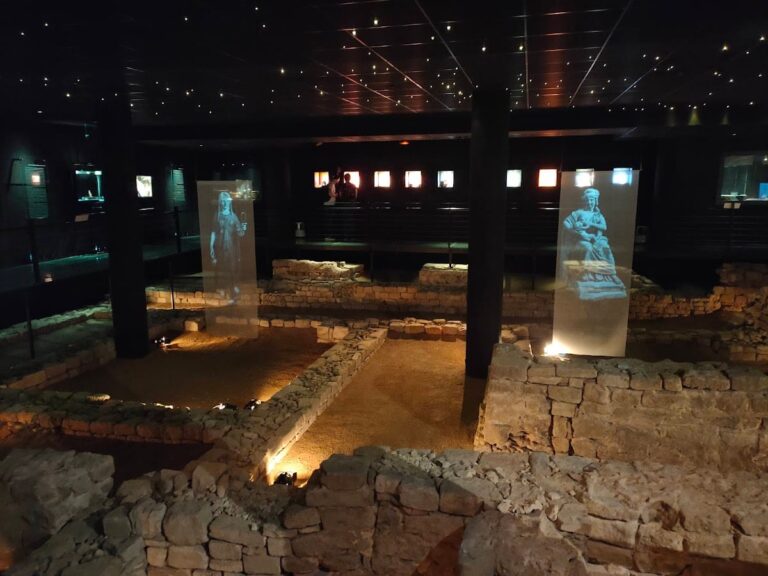
The center also houses a museum.
Nearby sites