Roman Germanic Museum Cologne: Archaeological Museum of Cologne

Site at a Glance
- Rating
- 4.4
- Popularity
- Very Low
- Country
- Germany
- Primary era
- Classical
- External website
- Open
- Eras represented
- Stone Age, Bronze Age, Iron Age, Classical, Medieval
- Civilizations
- Celtic, Merovingian, Roman
- Site type
- Museum
On this page20 sections
History
The Roman Germanic Museum Cologne is the archaeological museum of Cologne, Germany, preserving material from more than 100,000 years of human history, including the Roman and Frankish periods. It also serves as the city’s archaeological archive and heritage authority, except for the independently administered Archaeological Zone. Its collections trace the development of Cologne and the surrounding Rhineland from the Paleolithic and Mesolithic through the Neolithic, Bronze and Iron Ages, the nearly five-century Roman urban period, and the Merovingian era of the fifth to seventh centuries.
Prehistoric and Early Historic Rhineland
The museum’s earliest material illustrates the settlement of the Rhineland by hunter-gatherers and the emergence of permanent Neolithic villages during the sixth millennium BC. Finds from settlements and graves provide evidence for farming, burial customs, and the objects placed with the dead. They also record the presence of Celtic and Germanic communities during the last pre-Christian millennium.
The band-ceramic settlement at Cologne-Lindenthal is presented as a major achievement in European Neolithic research. Stone tools, weapons, handmade pottery, and other finds reveal aspects of life almost 8,000 years ago. Later displays include Alamannic graves from the fifth and sixth centuries, a sixth-century Frankish girl’s grave from Cologne-Worringen, and the sixth- or seventh-century bone buckle of Leodobodus.
Creation and Growth of Roman Cologne
The Roman collections focus on Cologne as the settlement and later colony of the Ubii, a Germanic people allied with Rome and settled there under Roman protection. The settlement traditionally associated with the foundation of the Roman city was established under Marcus Vipsanius Agrippa, the Roman general and statesman who served Augustus. In AD 50, during the reign of Emperor Claudius, it received colonial status and the official name Colonia Claudia Ara Agrippinensium, usually abbreviated CCAA. The name referred to Claudius, the colony’s altar, and Agrippina the Younger.
Agrippina the Younger was born at Cologne and later became the wife of Claudius and the mother of Nero. Her connection with the settlement is associated with the granting of colonial status. The colony developed into a political, religious, administrative, economic, and commercial centre of the Roman province of Lower Germany, and later became an administrative centre of Germania Secunda.
Roman Cologne contained a governor’s palace, temples, a theatre, a mint, villas, public buildings, cemeteries, a Rhine harbour, and an extensive road network. The archaeological record also includes the Rhine bridge built under Emperor Constantine, the early fourth-century ruler, and its bridgehead at Divitia on the opposite bank. Religious material reflects Roman, Celtic, and local cults, early Christianity, and the worship of the Matronae, local protective mother goddesses often represented on votive altars.
From Roman Rule to Frankish Cologne
The museum’s later collections come from Frankish and Merovingian burials in Cologne and nearby villages. Weapons, glass, jewellery, dress fittings, and other grave goods illustrate early medieval culture in the region. Together with the burial evidence, they illuminate the Christianisation of Cologne after the Roman period and the changing customs of communities living around the former Roman city.
Institutional Development
The museum was established in 1946 by combining the Roman and Germanic sections of the Wallraf-Richartz Museum with the Museum of Prehistory and Early History. Its predecessors included the Cologne antiquities collection founded in 1807 and a Roman antiquities collection formed from material acquired by the city from Ferdinand Franz Wallraf.
The museum opened in the Dom Bunker, an air-raid shelter beneath Cologne Cathedral, on 24 November 1961. Following an architectural competition in 1960, Klaus Renner and Heinz Röcke designed a new building. Construction began in 1967, and the building opened on 4 March 1974. The structure was conceived around the Roman house and mosaic preserved below it, creating a modern museum whose architecture relates directly to the ancient remains.
The museum has supervised archaeological work in Cologne since 1923. It maintains the city’s archaeological site archive and the Digital Archaeological Stratigraphic Atlas of Cologne, while its heritage work includes the documentation, conservation, restoration, and presentation of excavations at Groß St. Martin, St. Severin, the Roman Tower, the Alteburg naval fort, the Roman baths, and the Roman Rhine harbour.
Excavations connected with construction of the north-south underground railway exposed sections of the Roman Rhine harbour, including exceptionally preserved wooden quay structures and boats. The museum incorporated these discoveries into exhibitions, publications, and research. Cooperation with the University of Cologne, the Technical University of Cologne, conservation and restoration institutions, and other research partners has supported archaeological databases, a digital model of Roman Cologne, specialist publications, and conferences.
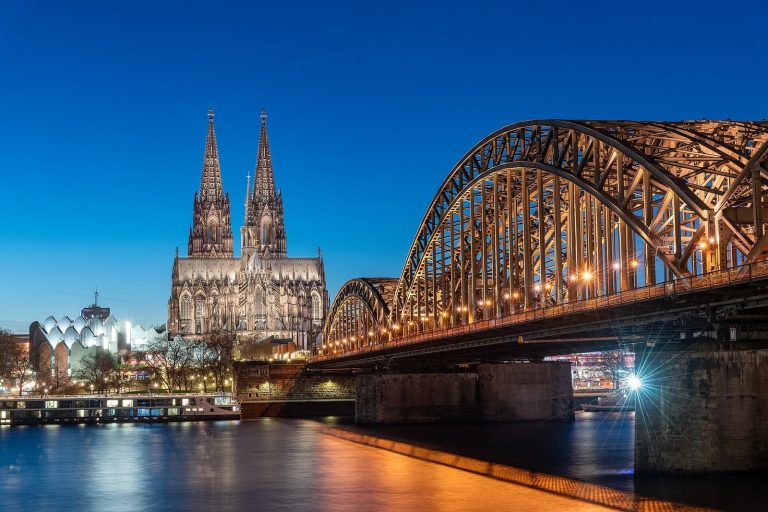
The original museum building closed for general renovation by 2019. An interim museum was established in the former Belgian consulate, the Belgian House on Cäcilienstraße near Neumarkt. It opened on 14 November 2019, with approximately 1,000 objects transferred for a new permanent exhibition. The museum building, its passage, and its eastward visual axis from the cathedral forecourt toward the Rhine received heritage protection at the end of 2016. Construction of the Museum Ludwig later obstructed the view toward the Rhine.
In January 2007, Storm Kyrill drove a wooden structure from the cathedral forecourt through the museum’s glass front and damaged the Dionysus Mosaic. Conservation specialists from Erfurt restored it in cooperation with the Italian conservation institute in Rome, which had also worked on its earlier conservation and lifting in the late 1950s.
Remains
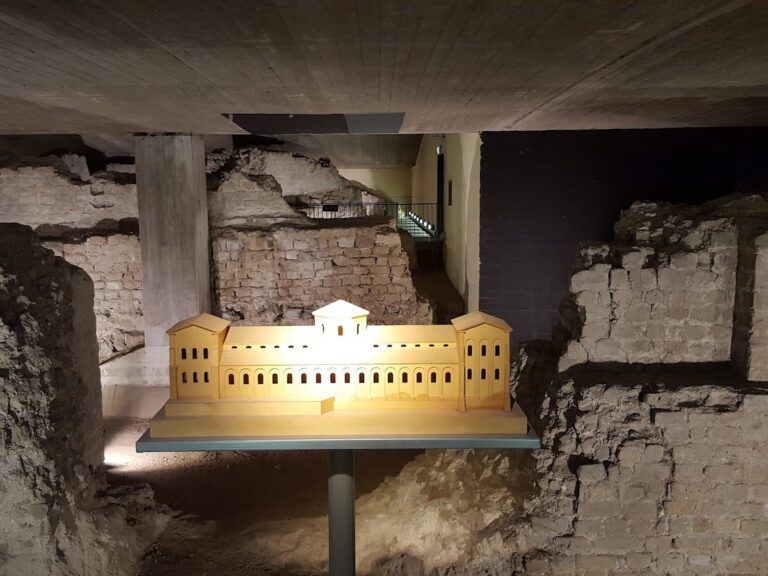
The museum stands on and around the remains of a Roman peristyle house beside the Roman harbour road near Cologne Cathedral. A peristyle house was a Roman dwelling arranged around an interior courtyard bordered by columns. The modern building consists of two principal volumes with atria, and its colonnades recall the ancient house below. Granite clads the upper floor, while the ground floor opens toward the cathedral forecourt through a continuous glass facade. The ancient house and its mosaic provided the organising principle for a building intended as a modern window onto the Roman period.
Roman House and Dionysus Mosaic
Dionysus Mosaic
The Dionysus Mosaic remains in its original archaeological position in the basement, beneath an opening in the former air-raid-shelter roof. Dating to about AD 220 or 230, it measures approximately 7 by 10.6 metres and contains more than one million small tesserae. It decorated the principal room of a Roman urban villa, probably a dining or banquet room, with scenes centred on Dionysus, the Greek god associated with wine, festivity, and theatre, whom the Romans identified with Bacchus. The Roman harbour road is presented in relation to the mosaic, while the museum’s circulation evokes the right-angled street plan of Roman Cologne.
Monuments and Urban Infrastructure
Tomb of Lucius Poblicius
The reconstructed tomb monument of Lucius Poblicius rises approximately 15 metres and dates to around AD 40, in the middle of the first century. Poblicius was a legionary veteran, meaning a former soldier of a Roman legion. His monument originally stood beside the road from Cologne toward Bonn and has been re-erected within the museum.
Northern City Gate
The reconstructed central arch of the northern city gate of CCAA is displayed on the upper floor. Its inscription identifies the colony, while a cast of a round tower helps present the fortifications of Roman Cologne. Architectural fragments, building and tomb inscriptions, tomb monuments, reliefs, wall paintings, mosaics, and other remains place the gate within the wider urban fabric.
Cardo Maximus
The route later represented by Hohe Straße followed one of the principal streets of Roman Cologne. The Cardo Maximus, the main north-south street of a Roman city, was first surfaced with gravel and drained through side ditches. Large trachyte slabs were added at the end of the first century AD. An underground wastewater system served the street, which was lined with arcades, shops, inns, and public buildings. Later repairs reused stone from tombs, altars, buildings, and other structures.
Domestic Life and Roman Glass
Domestic Reconstructions
The exhibition reconstructs aspects of Roman domestic life through a dining room and a kitchen with a dish rack. Everyday objects, domestic ceramics, lamps, and a reconstructed dining couch explain the material setting of Roman meals and household activity. A reconstructed Roman travel wagon presents the long-distance roads that connected the Roman Empire.
Glass Vessels
The museum houses more than 4,000 complete Roman glass vessels dating from the first to the fourth centuries. The collection includes molded and blown figure vessels, snake-thread glass, cut glass, vessels with attached coloured drops, and three-coloured cage cups. A cage cup, also called a diatret, is a luxury vessel whose openwork decoration forms a delicate lattice around the glass body.
Among the vessels is a colourless bottle 27.5 centimetres high, made in the third century with multicoloured glass applied to its surface. It was found in 1893 in a sarcophagus on Luxemburger Straße. A 20.8-centimetre shell cup from the second half of the fourth century came from Kartäuserhof, while a 24.5-centimetre Achilles Cup with polychrome painting, dating to the first half of the third century, was found at Richard-Wagner-Straße 47. A 12.1-centimetre cage cup came from a grave at the Roman villa estate of Cologne-Braunsfeld, excavated in 1960. Its Greek inscription translates as “Drink, live beautifully, forever.”
An early first-century glass portrait head of Emperor Augustus measures 4.7 centimetres. It is made of black glass with a turquoise-green overlay. Other Roman objects include portraits, jewellery, coins, bronze pieces, ivory and bone objects, pottery, lamps, and imported and locally made ceramics.
Sculpture, Religion, and Burial Finds
Cologne Venus
The so-called Cologne Venus is the surviving upper body of a just-under-life-size marble statue, approximately 35 centimetres high. It was carved from high-quality white marble by an Italian sculptor, transported to Cologne by ship, and installed in the villa of a wealthy Roman family. The statue was later broken up, and the surviving fragment was reused in late antique paving on the Cardo Maximus. It lay with its back uppermost and chest downward, and wagon traffic left marks on the back. Archaeologists recovered it during work in a subterranean canal tunnel beneath Hohe Straße in the early 2000s.
Matronae and Theatre Mask
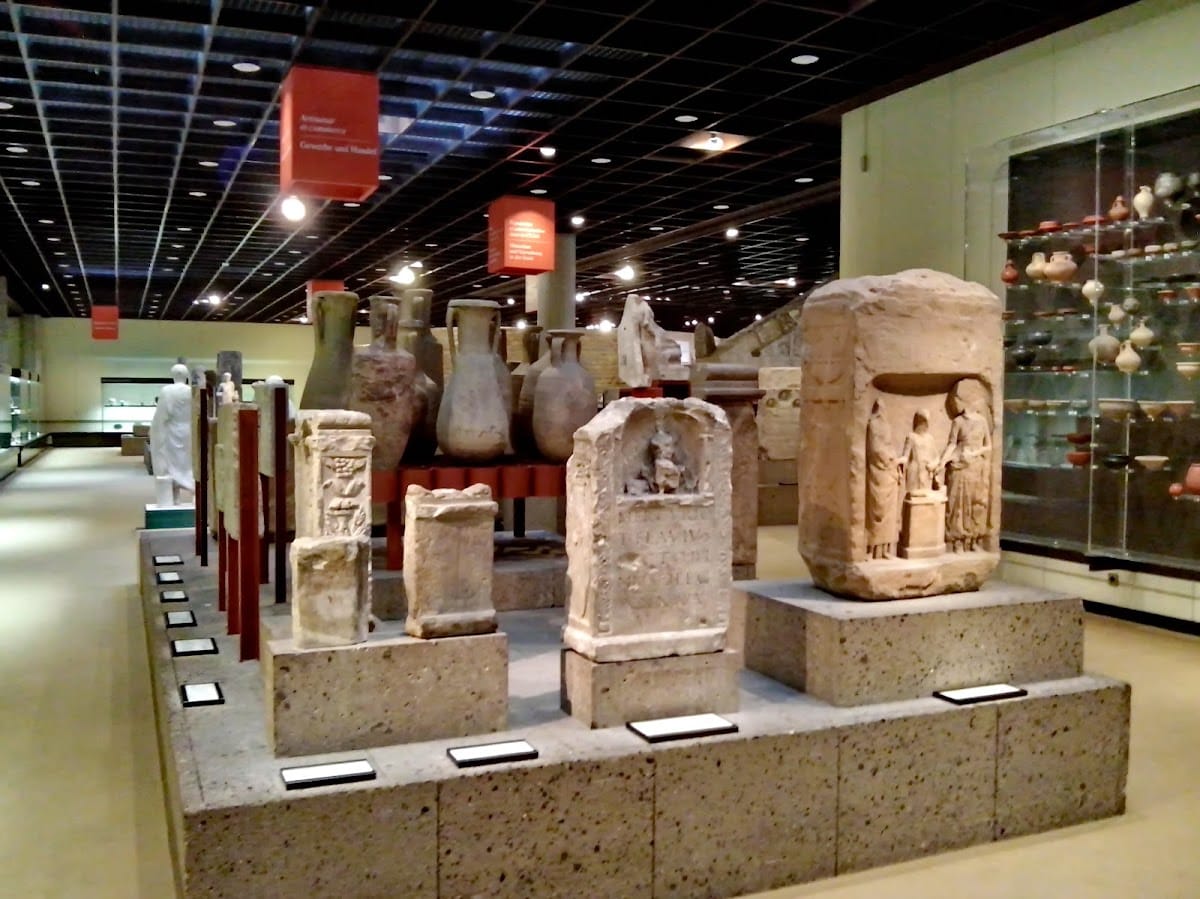
A small light-terracotta sculpture shows a group of Matronae, the local protective mother goddesses worshipped in the Rhineland. Made in the Cologne workshop of Fabricius during the second half of the second century AD, it has a reverse inscription identifying CCAA as its place of manufacture. A large limestone theatre mask from the first century AD was recovered in the Roman cemetery at Clodwigplatz. The museum also displays the tombstone of Balla, a Roman woman shown with her young child. Her husband, Longinus, erected the monument.
Göttervase
The Göttervase is a rounded, yellowish ceramic vessel 27 centimetres high, made in a Roman-period pottery workshop. It dates broadly to the second century AD, more narrowly to the late second or early third century. Excavated in 1909 from a richly furnished Germanic grave at Fliegenberg near Troisdorf, it was found broken and later restored. The vessel is displayed in the Belgian House.
Six divine heads decorate the vessel, four male and two female, separated by smooth columns and generally framed by arches. The reliefs were made in molds, with further details stamped and incised. Two heads are badly damaged. One well-preserved figure has three faces and is identified as a Celtic god, while the other figures remain unidentified because they lack distinctive attributes. The form and relief decoration imitate bronze or silver vessels, and rows of stamped concentric circles resemble metal rivets. The imagery has been compared with the reliefs of the Gundestrup Cauldron. Fragments of similar vessels have been found along the Via Belgica, the Roman road linking Cologne with the Atlantic coast.
Merovingian and Migration-Period Objects
The early medieval displays include the Kertscher Crown, a fifth-century goldsmith’s work from the Black Sea region measuring 34.2 centimetres; a large belt fitting from northeastern France dating to about AD 600 and measuring 10.4 centimetres; and a sixth-century Frankish disk brooch for a woman measuring 5.2 centimetres. These objects are associated with the Johannes von Diergardt Collection. Together with grave finds from Cologne and neighbouring settlements, they form part of a wider display of wall paintings, mosaics, gold and silver objects, amber and jet jewellery, brooches, rings, belts, bronze statuettes, ritual and votive monuments, imported glass and pottery, and finds from Roman cemeteries and villa estates.
The study building, occupied in 1971, contains the specialist library, photographic resources, study collections, and archaeological finds beyond those shown in the permanent exhibition.