Roman Theatre Mainz: A Roman Stage Theatre in Germany


Site at a Glance
- Rating
- 4.3
- Popularity
- Low
- Country
- Germany
- Primary era
- Classical
- External website
- Open
- Eras represented
- Classical
- Civilizations
- Roman
- Site type
- Entertainment
- Remains
- Theatre
On this page8 sections
History
Roman Theatre Mainz is a Roman stage theatre in Germany, built at Mogontiacum, the settlement that developed into Mainz. Its construction belongs to the Roman period, when the settlement served as a military centre on the Rhine frontier and the theatre became a major venue for public ceremonies and performances. With seating for roughly 10,000 people, it was regarded as the largest Roman stage theatre north of the Alps.
Mogontiacum and the Roman military centre
Mogontiacum stood near the confluence of the Main and Rhine. Its position supported the defence of the nearby limes, the fortified or controlled frontier marking the edge of Roman imperial territory, and helped organize campaigns against Germanic peoples. A double legionary camp was established there around 13 to 12 BC and remained in use until sometime after AD 350.
A civilian settlement, known as a vicus, developed around the camp. A vicus was a civilian community associated with, but distinct from, a Roman military camp. Around AD 80, Mogontiacum became the capital of Germania Superior, the Roman province covering the upper Rhine region.
Commemoration of Drusus
The theatre was probably built in connection with funerary games held in honour of Drusus, a Roman military commander whose memorial at Mainz became the focus of commemorative ceremonies. His cenotaph, a monument honouring a dead person whose remains were elsewhere, stood at the Drususstein, about 340 metres from the theatre.
Military processions called decursiones militum were held at the memorial, and the theatre may also have hosted a supplicatio, a public Roman thanksgiving ceremony, attended by representatives of sixty Gallic communities. Suetonius mentioned a theatre at Mogontiacum in connection with events of AD 39.
Decline, burial use, and disappearance
The stone theatre probably replaced an earlier wooden building. After the city walls were altered in the mid-fourth century, stone probably taken from the theatre was incorporated into the defences. The building then stood outside the protected area, and its theatrical use ended. Its masonry was progressively removed for other construction.
From the sixth century, the surviving vaulted spaces were used for burials associated with monasteries in the surrounding area, particularly the now-vanished monastery of St Nikomedes. The last known medieval mention came in the eleventh century, when Gozwin of Mainz, a writer associated with the city, described the ruins as those of a Roman building used for circus games and theatrical spectacles.
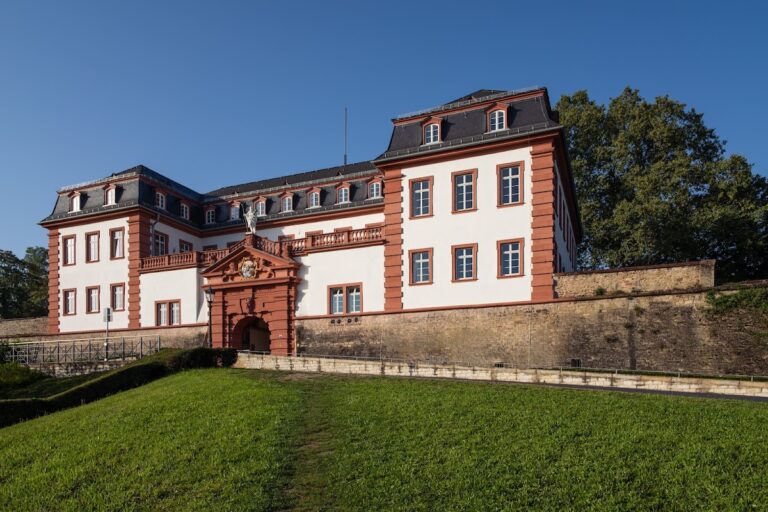
The area was completely levelled during construction of the Mainz Citadel in the mid-seventeenth century. The last visible masonry disappeared, and the theatre was subsequently forgotten. Foundations of its stage building were found during railway construction in 1884, but they were surveyed and then demolished to make room for the tracks and platforms of the South Station. Further remains discovered during canal construction in 1914 were identified by the art historian Ernst Neeb as those of a Roman theatre. An exploratory excavation in 1916 supported the identification, although the First World War prevented larger work.
Rediscovery and modern interpretation
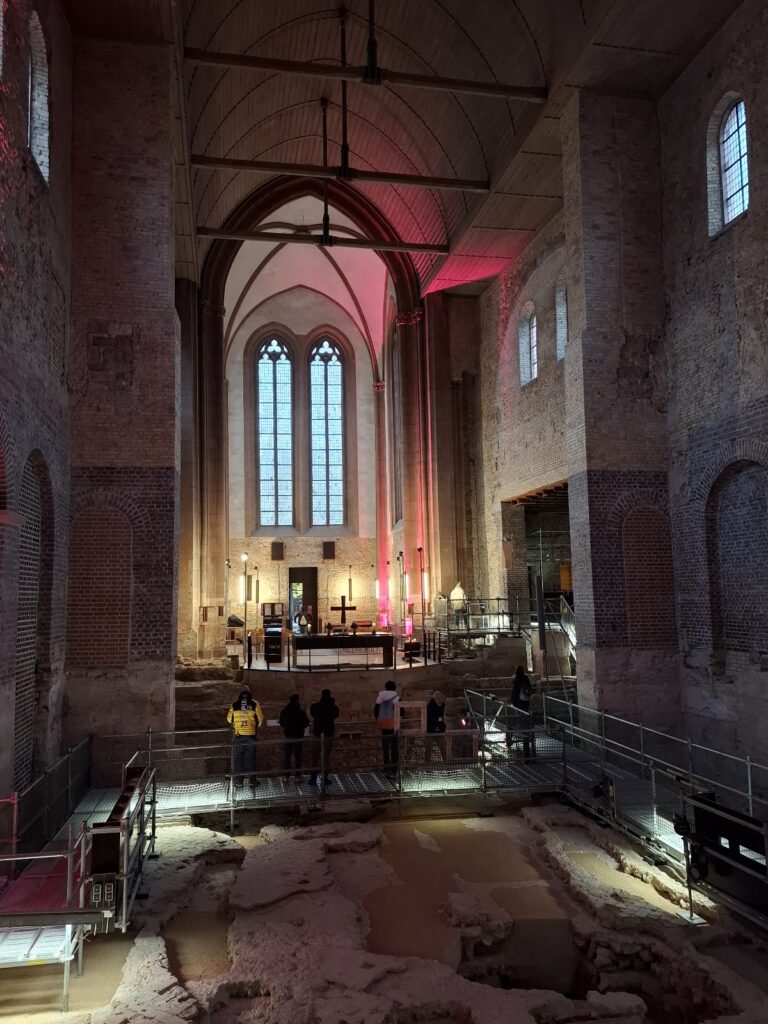
A test trench opened in 1998 exposed several pillar remains. Extensive excavations began in 1999 with support from donations, sponsorship, and local volunteers. These investigations revealed additional structural remains and graves connected with the theatre’s later burial use.
In 2004, the site hosted its first theatrical performance in modern times. The original stone seating rows were reproduced in wood to create temporary seating for about 500 people. On 5 August, the sold-out performance presented Tablao by the Barcelona flamenco dance theatre Increpación Danza.
Mogontiacum very probably also had an amphitheatre, although its existence and location remain unconfirmed archaeologically. Historical references and excavation indications have pointed to Zahlbach, near the former Dahlheim cloister, while Father Joseph Fuchs placed it between the modern city centre and Hechtsheim. The hypothesis rests indirectly on evidence such as dedications connected with gladiators.
Remains
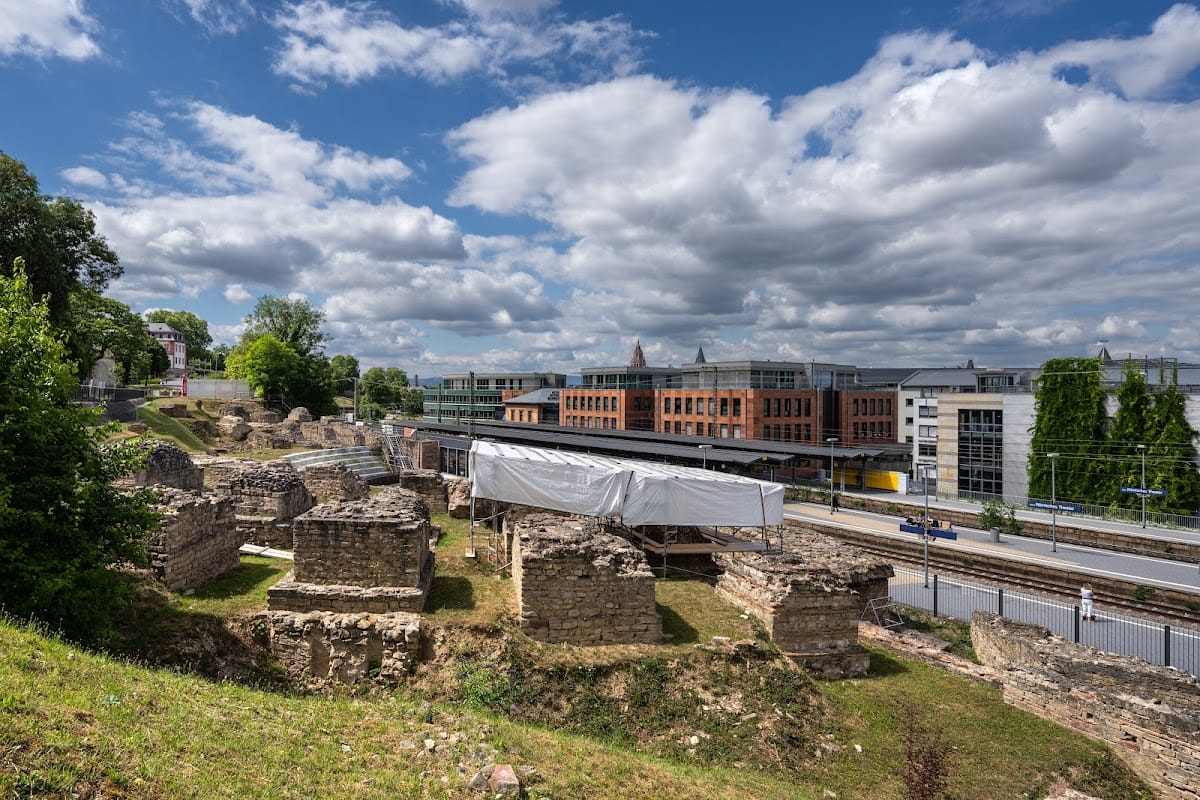
The excavated theatre lies immediately beside the railway station now called Mainz Römisches Theater. Its circular seating area measured approximately 116 metres across, while the stage was about 42 metres wide. The building was substantially constructed in stone and contained massive masonry vaults beneath the auditorium. These dimensions and its capacity of roughly 10,000 spectators indicate the scale of the Roman structure.
Auditorium and stage
The auditorium occupied a broad circular plan, with stone seating arranged around the performance space. The theatre’s original seating blocks were gradually dismantled and reused in later building projects. A wooden installation created for the 2004 performance followed the lines of the former stone seating and occupied the circular auditorium.
Foundations belonging to the stage building were recorded during the railway works of 1884 and were later destroyed for the station construction. The remains exposed by the 1998 test trench included several pillars, and later excavations uncovered further parts of the structure.
Vaults and burial spaces
The theatre’s heavy stone vaults survived for several centuries after performances ended. From the sixth century onward, these vaulted areas were adapted for burials. Graves from this period have been found within the excavated remains, linking the surviving underground spaces with the monasteries that surrounded the former theatre.