Gleninagh Castle: A Historic Tower House in County Clare, Ireland

Visitor Information
Google Rating: 4.5
Popularity: Low
Country: Ireland
Civilization: Unclassified
Site type: Military
Remains: Castle

History
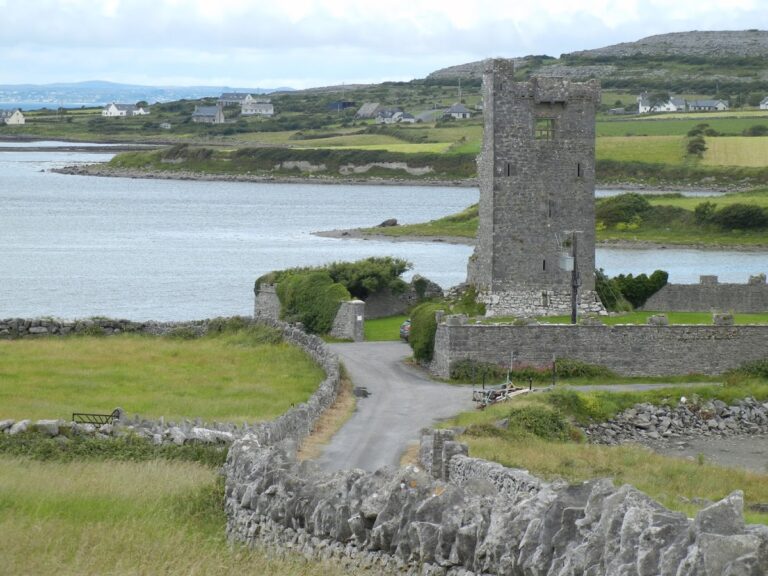
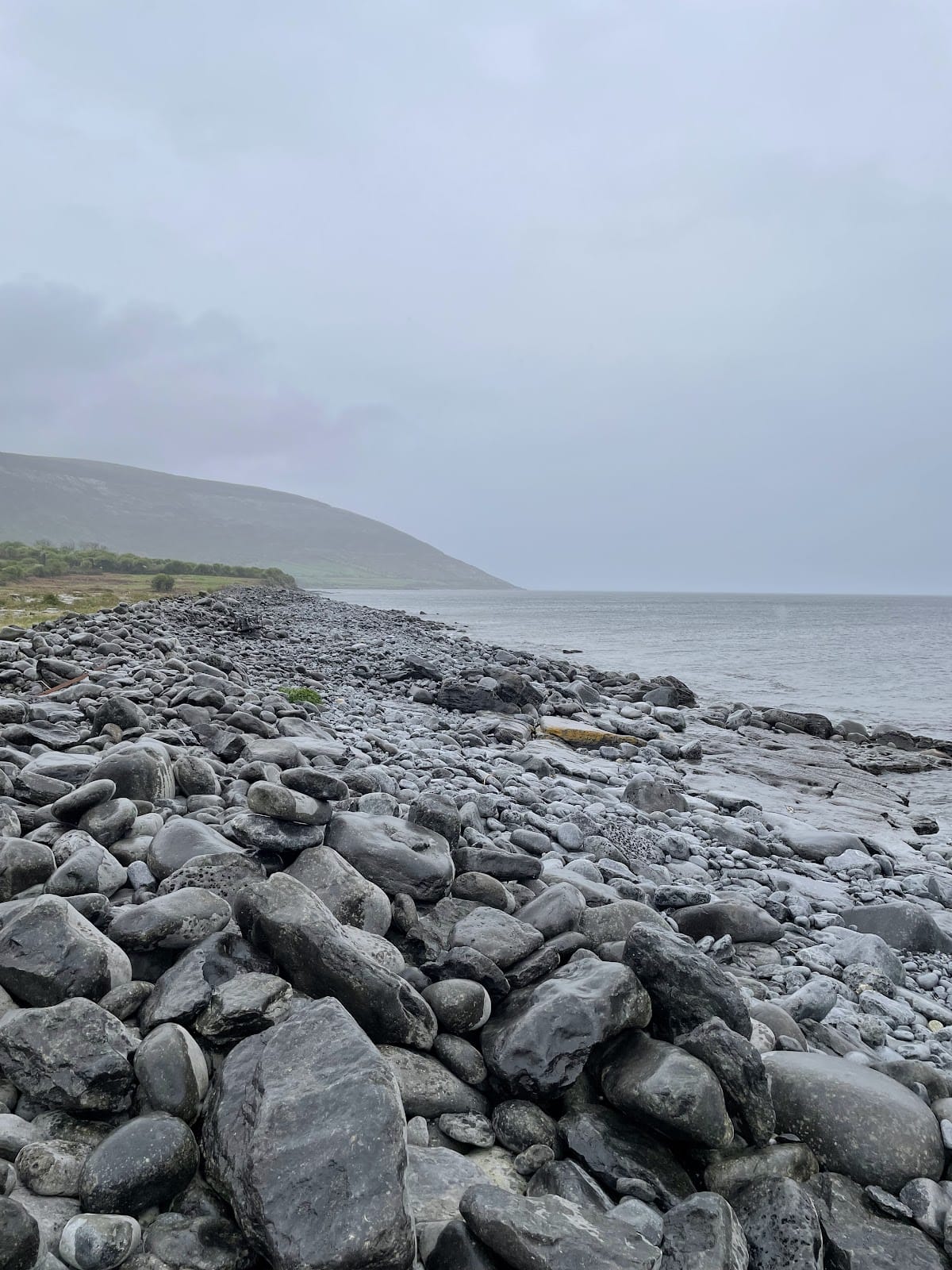
Gleninagh Castle is situated near Galway Bay in the area known as Gleninagh North, County Clare, Ireland. It was erected during the 16th century by the Irish O’Loughlin clan, a family deeply rooted in the local Gaelic tradition.
Throughout its early history, the castle acted as a stronghold and residence for the O’Loughlins. In 1544, King Henry VIII granted the surrounding lands and the castle itself to Richard Harding, with the expectation that he would seize control of the territory. Despite this royal grant, the castle remained fiercely contested, including a notable episode in 1570 when James Lynch, a prominent figure from Galway, captured it. By the early 17th century, specifically in 1629, the ownership of the land had passed to the diocese of Kilfenora, indicating a shift towards ecclesiastical control.
The castle continued to function as a family residence well into the 19th century. Reports from 1839 describe the structure as being in good condition, although only a few years later, by 1843, it had been abandoned for habitation. During this period, the local landlord, Lord Blood, repurposed the building’s upper floors as a dovecote while converting the ground floor for use as a cattle barn. The castle saw partial restoration efforts undertaken sometime in the 20th century.
Close to the castle, the site includes the ruins of an old church believed to date back to 1302. This church was constructed on the grounds of a former monastic settlement, with remaining monastic walls and archaeological finds hinting at historic religious and economic activities, although no comprehensive excavations have yet been performed. By 1839, accounts describe the church as being overgrown with ivy yet still standing, and it remained standing in 1897 before falling into abandonment.
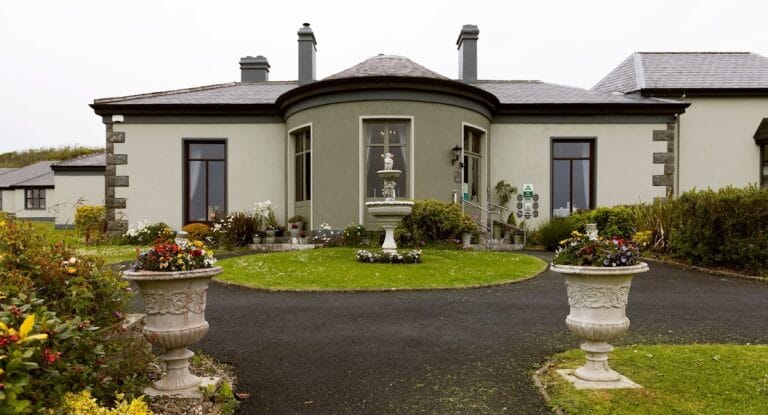
Around the castle, the landscape holds further historical interest, including remnants of a ruined 19th-century landlord’s house with its accompanying garden and a well held sacred locally. This property was once owned by William Bindon Blood, a descendant of the infamous Colonel Thomas Blood. Nearby are several ancient sites that include locations used for pilgrimage and ritual, such as Tobar na Croiche Naoimhe (“Place of the Holy Cross”), recognized for Gothic-style stonework and human remains linked to ancient sacrificial rites, and other sacred wells and ancient earthworks. Together, these features underscore the long history of human occupation and spiritual significance in this part of County Clare.
Remains
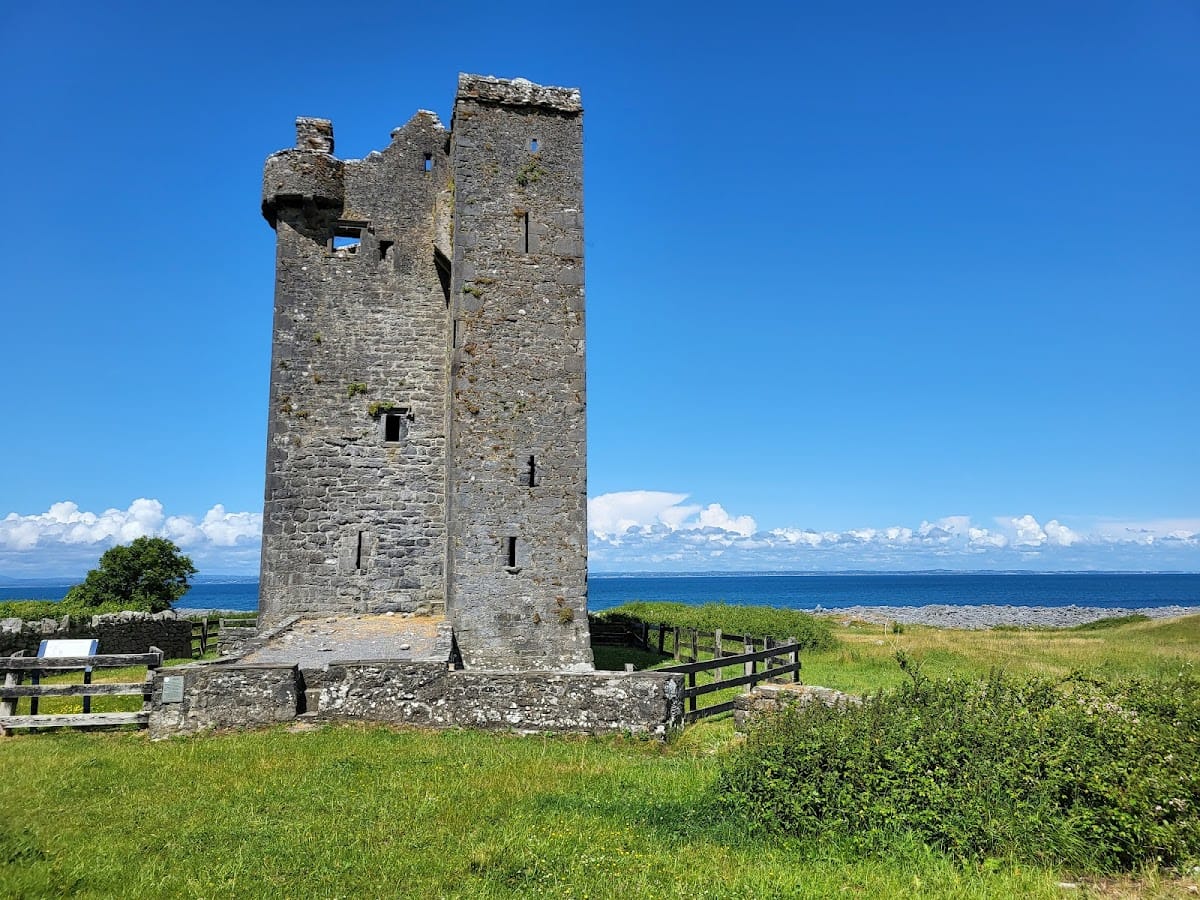
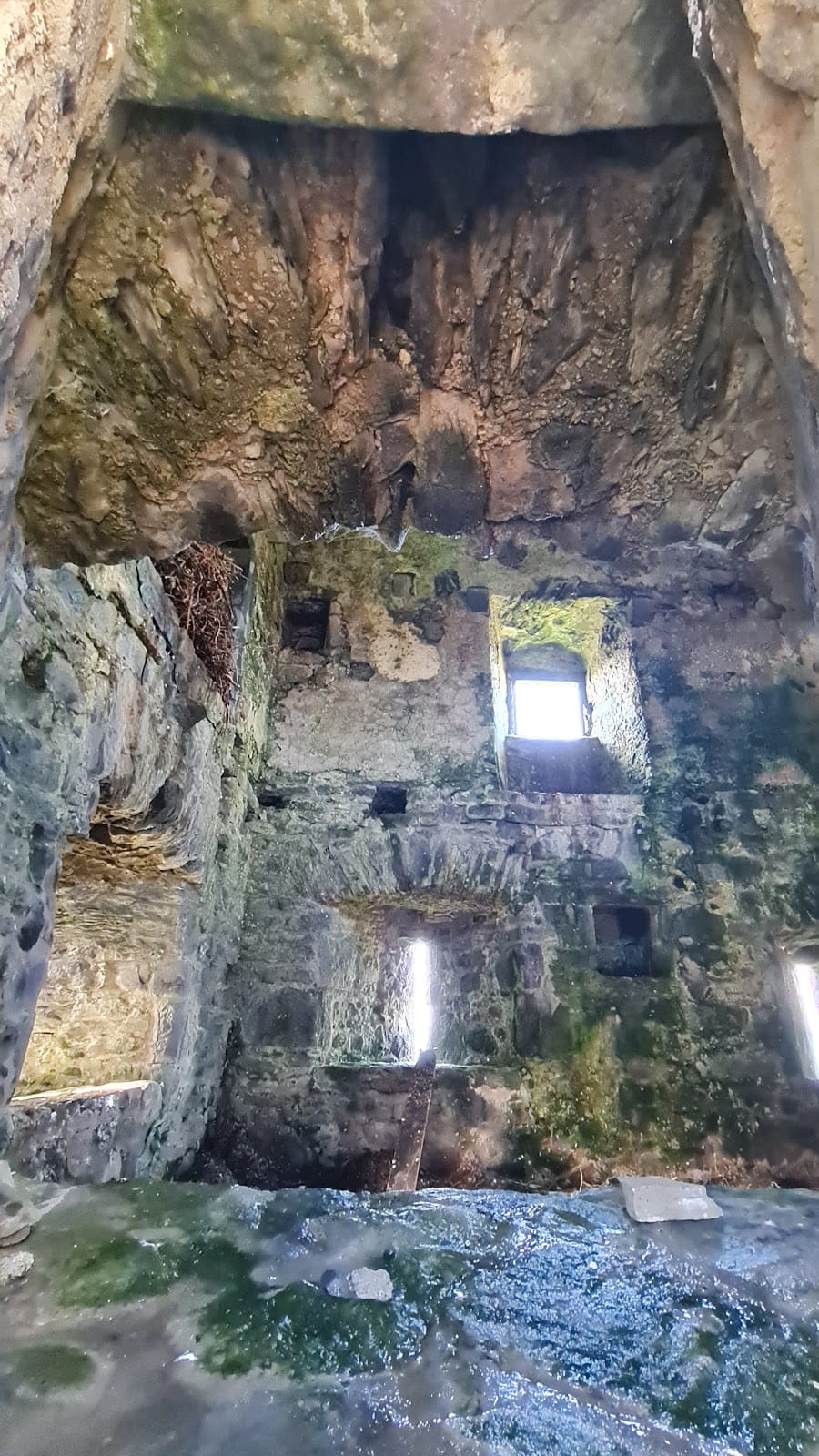
The principal feature at Gleninagh is the castle itself, a four-storey tower house designed with an L-shaped plan. The footprint measures approximately 32 by 28 feet and sits prominently on a rocky cliff overlooking Galway Bay. The tower’s construction consists of substantial stone walls, with a well-preserved spiral staircase within. The main entrance, situated on the ground floor, is guarded by a machicolation—a projecting stone opening above the doorway historically used to drop objects or pour substances on attackers below.
Three of the tower’s corners are equipped with round bartizans, which are small turret-like structures serving as defensive positions with gun loops for firing. The walls are pierced by narrow windows and arrow slits that enabled occupants to launch projectiles while remaining protected. During the 17th century, many of these openings were sealed, possibly to adapt parts of the tower to include open fireplaces, reflecting changes in use and comfort. Multiple old fireplaces built into various floors testify to this adaptation. Notably, a thatched roof covered the castle in the 19th century, revealing a roofing style that differed from typical stone or slate.
Adjoining the castle, the ruins of a medieval church retain thick stone walls up to eight feet high and about two and a half feet thick. The southern wall remains pointed in structure and features a finely crafted stone doorway about five feet tall. Accompanying this doorway, two windows on the south face—one rectangular and one round—survive as evidence of the church’s original design. These walls stand among ivy and rubble, marking the presence of this religious building associated with an earlier monastery.
The castle grounds also hold the remains of a nearby 19th-century landlord’s house along with its former garden area. Within this vicinity lies a well traditionally regarded as holy, reflecting the site’s ongoing cultural and spiritual importance. Scattered across the landscape are ancient lime kilns, used historically for producing lime from limestone, an essential building material and soil conditioner.
Additional features enrich the archaeological narrative nearby. There are sacred and ritual sites such as Tobar na Croiche Naoimhe, which includes a Gothic arch and cross marking a pilgrimage location where excavations in 1840 uncovered human skulls and evidence suggestive of early pagan sacrifices. Another nearby pilgrimage well, Tobar Cornain, is surrounded by a 19th-century structure built in the style of Gothic revival architecture. The site’s setting includes the ancient earthwork Dough Branneen, an old burial mound; the sacred stone named Keger; and the nearby Iron Age Celtic fort called Dun Fergus. This fortification is notable for its circular design and natural caves beneath, reflecting early settlement and defensive strategies in the region. Together, these features create a rich landscape of continuous human presence ranging from prehistoric to medieval times.
Nearby sites