Dunguaire Castle: A Sixteenth-Century Tower House in Ireland


Site at a Glance
- Rating
- 4.3
- Popularity
- Medium
- Country
- Ireland
- Primary era
- Early Modern
- External website
- Open
- Eras represented
- Early Modern
- Civilizations
- Irish
- Site type
- Military
- Remains
- Castle
On this page7 sections
History
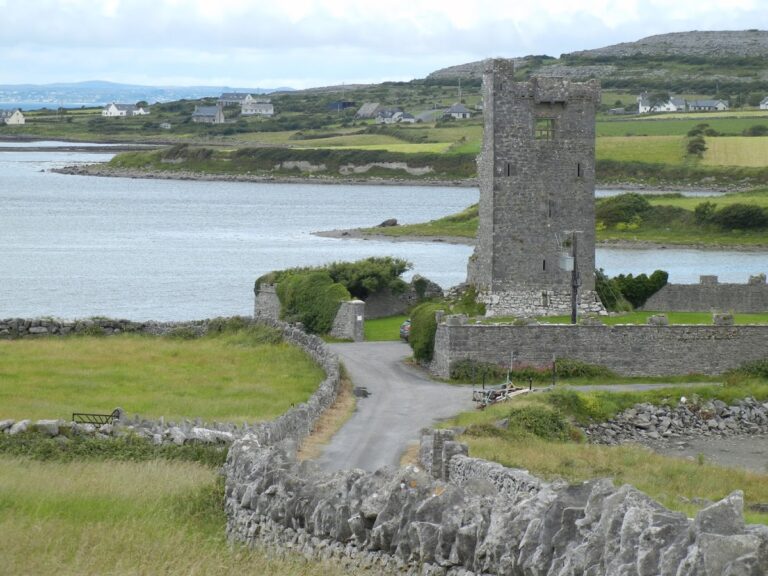
Dunguaire Castle is a sixteenth-century stone tower house in Ireland, near Kinvara on the southeastern shore of Galway Bay. The Hynes clan built it in 1520, creating a fortified residence that combined domestic accommodation with defensive features. The castle takes its name from the fort of King Guaire and remains associated with the history and legends of the surrounding region.
Early associations and the Hynes clan
The land was associated with the Hynes from at least 662, when tradition identified the site as the royal residence of Guaire Aidne, a legendary king linked with Connacht and regarded as the founder of the Guaire lineage. An earlier fortress may have occupied the location before its destruction. The regional legend known as “The Road of the Dishes,” or Bothar na Mias, also connects the place with King Guaire and Saint Colman of Kilmacduagh, an Irish Christian saint associated with the medieval religious foundation at Kilmacduagh.
In the nineteenth century, the Gaelic scholar John O’Donovan attributed the castle to the Hynes clan. At that time, the Hynes were chiefs of the district around Kinvara and of Uí Fiachrach Aidhne, a territory extending between the Burren, Galway Bay, and Slieve Aughty.
Later ownership and cultural associations
During the seventeenth century, the castle and its surrounding lands passed to Oliver Martin, the father of Richard Martin. The Martin family retained the property until the early twentieth century.
Oliver St John Gogarty, an Irish poet and surgeon, acquired Dunguaire Castle in the early twentieth century and began restoring its badly ruined remains. During his ownership, the castle was visited by William Butler Yeats, George Bernard Shaw, Lady Gregory, and John Millington Synge. These figures were associated with the Celtic Revival, a movement that promoted Irish literature, language, folklore, and cultural identity.
Lady Christobel Amptill acquired the castle in 1954 and completed the restoration begun by Gogarty. The property later passed to Shannon Development, an Irish state-linked corporation involved in regional economic development and the management or promotion of historic and tourism properties. Dunguaire Castle was also used as a filming location in Guns in the Heather in 1969, when it represented Boyne Castle, and in North Sea Hijack in 1979, when it represented a Scottish castle and the home of the principal character.
Remains
Dunguaire Castle consists of a tall stone tower house enclosed by a defensive wall. The principal tower rises 75 feet, approximately 23 metres, and the surrounding defensive works define the castle’s compact fortified layout. The tower and wall were restored in the 1980s, and the restored structures were described as being in very good condition.
Tower and defensive enclosure
Principal tower
The principal tower is the castle’s dominant surviving structure. Built as a sixteenth-century tower house, it provided a fortified residential setting for the Hynes clan. Its stone construction and height of approximately 23 metres reflect the building’s defensive form, while its role as a residence distinguishes it from a purely military stronghold. The tower was restored in the twentieth century, including work carried out during Gogarty’s ownership and completed after Lady Christobel Amptill acquired the castle.
Defensive wall
A defensive wall surrounds the tower and forms the castle’s outer enclosure. The wall was restored together with the tower in the 1980s and survives as part of the restored defensive layout. Its presence preserves the relationship between the residential tower and the works intended to protect it.