The Roman Villa of Els Munts: A Roman Coastal Villa near Tarragona



Visitor Information
Google Rating: 4.3
Popularity: Medium
Google Maps: View on Google Maps
Official Website: www.mnat.cat
Country: Spain
Civilization: Roman
Remains: Domestic

History
The Roman Villa of Els Munts is situated on a coastal hill near Altafulla, approximately 12 kilometers from the ancient Roman city of Tàrraco, now Tarragona. Constructed by the Romans, this villa functioned as a luxurious residence during the 2nd century AD. It was originally established in the 1st century AD atop the remains of an earlier agricultural estate, reflecting the Roman practice of reusing and expanding existing rural properties.
During the mid-2nd century AD, the villa became the domicile of Caius Valerius Avitus, a prominent magistrate (duumvir) of Tàrraco’s administration. Avitus was relocated to this site by Emperor Antoninus Pius from Augustobriga, a settlement in present-day Soria. Under his ownership, the villa underwent significant enlargement and refurbishment, including the expansion of the main baths, the addition of ornamental pools and statues, and the construction of a large cistern. Decorative elements such as renewed wall paintings and mosaic floors were also introduced during this period.
Between 260 and 270 AD, the villa suffered extensive damage from a major fire, likely linked to the initial barbarian incursions into the region. Following this destruction, the residential quarters were abandoned and not restored for habitation. Instead, the site was repurposed for agricultural production, particularly for pressing oil or wine. Despite this shift, the villa complex remained in use until the 6th or 7th century AD, after which it was deserted and subjected to looting.
Known to scholars since the 16th century, the Roman Villa of Els Munts has been the focus of systematic archaeological investigation beginning in 1967 under the auspices of the Tarragona Archaeological Museum. Excavations conducted primarily in the 1960s and 1970s, with further work in the 1990s and early 2000s, uncovered richly decorated rooms, a mithraeum (a sanctuary dedicated to the god Mithras), and revealed the spatial connections between the main residential building and the southern bath complex.
Remains
The villa occupies a gently sloping hill overlooking the Mediterranean Sea, strategically positioned near the Via Augusta and the Gaià River. This location facilitated agricultural exploitation and communication with Tàrraco. The complex is divided into a residential sector facing south and a productive agricultural zone on the northern and western slopes, demonstrating a clear separation of leisure and workspaces.
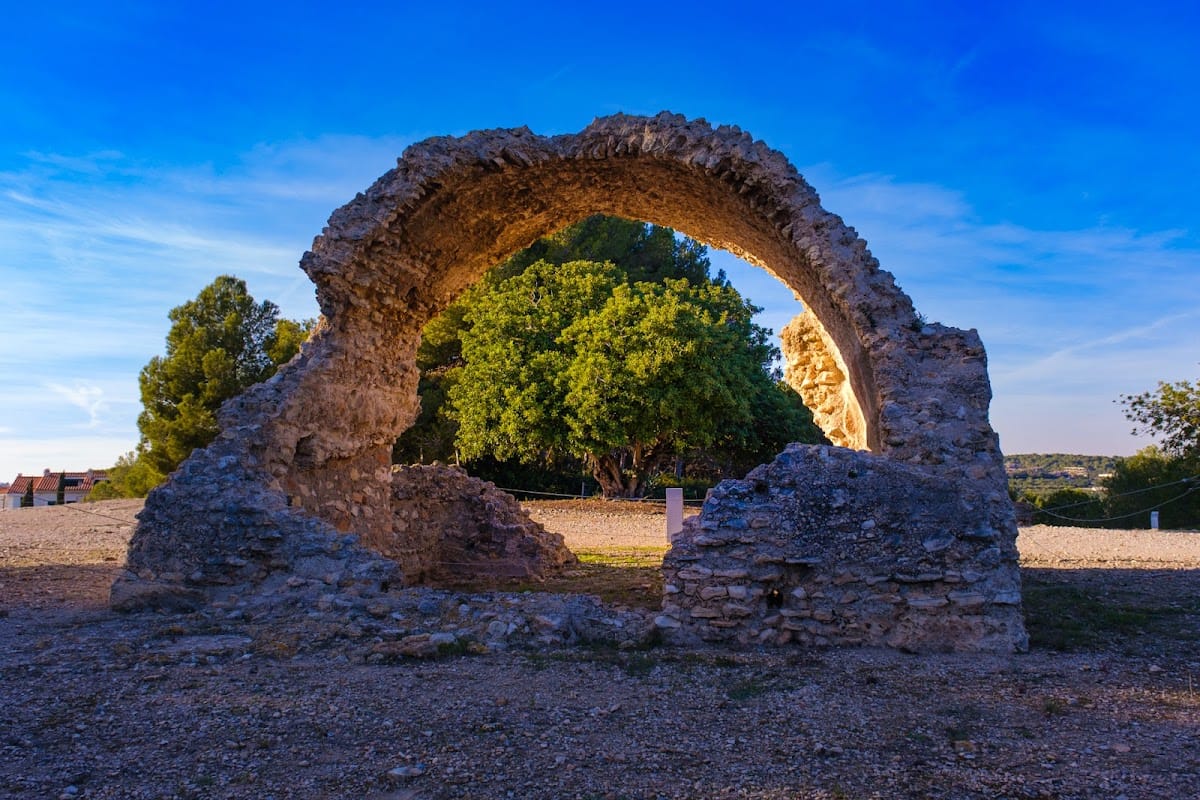
The residential area features a large two-story domus arranged around a central garden (hortus). A semi-subterranean L-shaped corridor known as a cryptoporticus surrounds the garden, paved with elaborate polychrome mosaics and adorned with richly painted walls displaying geometric and floral designs. Some ceilings were decorated with coffered patterns and paintings inspired by Dionysian themes. The upper floor, mostly lost, once included a portico with Corinthian columns overlooking the sea, decorated with small mosaic panels depicting muses. Excavations have recovered statues such as one of Antinous, a Bacchus torso, a fragment of Emperor Marcus Aurelius’s portrait, and a female deity’s head.
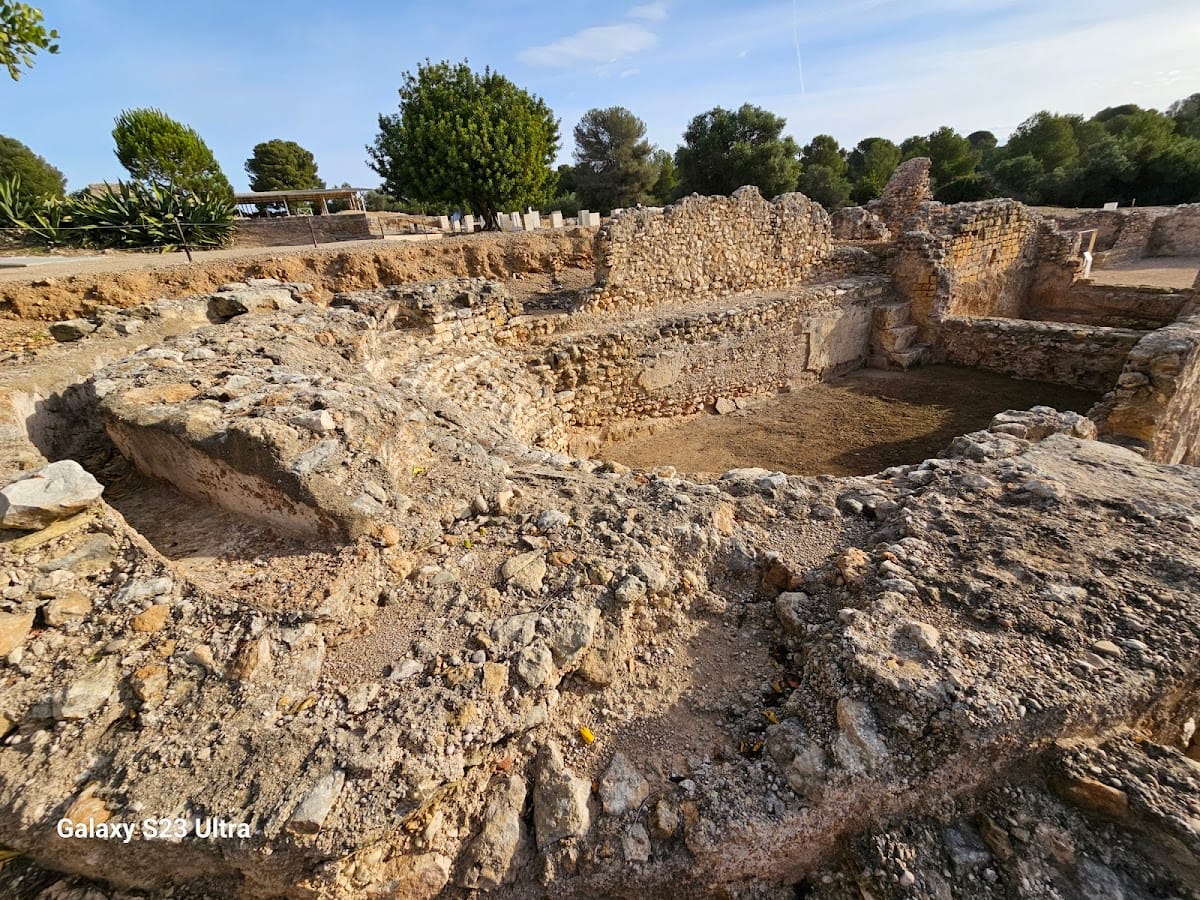
The villa contained at least three bath complexes. The main baths, located near the residential quarters, were expanded during the 2nd century. A smaller bathhouse was situated on the beach, and another set of baths lay on the southern side, connected to the main building by a large garden. The best-preserved baths, known as the lower baths, include changing rooms, cold and hot pools, a tepidarium (warm room), sauna, latrines, and furnaces for heating water and rooms. The pool walls retain marble slab cladding, indicating the baths’ luxurious character.
A large rectangular cistern with eight interconnected compartments crowns the hilltop. This cistern, equipped with an external channel system, supplied irrigation water to the northern agricultural fields. A painted mural depicting Oceanus, the personification of the ocean, decorated a fountain fed by the cistern. An inscription on this fountain names Caius Valerius Avitus and his wife Faustina as patrons and specifies the cistern’s dimensions and capacity.
The villa’s rural sector extends along the northern and western slopes, comprising agricultural structures such as cellars, stables, granaries, cereal storage pits (silos), and a small oil press. The press includes semi-buried dolia, large ceramic containers used for product conservation. Decorative elements recovered from the site include statuary, architectural fragments, polychrome mosaics, and wall paintings. An inscription commemorates the construction of the cistern by Avitus and Faustina, underscoring their role in the villa’s development.
Overall, the villa’s design exploits the natural topography to separate residential leisure spaces from agricultural production. The integration of gardens, porticoes, and pathways created an environment suited for rest, social interaction, and contemplation, with direct access to the sea and a beach bathhouse enhancing its appeal.
Nearby sites