Conisbrough Castle: A Norman and Plantagenet Fortress in England

Visitor Information
Google Rating: 4.5
Popularity: Medium
Google Maps: View on Google Maps
Official Website: www.english-heritage.org.uk
Country: United Kingdom
Civilization: Medieval European
Remains: Military

History
Conisbrough Castle is located in the town of Conisbrough, England. It was established by the Normans following their conquest of England in 1066, marking the beginning of its recorded history.
The site was initially held by the Anglo-Saxon King Harold II before passing to William de Warenne, Earl of Surrey, after the Norman victory. William de Warenne founded the castle during the late 11th century, securing control over the large estate that included Conisbrough and its surrounding townships. This early period laid the foundation for the castle’s role as a manorial and defensive site in the region.
In 1163, ownership transferred by marriage to Hamelin Plantagenet, an illegitimate half-brother of King Henry II. Hamelin and later his son William undertook substantial rebuilding between 1180 and 1190, reconstructing key elements of the castle in stone. This major phase included the erection of the castle’s striking cylindrical keep, a prominent feature that defines the site today. The castle remained within the Warenne and Plantagenet families for several centuries, despite occasional seizures by the Crown.
During the 14th century, Conisbrough Castle was inherited by Edmund of Langley, Duke of York. The castle returned to royal hands in 1461 when Edward IV took the throne amid the Wars of the Roses. Following this turbulent period, the castle’s military importance diminished.
By the 16th century, the castle had suffered a significant landslip, causing collapse of gates, bridge, and parts of walls including a keep floor. This was due to erosion of clay soils over limestone, fracturing sandstone below. The ruined castle was granted to the Carey family and later passed through marriage to the Heviningham and Coke families. It did not play a role in the English Civil War, likely because it was already decayed and militarily ineffective.
The castle came into possession of the Duke of Leeds in 1737 along with the manor. Repairs in the 19th century helped preserve the keep, notably re-roofing and installing wooden floors during the 1880s. In the 20th century, local council ownership transferred management to the Ministry of Public Works in 1949. Archaeological excavations in the late 1960s revealed foundations of inner bailey structures, with ongoing studies into the site’s facilities continuing into the 1970s.
English Heritage assumed management in 1984, partnering with local groups to improve the castle’s condition and visitor experience. Restoration work in the 1990s, funded by the European Union, included re-roofing and floor repairs to curb stone erosion. After further changes, English Heritage took sole responsibility in 2008 and oversaw a major renovation completed in 2013, supported by a Heritage Lottery Fund grant. Today, Conisbrough Castle is a Grade I listed building and a Scheduled Ancient Monument.
Beyond its historical functions, Conisbrough Castle gained literary fame as the setting for Sir Walter Scott’s 1819 novel Ivanhoe. Scott’s portrayal was based on the mistaken belief that the castle was of Saxon origin, a misconception that has influenced popular imagination despite lacking historical evidence.
Remains
Conisbrough Castle is arranged around two main enclosures known as the inner and outer baileys. The inner bailey occupies an oval shape cut into the hilltop’s natural contours, while the outer bailey, roughly rectangular, lies adjacent and housed service buildings like barns and stables. Defensive earthworks enclose the outer bailey, and originally a north-facing drawbridge linked it to the inner bailey; today this is replaced by an earth causeway.
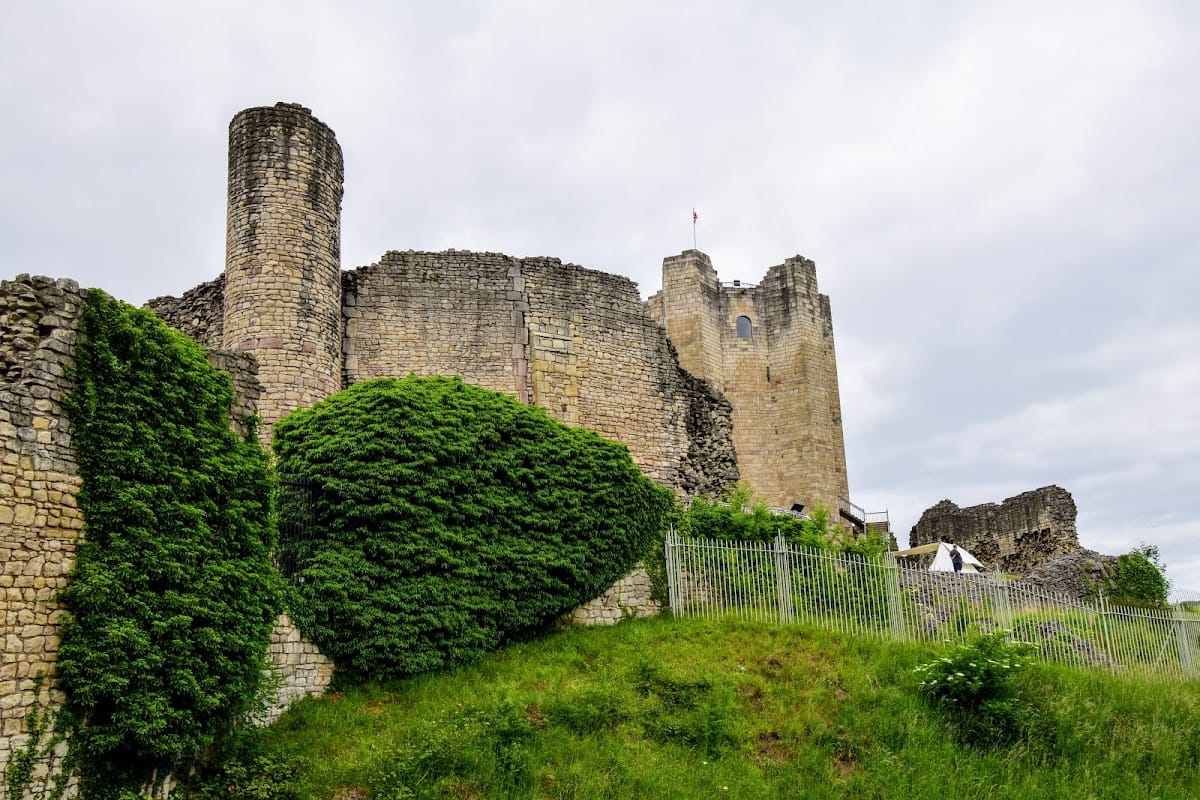
Encircling the inner bailey is a robust stone curtain wall dating to the early 13th century. Rising about 11 meters high and over two meters thick, it was built from roughly dressed magnesian limestone, with some sections later repaired using finely cut ashlar stone. It was reinforced by six mural towers mainly on the south and west sides; three remain in good condition. The north side’s defenses were strengthened with pilaster buttresses, projecting stone supports enhancing stability. The curtain wall and towers rest on shallow foundations with splayed bases to better distribute weight. A barbican, a fortified gateway with an extra corner turret, defended the approach from the drawbridge to the inner bailey’s main gatehouse. Collapsed curtain wall sections remain visible in the surrounding ditch.
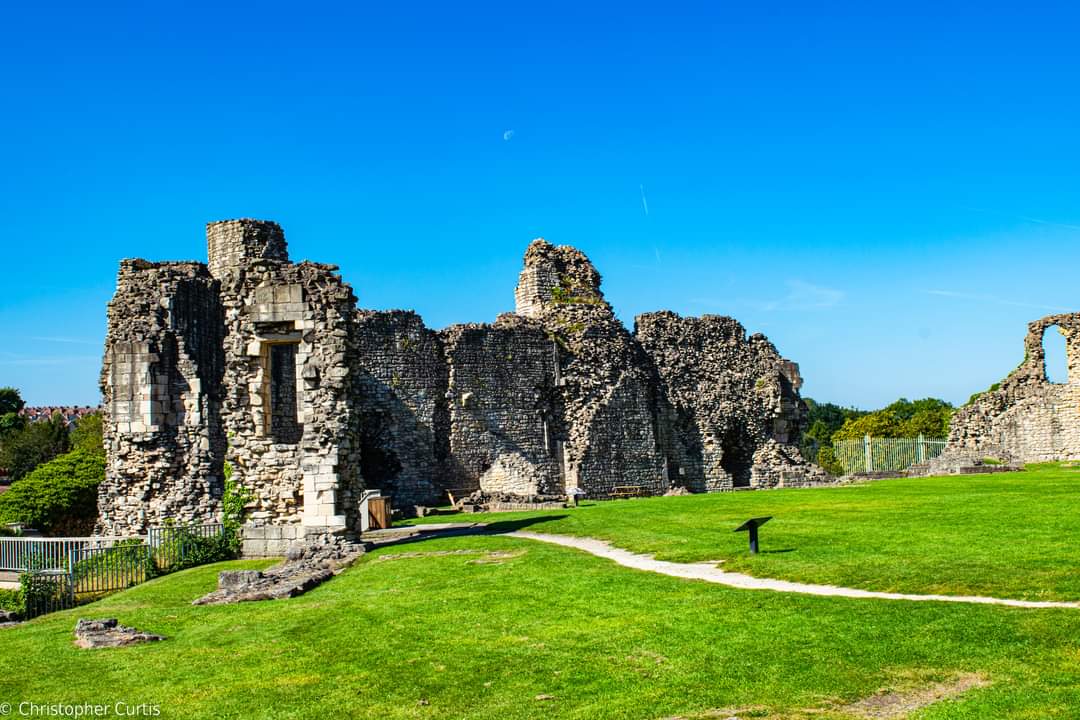
Within the inner bailey, buildings once stood constructed of similar rough limestone. In the southwest corner, a solar block contained private living quarters and adjacent chambers. Along the northern edge, a large hall about 21 by 7 meters stretched across the site. Likely two storeys, it originally featured a central hearth replaced by a fireplace in the late 13th century, reflecting heating changes. Nearby, a kitchen with cellar and pantry supported daily household activities. To the southeast, a chapel about 6 by 12 meters served religious functions. Today only foundations remain visible.
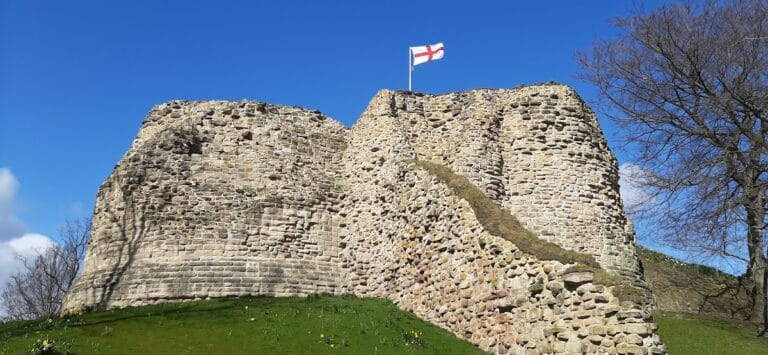
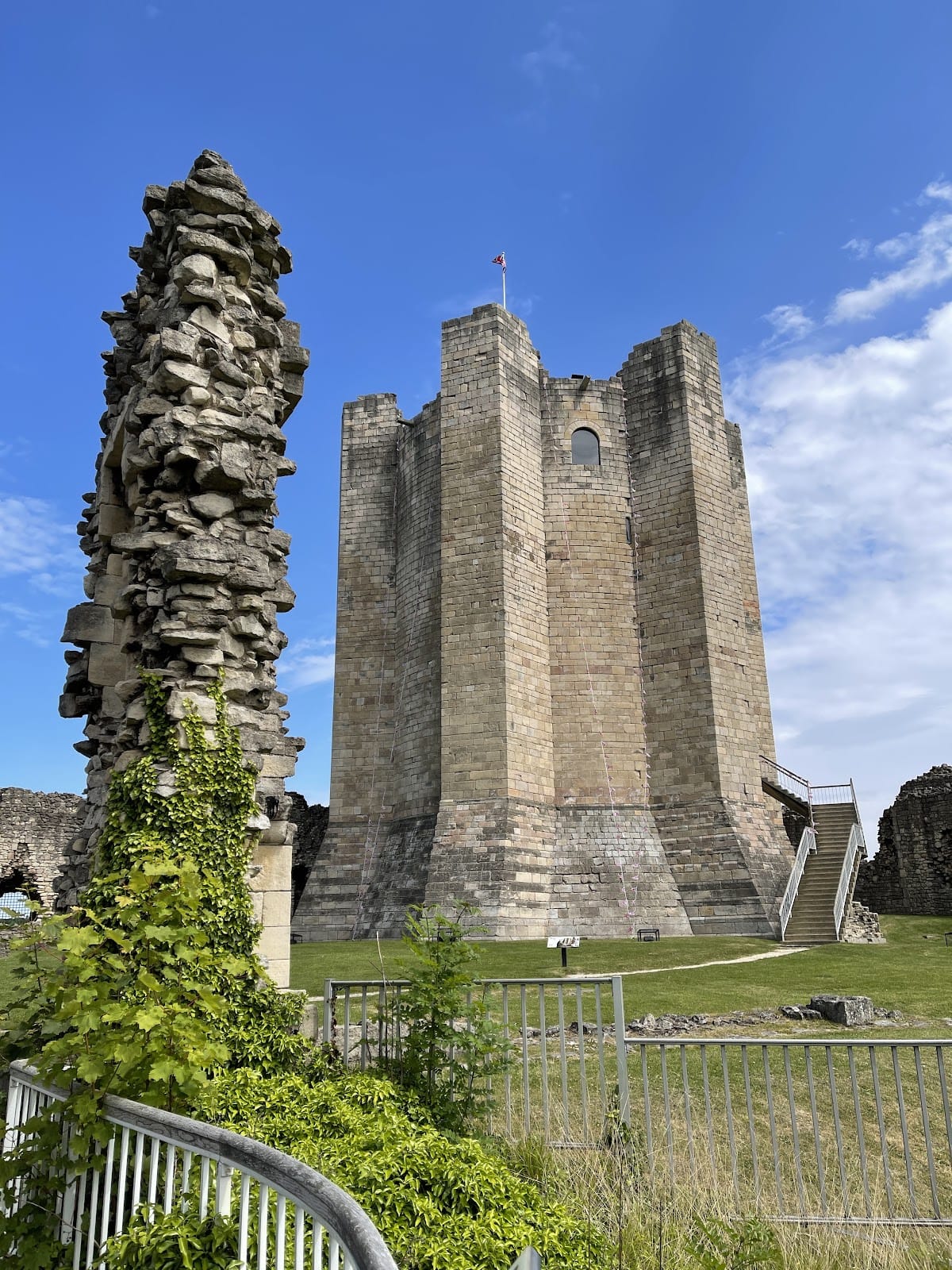
The castle’s most remarkable feature is its distinctive cylindrical keep, built of magnesian limestone on the northeast side of the inner bailey. This tower stands 28 meters tall with walls up to 4.6 meters thick, presenting a hexagonal shape formed by six massive solid buttresses extending from the circular core, each shaping a corner and giving the keep twelve edges. Inside, the keep has four floors. The vaulted ground floor functioned as a basement supporting chambers above. The main entrance was on the first floor, originally accessed by timber and stone stairs including a drawbridge before the door, likely for controlled access. The upper two floors contained principal living spaces, with the highest level providing a roof walk protected by battlements and likely sheltered by a pentice, a sloping roof over the battlements.
The keep was designed primarily for private use by Hamelin Plantagenet. The second and third floors served as main chamber and private lord’s chamber, with a vaulted hexagonal chapel cut into a buttress connected to the lord’s room. Large windows with deep recesses, about 56 by 142 centimeters, admitted light and included carved stone seats in embrasures. Fireplaces in the main chamber were advanced for their time, featuring decorative stone columns and carved capitals, indicating attention to comfort and status rather than military defense.
Despite its impressive appearance, the keep’s military effectiveness was limited. The many corners created by projecting buttresses formed structural weak points, and the absence of arrow slits prevented defenders from firing effectively. The castle’s natural position atop a magnesian limestone ridge, about 53 meters above the Don Valley, offered strong natural defenses through steep slopes.
Over time, the curtain wall and keep have undergone various repairs, including significant 19th-century work to protect the keep with roofing and flooring. Later conservation funded by the European Union focused on limiting damage to vulnerable stone. Today, sections of curtain wall remain standing alongside the prominently preserved keep, while inner bailey buildings survive only as foundation outlines. The outer bailey’s former drawbridge has been replaced by an earth causeway, and some curtain wall parts show collapse and subsidence from historic ground movement.
Nearby sites