Bedford Castle: A Medieval Fortress on the River Great Ouse


Site at a Glance
- Rating
- 4.2
- Popularity
- Low
- Country
- United Kingdom
- Primary era
- Medieval
- Eras represented
- Medieval, Early Modern
- Civilizations
- English, Norman
- Site type
- Military
- Remains
- Castle
On this page14 sections
History
Bedford Castle is a medieval fortress in Bedford, United Kingdom, built under the Norman monarchy after 1100 at the order of King Henry I. It stood within the town above the River Great Ouse and altered Bedford’s existing layout, requiring older Anglo-Saxon streets to be destroyed and diverted. The castle began as a relatively small earthwork fortress and later became the centre of a major royal siege during the civil wars of the twelfth and thirteenth centuries.
Foundation and the Beauchamps
The earliest castle was probably a motte-and-bailey, a raised earth mound with an enclosed area for buildings and defensive activity. Its first form consisted of the motte and an inner bailey. By the early twelfth century, the castle was held by the royal castellan Simon de Beauchamp, an officer responsible for administering and defending a castle on behalf of a king or lord. Simon’s father, Hugh de Beauchamp, had taken part in the Norman conquest of England in 1066.
Simon died in 1136 or 1137. King Stephen arranged for Simon’s daughter to marry Hugh the Pauper and intended that the castle should pass to Hugh. Simon’s nephews, Miles and Payn de Beauchamp, challenged this settlement and claimed Bedford Castle for Miles. The dispute soon became part of the wider conflict between rival royal factions.
The Anarchy
The Anarchy was the civil war between King Stephen and Empress Matilda, lasting broadly from 1139 to 1153 as both sides contested the English throne. Miles de Beauchamp initially supported Stephen, but Stephen tried to recover Bedford Castle before marching north against a Scottish invasion led by Matilda’s uncle, King David I. Miles received warning of the attack, gathered supplies for a prolonged siege, and resisted the royal assault.
Stephen left forces under Hugh de Beauchamp to starve the garrison into submission while he dealt with the Scottish threat. After five weeks, Henry of Blois, Bishop of Winchester, negotiated an agreement. The garrison surrendered and was allowed to depart peacefully, while the castle passed to the king. The Beauchamps apparently retained the surrounding estates. Miles returned in 1141 and regained the castle, although the manner of its recapture is unknown.
Miles later declared for Matilda. In 1146, Ranulf, Earl of Chester, captured the town of Bedford but failed to take the castle, which remained in Miles’s hands until his death several years later. Bedford was damaged in 1153 when Henry II passed through the town during the final year of the conflict. Whether the castle itself was besieged during that episode remains uncertain.
Falkes de Breauté and expansion
During the First Barons’ War, the rebellion of English barons against King John that began in 1215, rebel forces attacked Bedford Castle after failing to capture Northampton Castle. The fortress resisted, and the rebels continued south toward London. William de Beauchamp held Bedford at the time, but later rebelled against John. Falkes de Breauté, an Anglo-Norman leader loyal to the king, recaptured the castle in 1216.
John granted Falkes the Honour of Bedford and practical control of the castle, although it is unclear whether Falkes held the formal office of castellan or owned the fortress itself. He also controlled Plympton, Christchurch, and Carisbrooke castles. After John’s death in 1216, Falkes and other royalists helped establish the king’s young son, Henry III, in power.
Falkes made Bedford Castle his headquarters and greatly enlarged its defences. To create space for a new bailey, he demolished the neighbouring churches of St Paul and St Cuthbert and reused their stone in the castle. The expansion produced a much larger fortress with several defensive enclosures, a new keep on the motte, and additional ditches and walls.
The siege of 1224
The relationship between Falkes and Henry III deteriorated after Falkes’s castellan, Henry of Braybrooke, imprisoned a royal judge who was hearing legal cases against Falkes. When Falkes refused to release the judge, Henry III raised an army with the support of Stephen Langton, Archbishop of Canterbury. Falkes left about eighty men under his brother William de Breauté, who refused to surrender the castle. Langton excommunicated William, and the royal siege began.
The siege lasted eight weeks and drew equipment, materials, and labour from across England. Siege engines came from Lincoln, Northampton, and Oxfordshire, while others were built using timber from Northamptonshire. Ropes arrived from London, Cambridge, and Southampton, hides from Northampton, and tallow from London. Labourers were gathered from Bedfordshire and Northamptonshire, and miners came from Hereford and the Forest of Dean. Henry ordered 43,300 crossbow bolts, while local timber and stone supplied further ammunition. The royal wage bill reached £1,311, and the army may have numbered between 1,600 and 2,700 men at different times.
Langton supported the campaign by ordering bishops to provide one man for every 24 hectares of land they held and by imposing a special tax on church estates. The royal forces suffered heavy losses. Ralph of Coggeshall stated that seven knights and more than 200 soldiers and labourers were killed.
Bedford Castle fell through four successive attacks. Royal troops first captured the barbican, the outer defensive structure protecting an entrance, and then took the outer bailey. Miners working beneath the protection of a covered siege structure called a “cat” collapsed part of the inner wall. On 14 August, they lit a fire beneath the keep’s walls. The heat cracked the stone and filled the building with smoke. The women of the household, including Falkes’s wife, and Henry of Braybrooke were released. The royal standard was raised over the tower, and William de Breauté and the remaining garrison surrendered the following day.
Henry III ordered the male members of the garrison to be hanged, except for three knights who agreed to join the Knights Templar, a medieval military religious order associated with the defence of territories connected with the Crusades. Three days after the castle fell, Pope Honorius III demanded that Henry stop his campaign against Falkes, but the intervention came too late. Alexander de Stavenby, Bishop of Coventry, persuaded Falkes to surrender. Falkes handed over his remaining castles at Plympton and Storgursey, received absolution from Langton, and soon went into exile.
The prolonged resistance of Bedford Castle was later regarded as an example of a garrison holding out against the concentrated military resources of the kingdom. Its fall also represented a major victory for central government over powerful local barons.
Dismantling and later history
After the siege, Henry III ordered the castle to be dismantled. Its ditches were filled, and the stone walls were reduced to half their height. William de Beauchamp was forbidden to rebuild the fortress and instead constructed an unfortified house in the inner bailey. Stone from the castle was used to rebuild St Paul’s and St Cuthbert’s churches in 1224 and to repave streets in Bedford. Local tradition also associates castle stone with the first stone bridge in Bedford, known as the Great Bridge.
The site appears to have remained derelict for much of the medieval period. In 1361 it was described as an empty plot enclosed by old walls. John Leland wrote in the sixteenth century that the castle had been completely demolished, while John Speed’s map of 1611 showed the motte and fragments of bailey wall on an otherwise vacant site.
Bedford supported Parliament during the English Civil War. Prince Rupert of the Rhine temporarily captured the town in 1643, after which the castle remains were partly refortified for the conflict. A probable wooden fort and prison were built on the motte and defended by a garrison of 100 men. After the war, the motte became a bowling green and retained that use until the nineteenth century. In 1804, the north-east tower was converted into a hexagonal building for the local militia. Bedford’s eastward expansion later placed pressure on the castle’s baileys, and in 1851 the remaining barbican was destroyed to make way for cottages.
Bedford Castle is protected as a Scheduled Monument. Archaeological work between 1969 and 1973 established the broad form of the fortress, with further investigations in 1995 and 1996 and again in 2007. An archaeological park was created on part of the site between 2007 and 2009. It incorporates surviving remains within a mixed-use development containing restaurants and apartments. In 2004, Bedford Borough Council commissioned artist Gary Drostle to create a mosaic map of Bedford, including the castle and the town’s medieval history, in front of the castle mound.
Remains
Bedford Castle stood within the town above the River Great Ouse. Its early earthwork form was later expanded into an approximately quadrangular fortress with a barbican, outer bailey, and inner bailey. The western boundary followed the rear of modern High Street, while the northern boundary followed the lines of modern Ram Yard and Castle Lane. The inner bailey occupied the south-east corner and was protected by an internal ditch and a stone-lined palisade. Further stone-lined ditches enclosed the wider castle.
Earthworks and defensive enclosures
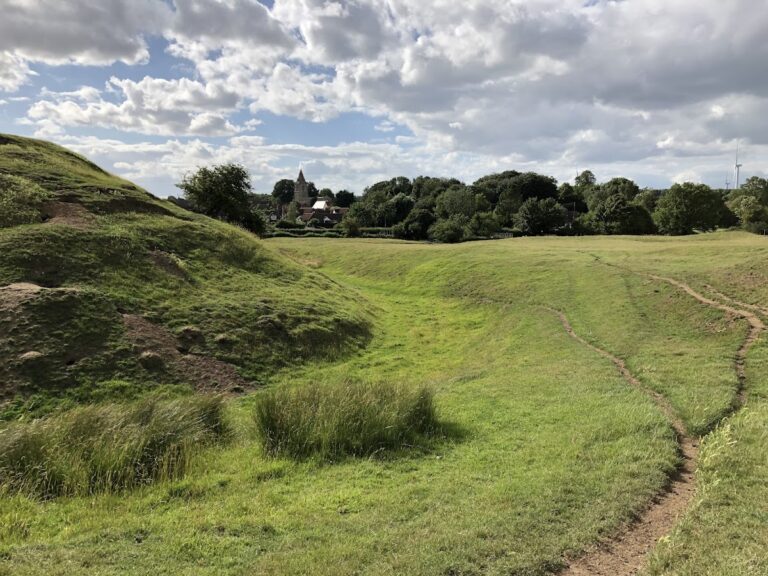
The motte and keep
Only the lower part of the motte survives. It is approximately 7.5 metres high and 49 metres in diameter at the top. The early castle’s earthworks were described as a massive bank and ditch, accompanied by a high, strong wall and a strong keep. Falkes’s rebuilding placed a new keep on the motte. It may have occupied the entire upper surface and perhaps formed a shell keep, a fortified enclosure around the top of a motte, combined with a tower. Its precise design remains uncertain.
Walls, ditches, and entrances
The expanded fortress used stone-lined palisades and ditches, an unusual arrangement in England. The nearest comparable example identified is at Skenfrith Castle in Wales. A barbican protected the entrance, while a postern watergate, a smaller secondary doorway, led toward the river. A large stone gatehouse may have stood in the outer-bailey wall, and a mound in the north-east corner probably supported a large tower.
Inner bailey buildings
The great hall
A great hall stood in the centre of the inner bailey and measured at least 13 by 40 metres. Its foundations were discovered through archaeological investigation and are incorporated into the archaeological park. The hall formed part of the domestic and administrative core created during the castle’s expansion.
The lime kiln
One of the castle’s lime kilns survives within the archaeological park. It was rediscovered in 1973 and provides physical evidence of construction activity at the site. The kiln is presented alongside the foundations of the hall and the surviving motte.
Evidence of the 1224 assault
The arrangement of the 1224 siege can be related to the castle’s defensive sides. A probable trebuchet and two mangonels were positioned east of the fortress, while two mangonels attacked the keep from the west. One mangonel stood on each of the northern and southern sides, and two temporary siege castles allowed the besieging forces to observe the defenders. Medieval terms for siege engines were inconsistent, so the precise type of some machines remains uncertain.
The final assault reshaped the surviving fortress. The barbican and outer bailey were captured first, followed by the partial collapse of the inner wall through mining. Fire beneath the keep’s walls cracked the stone and filled the stronghold with smoke. After the surrender, the ditches were filled and the walls reduced in height. Later military, recreational, residential, and urban uses further altered the remaining fabric, while the motte and excavated foundations preserve the principal visible and archaeological evidence of the castle.
Nearby sites