Castle of Guiglia: A Medieval Fortress and Noble Residence in Italy

Visitor Information
Google Rating: 4.2
Popularity: Low
Google Maps: View on Google Maps
Official Website: www.castellodiguiglia.it
Country: Italy
Civilization: Medieval European
Remains: Military

History
The Complex of the Castle of Guiglia is located in the municipality of Guiglia, Italy. It was originally constructed by medieval communities during the early Middle Ages to defend the territory from external threats.
The earliest origins of the fortress date back to the late 9th or early 10th century, when it was built as a defensive stronghold against Hungarian invasions. The nearby settlement of Guiglia is documented as early as 890 AD in a parchment from the Abbey of Nonantola, indicating the area’s connection to the lands administered by the noblewoman Matilda of Canossa. This early setting established the site as an important military and territorial foothold in the region.
During the first half of the 14th century, the castle became involved in the territorial struggles between the cities of Modena and Bologna. In 1326, it was captured by papal forces led by Versuzio Lando, bringing it under the control of the Este family. The castle was then granted as a fief to Taddeolo da Guiglia. Following his death, disputes over succession allowed Giacomo dell’Abbazia to take control. Dell’Abbazia allied with the Visconti rulers of Milan, enemies of the Este, further entangling the fortress in regional power conflicts.
On June 16, 1361, the castle suffered devastating damage from a major fire, possibly set as retaliation during ongoing hostilities. Reconstruction began the following year and persisted for around forty years. During this time, an oratory was founded near the castle and eventually entrusted to the Carmelite Fathers. Their presence led to the establishment of the Madonna del Carmine church and an adjoining convent, earning the complex the nickname “Conventino.”
After the Este family regained control in 1405, they granted the castle as a fief to the Pio family from Carpi, who held it until 1510. The following decades were marked by contests between the Tanari and Montecuccoli families. The fief was elevated to a marquisate in 1596 and passed through various noble lineages, including Ferrante Estense Tassoni and later Ugo Pepoli.
In 1621, Francesco Montecuccoli, married to Sigismonda Laderchi, acquired the fief and undertook significant renovations to transform the castle from a military fortress into a noble residence. Despite these improvements, the castle suffered damage from papal troops in 1643 and was affected by a strong earthquake in 1624, which caused partial collapses.
The Carmelite convent was suppressed in 1768 by order of Duke Francesco III d’Este, forcing the monks to leave. The Carmelite properties near the castle were subsequently acquired by Marquis Giuseppe Montecuccoli-Laderchi. The Este family maintained control of Guiglia until the abolition of feudal privileges in 1796 during the French Revolutionary era, when the territory was incorporated into the Department of the Reno.
In the late 19th century, the castle changed hands and was purchased by Swiss engineer Giovanni Beusch. He converted the complex into a hydro-electro-therapeutic spa hotel, capitalizing on an iron-rich spring found on the property. This hotel ceased operations before the outbreak of the Second World War.
During World War II, the castle served a military purpose, functioning as both a hospital and a storage site for precious artworks from the Galleria Estense. On April 15, 1945, shortly before the liberation, it was damaged by Allied bombing. After the war, local authorities repurposed parts of the complex for exhibitions and other functions. For a brief period in 1946, two large ground-floor halls housed a casino, which was later closed due to new national regulations.
Remains
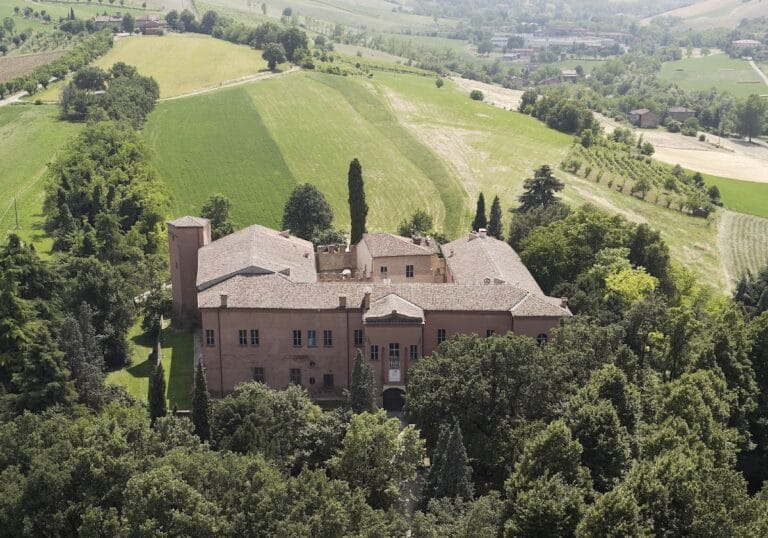
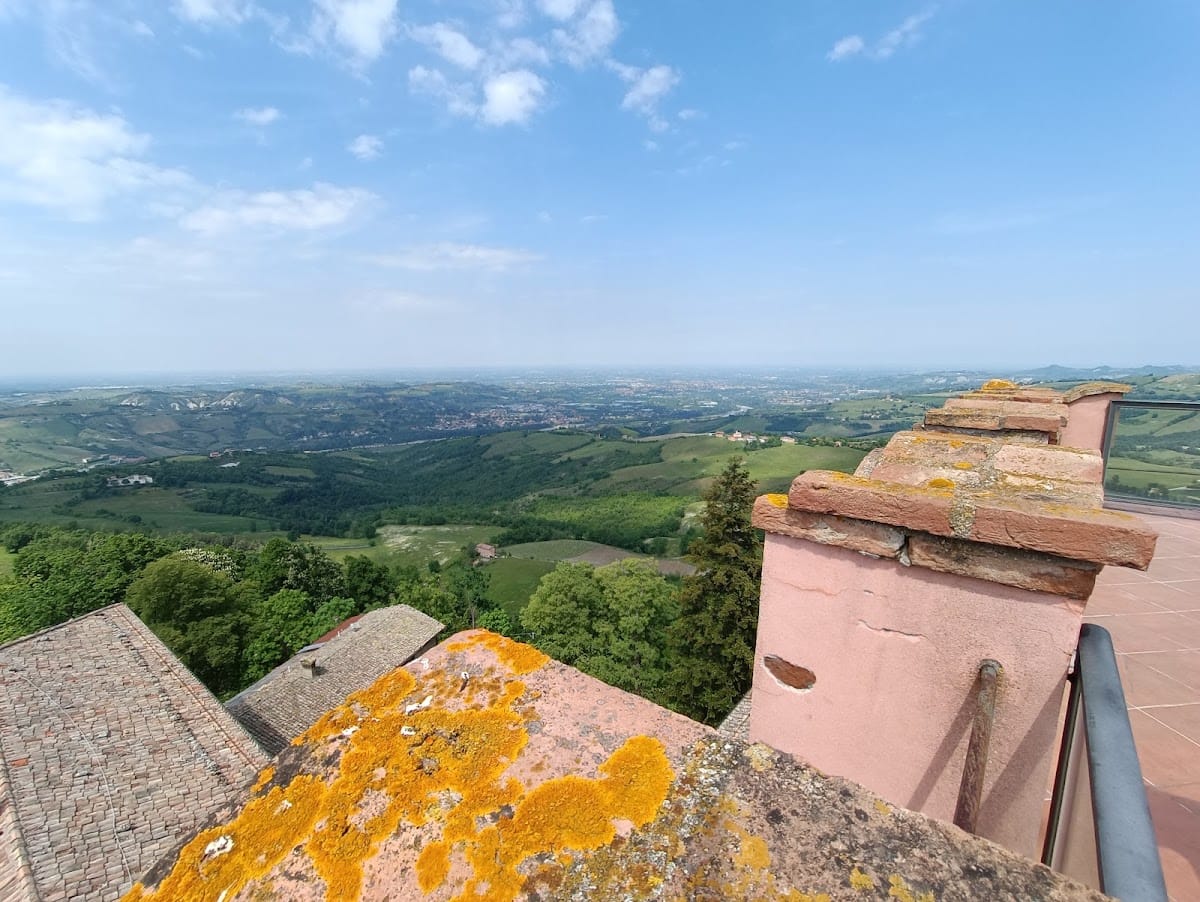
The castle complex is situated on a hill overlooking the town of Guiglia and the valley of the Panaro river. This strategic position provided both military advantage and commanding views of the surrounding countryside. The structure occupies a prominent location near Vignola, about 35 kilometers from Modena, accessible by the road connecting those towns.
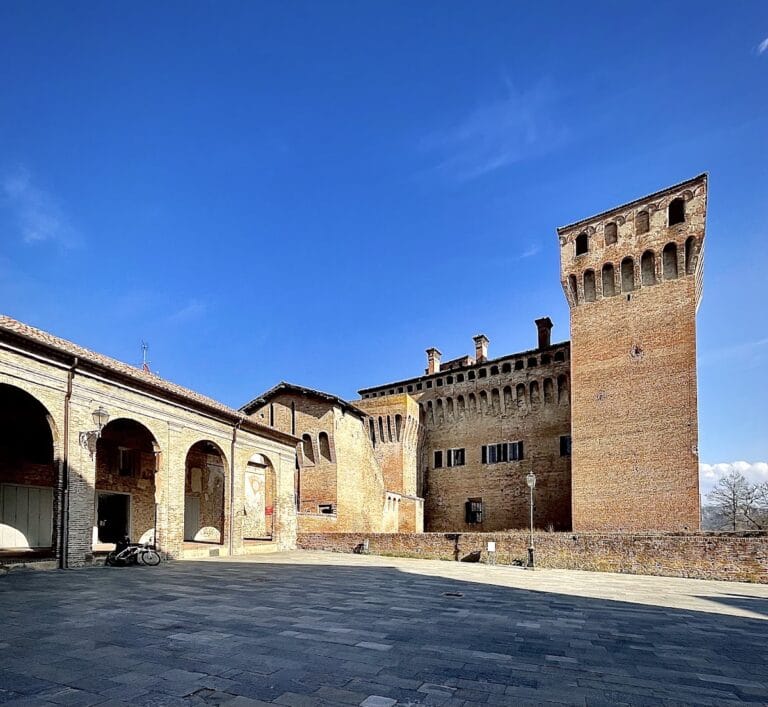
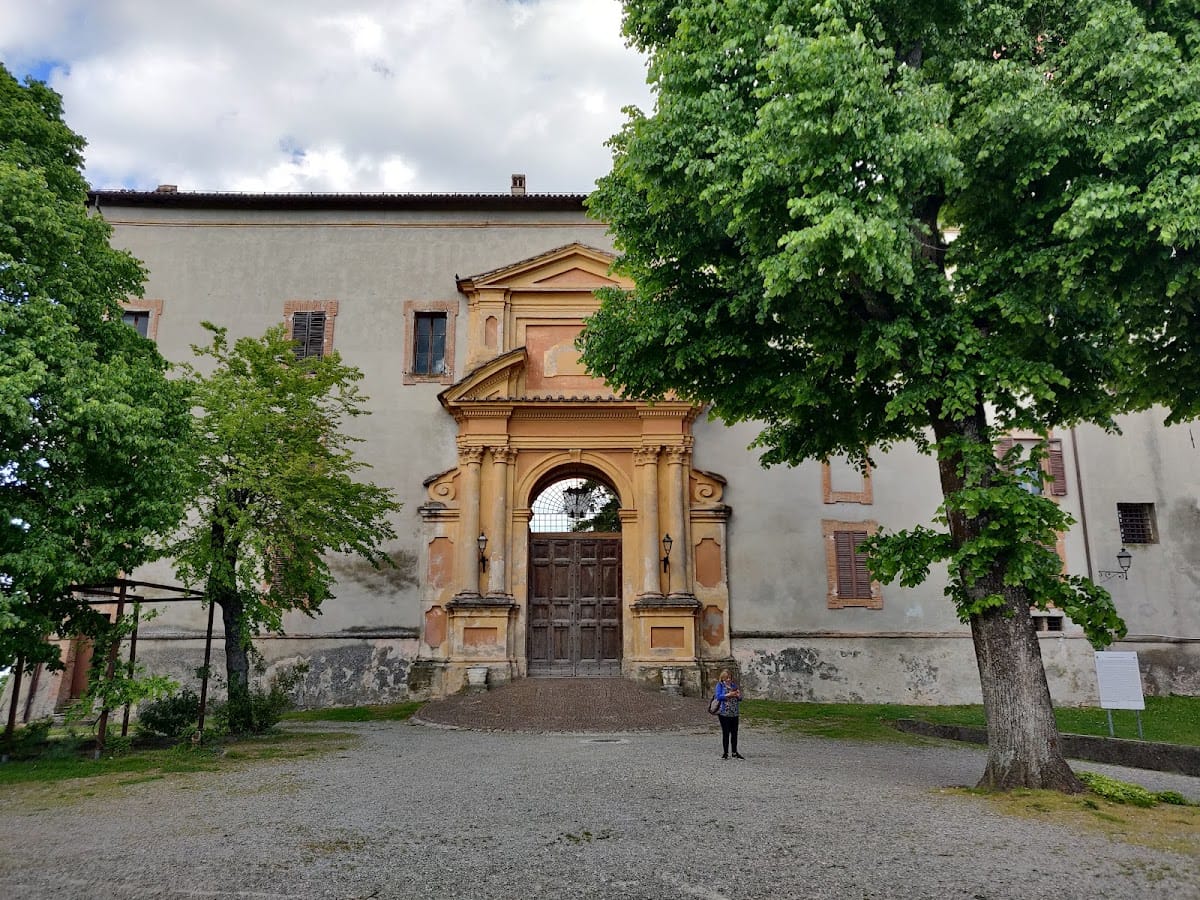
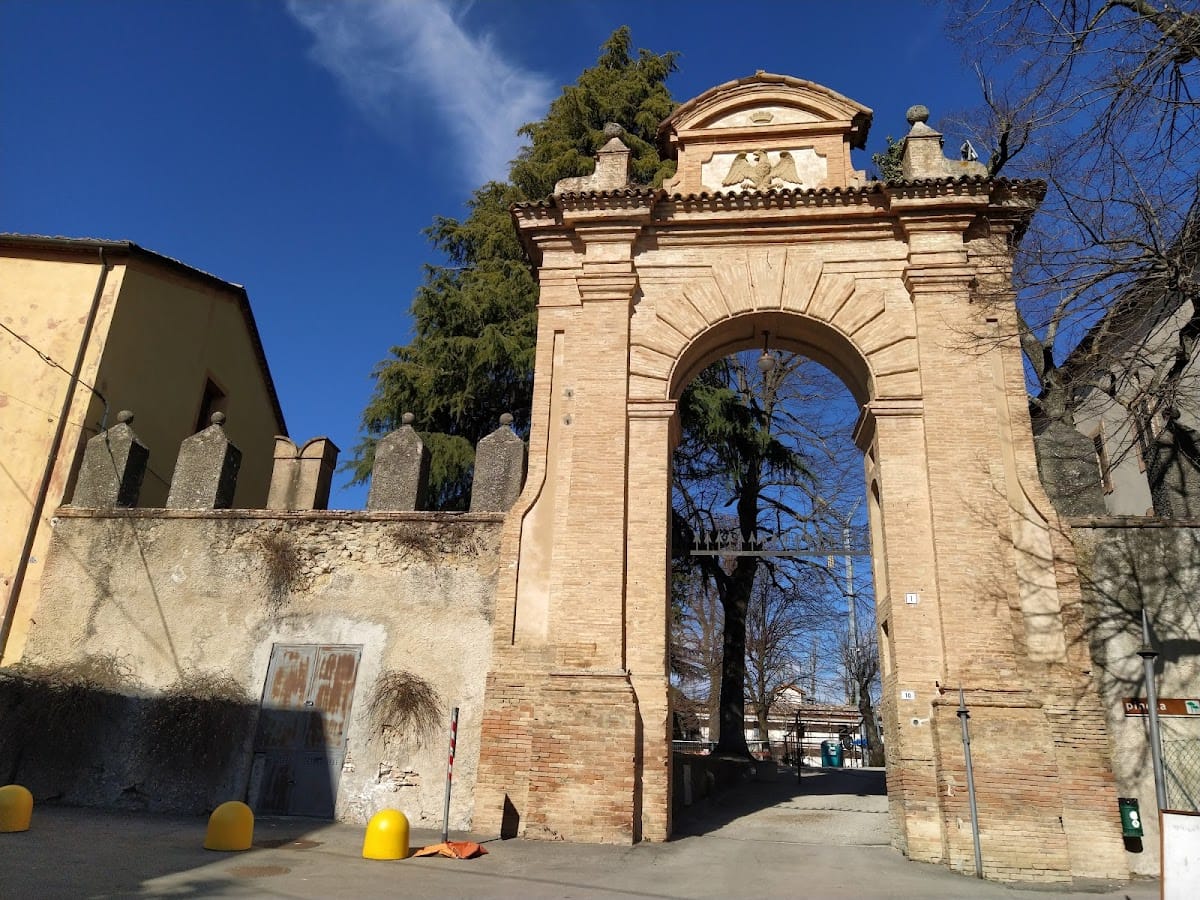
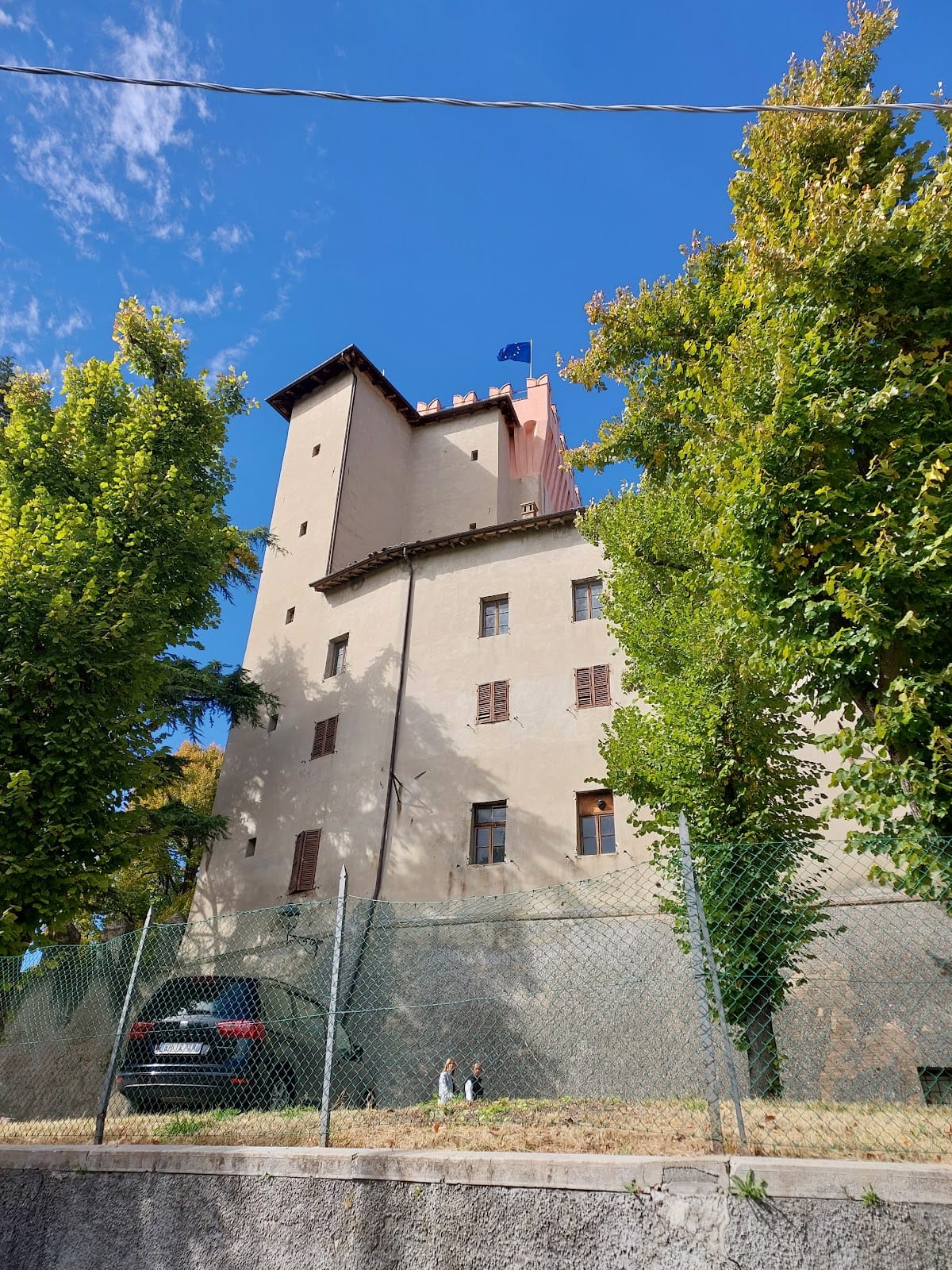
The original medieval fortress underwent numerous changes following periods of damage by fire and earthquake, notably during events in 1571 and 1624 that led to the collapse of walls and turrets. Around 1630, Marquis Francesco Montecuccoli extensively remodeled the castle, shifting its design from a fortress into an elegant noble residence. This transformation involved the removal of defensive features such as the drawbridge and east gate, and the expansion of the residential quarters. A new main entrance was created, distinguished by a tall portal with a triangular decorative element, or tympanum, supported by columns.
Passing through this grand entrance leads to a loggia adorned with elaborate stucco decorations. Inside, rooms were richly furnished and embellished with stucco and scagliola—a technique that imitates marble using plaster mixed with pigments. Frescoes by the painter Francesco Vellani (1688–1768) further decorate these interior spaces, adding artistic refinement to the residence. Most of the original defensive walls have vanished, except for one crenellated tower dating to the 15th century. This turret was incorporated into the residential structure during the 17th-century renovations.
Courtyard access is gained through a portal decorated with terracotta elements, which enhance the visual impression of the entrance. Within the castle walls stand the remnants of the Carmelite convent established in the 14th century, along with the adjacent church dedicated to Madonna del Carmine. These religious buildings contribute to the complex’s historical identity known as the “Conventino.”
In the square before the castle, occupying the former site of the Carmelite church, Marquis Giuseppe Montecuccoli-Laderchi commissioned a theater in 1745. This venue became a cultural hub, hosting theatrical performances and other public events.
Not far from the castle, concealed within a pine grove, is the Oratorio della Madonnina. Built between 1690 and 1715, this small chapel replicates in miniature the Sanctuary of San Luca in Bologna. The oratory contains a single altar placed in a central niche and side rooms formerly used for storage and as a sacristy. A dome topped by a circular lantern crowns the structure. It also serves as the burial place for members of the Montecuccoli-Laderchi family, whose tombs, numbering three, rest inside alongside numerous votive tablets left by visitors.
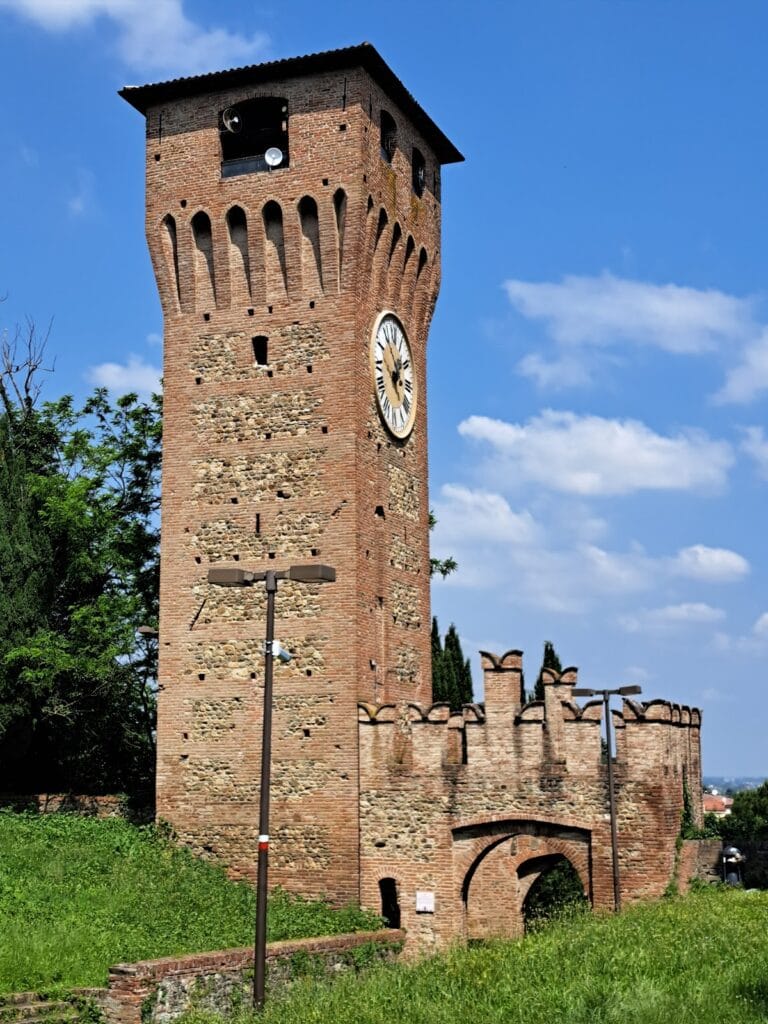
Outside the castle walls, opposite one of the castle entrances, stands the Torre dell’Orologio, or Clock Tower, dating to 1535. This tower has a square footprint and is marked by a terracotta basket-arch portal. A belfry crowning the tower houses a bell from the 17th century.
The former primary entrance to the castle, known as the Torre del Pubblico, features a square base and is distinguished by its terracotta portal. Historical accounts suggest this tower also served as a local assembly point called the “Casella,” reflecting its communal significance within the town’s governance.
Together, these elements form a layered ensemble reflecting the castle’s continuous adaptation from a defensive medieval fortress to a noble residence interwoven with religious and civic structures.
Nearby sites