Château d’Aguilar: A Medieval Fortress in Southern France


Visitor Information
Google Rating: 4.3
Popularity: Low
Google Maps: View on Google Maps
Country: France
Civilization: Unclassified
Remains: Military

History
Château d’Aguilar is a medieval fortress situated near the village of Tuchan in southern France. Built by the local feudal lords of the Termes family in the 12th century, its history reflects the turbulent political and military struggles of the region during the Middle Ages.
The site originally belonged to the County of Carcassonne in the early 11th century. Around 1010, control passed to the Count of Besalù, who in 1021 described Aguilar as a hill marking the boundary between the counties of Narbonne and Roussillon. The castle itself is first explicitly mentioned over two centuries later, in 1240. Following his loss of his main stronghold in 1228, Olivier de Termes made Aguilar his primary residence. It was likely under his direction that the core castle and a fortified village to its south were constructed.
In the mid-13th century, Château d’Aguilar became entwined in wider regional conflicts. During the Trencavel uprising against royal authority in 1240, the castle served as a gathering point for rebel knights. After the revolt collapsed, Olivier submitted to King Louis IX and surrendered Aguilar in 1241, placing it under royal control. However, in recognition of Olivier’s service during the Crusades, Saint Louis returned the castle to him around 1251. Olivier sold it back to the crown in 1262, after which it became a royal fortress. From this time until the 17th century, Aguilar guarded France’s frontier against neighboring Spanish kingdoms.
To strengthen its defenses, the castle underwent major expansions between the mid-13th and early 14th centuries. A second, outer enceinte (defensive wall) incorporating advanced military features was added, in part over the space once occupied by the fortified village. Despite these improvements, the fortress faced attacks throughout its history. In 1387, 300 mercenaries seized the castle by night, though they were later repelled by Aragonese troops. The 16th century brought further conflict: Spanish forces under Emperor Charles V captured it in 1525, and it endured another assault and brief occupation by German mercenaries in 1542 before returning to French hands in 1544.
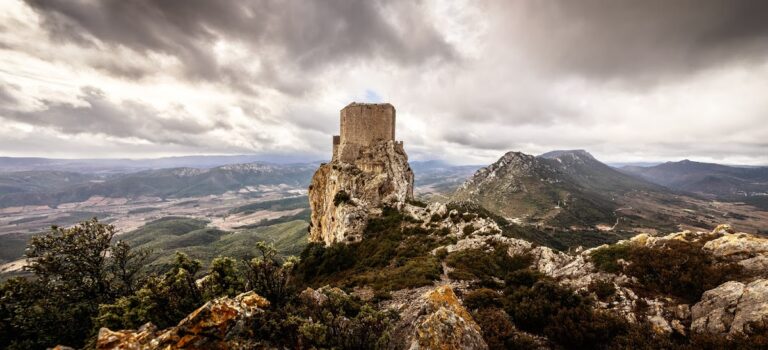
Château d’Aguilar continued to serve as a garrison until the Treaty of the Pyrenees in 1659, which redefined the border and rendered the fortress obsolete. Afterward, it fell into ruin. Since the mid-20th century, the castle has been officially recognized for its historical value, with protective designations covering its ruins and surrounding natural site. It is also known as one of the “Five Sons of Carcassonne,” a group of castles on high rocky outcrops famed for their defensive strength.
Remains
Château d’Aguilar occupies a rocky hill rising 96 meters above the surrounding plain, providing a commanding view over the Corbières massif and key routes between Narbonne and Roussillon. The fortress is made up of two distinct fortified enclosures, separated by a bailey, or open courtyard, known as a lice.
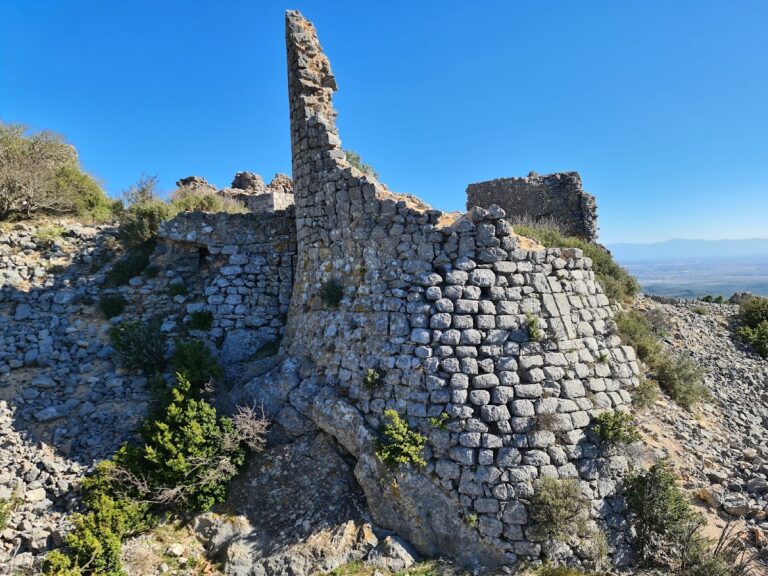
The inner enclosure retains the oldest elements dating to the 12th century, corresponding to the original feudal castle built by the Termes lords. Inside lies a residential structure known as the corps de logis, which was supplemented by a cistern to collect water. Later, a rectangular tower was added adjacent to this section, reflecting continued development. Construction here employed roughly hewn stones characteristic of the early medieval period.
Surrounding this core is a larger, pentagonal outer enceinte constructed between the mid-13th and early 14th centuries by royal engineers. This outer wall features six semi-circular towers, each pierced with narrow vertical openings called arrow slits, designed to allow defenders armed with bows and crossbows to fire while remaining protected. This enceinte was oriented strategically to defend the most vulnerable approach to the castle. The masonry here reveals a more advanced technique, with carefully cut and smoothly finished stones laid in even horizontal layers. Within the walls, rubble infill was used to strengthen the structure.
Of particular note, Château d’Aguilar lacks a central keep or donjon, which is uncommon for castles of its era. The entrance was guarded by a barbican, a fortified gateway, adding an extra layer of defense on the southern slope. Nearby stands the small Romanesque chapel of Sainte-Anne, once associated with the castle community. This chapel remains largely intact and is one of the site’s enduring features.
Additional remnants include fragments of the enceinte that once enclosed the now-vanished fortified village to the south of the castle. Underground vaulted spaces constructed with robust barrel vaults survive, reflecting the need for secure, weatherproof storage or shelter. Archaeological evidence found during excavations in the 13th century revealed religious ornaments alongside military armaments including several crossbows, hundreds of bolts, iron helmets, and shields, illustrating the dual spiritual and martial character of the site.
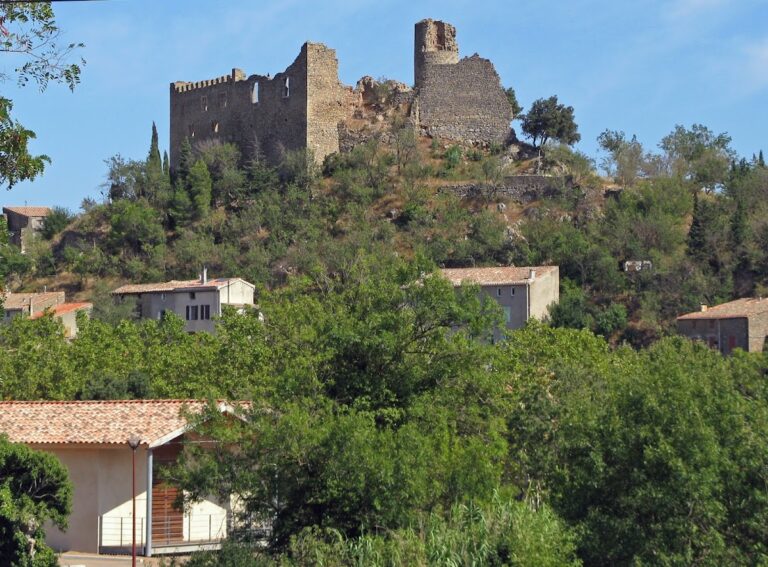
Today, the ruins consist of substantial sections of walls and towers, the chapel, and various other structural elements, all preserved under recent heritage protections. These features collectively demonstrate the castle’s historical evolution and strategic significance along the French-Spanish frontier.
Nearby sites