Château du Falkenstein: A Medieval Semi-Troglodyte Fortress in France


Site at a Glance
- Rating
- 4.8
- Popularity
- Low
- Country
- France
- Primary era
- Medieval
- Eras represented
- Medieval, Early Modern
- Civilizations
- Holy Roman Empire
- Site type
- Military
- Remains
- Castle
On this page13 sections
History
Château du Falkenstein is a medieval semi-troglodyte fortress in France, near Philippsbourg in the Northern Vosges. Built in the twelfth century, it was the seat of a county and an immediate fief of the Holy Roman Empire, meaning that it was held directly from the emperor rather than through another territorial lord. The castle protected possessions in the Holy Forest of Haguenau and stood within the Palatinate of the Rhine.
Foundation and early lordship
Count Peter of Lützelburg built the castle, which is first mentioned in 1127. Its position served both to secure his lands and to resist the westward expansion of the Hohenstaufen, a powerful medieval German ruling dynasty that included Emperor Frederick Barbarossa.
After Peter’s son Renaud died without an heir in 1150, control of Falkenstein became the subject of an inheritance dispute. The castle was divided between Folmar of Sarrewerden and the Hohenstaufen family. Frederick Barbarossa intervened in the dispute in 1143 and granted the castle to Count Volmar of Sarrewerden.
Co-ownership and division of the castle
Jacob of Falkenstein appears in the historical record in 1205, when he witnessed a charter at Haguenau. In 1316, Gottfried, Conrad, Heinrich, and Jacob of Falkenstein swore peace with Strasbourg. A later castle peace, agreed in 1335, regulated the rights of the co-owners and divided the fortress into three shares separated by transverse walls.
The Sarrewerden share was held by Jean of Finstingen from 1419. In 1474, the Falkenstein co-heirs agreed that no share could be transferred without the consent of the other shareholders. Disputes over this arrangement continued in 1482 and 1483. In 1483, the Count Palatine received rights to open the castle, and the conflict was settled in 1487, when Wilhelm of Falkenstein established a new chapel at the fortress.
Late medieval transformation
The castle passed to the counts of Zweibrücken-Bitsch in 1479 and came into the sole possession of the Falkensteins in 1515. Balthasar of Falkenstein began a programme of modernization, which his sons continued. During the fifteenth and sixteenth centuries, the fortress was adapted for firearms, while Renaissance buildings were erected within the medieval stronghold.
In 1564, Philipp IV, Count of Hanau-Lichtenberg, purchased Falkenstein from Balthasar’s children and grandchildren. Several months later, lightning caused a major fire that destroyed the castle. It was never rebuilt. Part of the ruins remained inhabited by a Hanau-Lichtenberg forester from 1570, and the site thereafter served only as a forester’s post.
War, destruction, and the end of territorial power
A conflict between Hanau-Lichtenberg and the Duchy of Lorraine lasted from 1570 to 1605. The settlement reached in 1606 returned the castle to Hanau-Lichtenberg, although the German emperor invested Duke Henri II of Lorraine with the Falkenstein fief in 1609.
The Falkenstein county and its dependencies were retained when Lorraine was ceded to France in 1736 and under the definitive treaty of 1738. The county included Philippsbourg and Baerenthal, both of which were incorporated into France in 1794.
During the Thirty Years’ War, the major European conflict fought principally from 1618 to 1648, Mansfeld’s troops plundered and damaged the castle in 1623. The foresters could no longer live there. French troops under Montclar carried out the final destruction between 1676 and 1677.
The title “Count of Falkenstein” continued as an honorary title in the House of Lorraine, even though it no longer represented territorial possession. François III of Lorraine still used the title before becoming emperor.
Preservation of the ruins
The ruins became state property and were classified as a French historic monument in 1930. Storm damage led to a prohibition on access from 1999, after which general safety and restoration works continued through 2013. The castle reopened to the public that year. In 1981, the Vosges Club of Strasbourg installed an orientation marker at the summit showing the elevation and directions to nearby features.
Remains
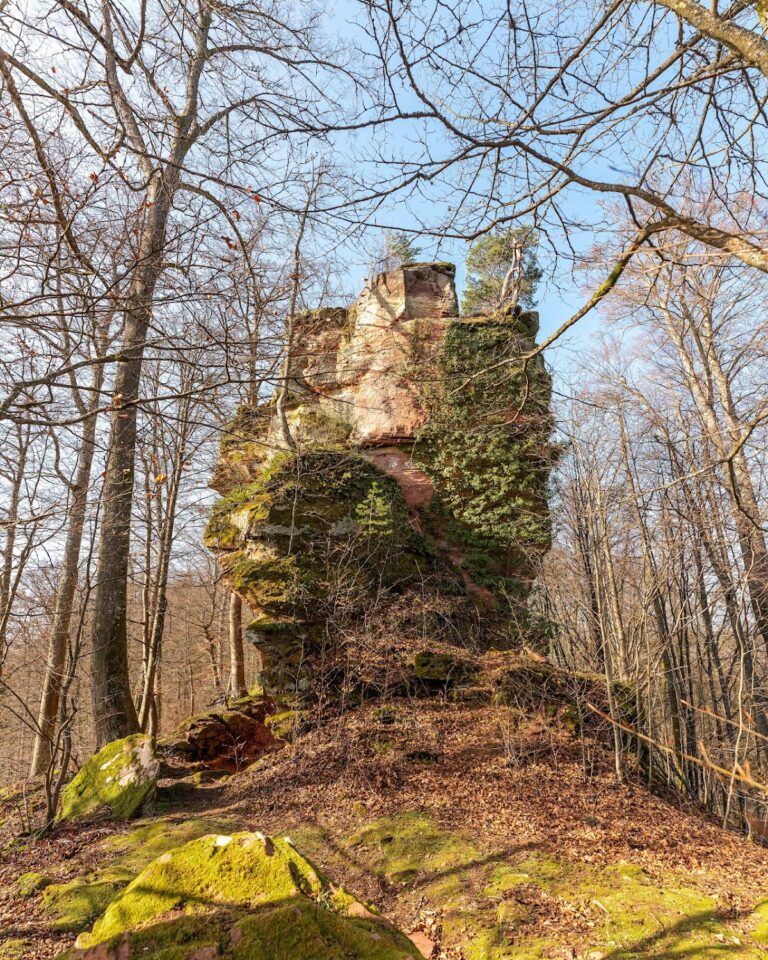
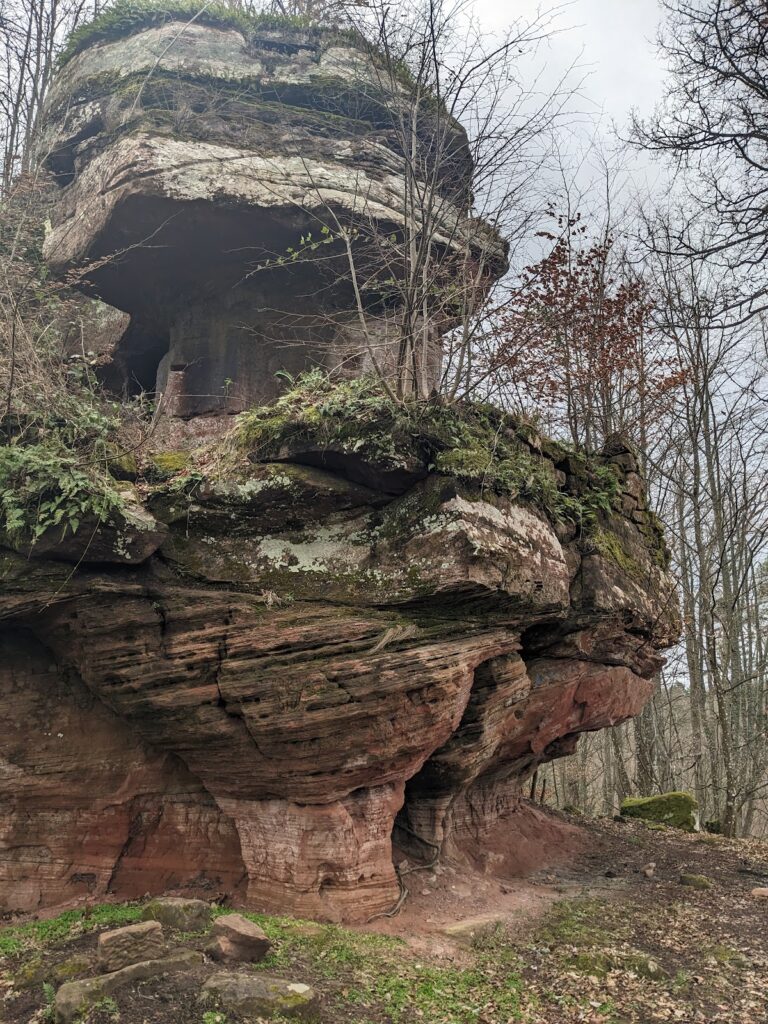
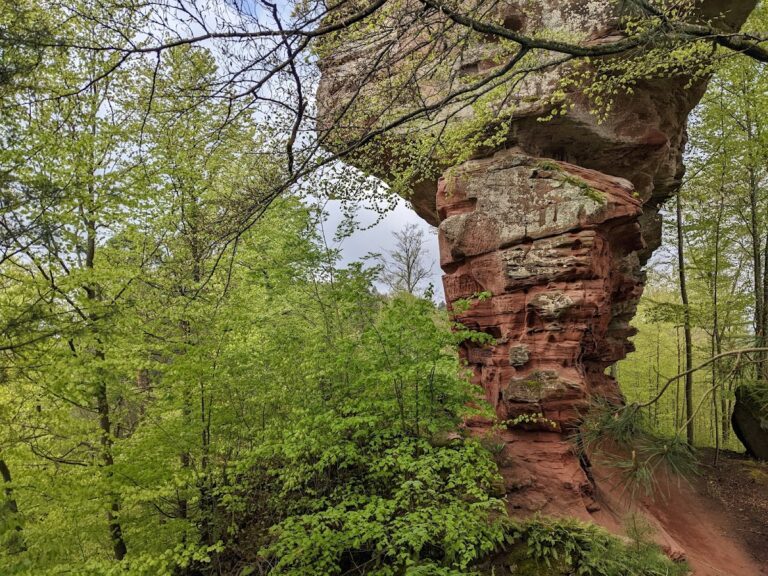
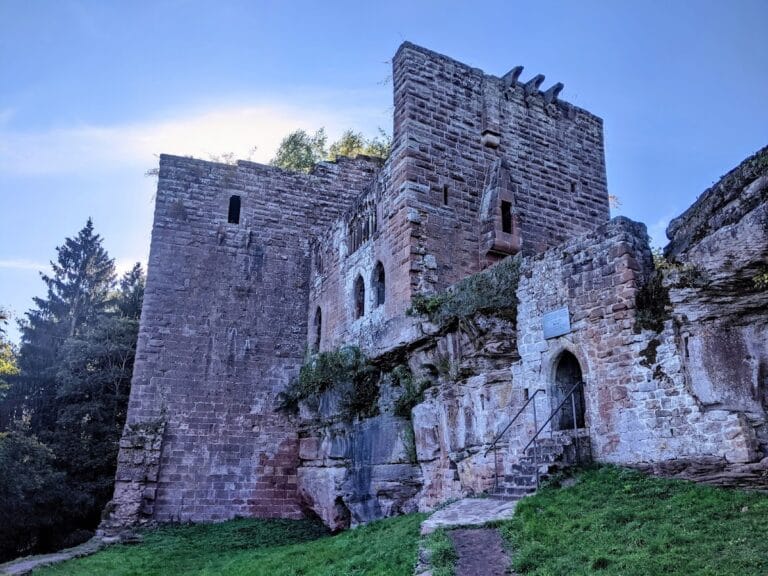
Château du Falkenstein occupies a sandstone rock formation about 120 metres long, approximately 22 metres high, and between three and eight metres wide. At an elevation of 386 metres, the rock rises above the Zinsel valley, which the semi-troglodyte fortress dominates. The surviving complex combines masonry defensive works with rooms cut directly into the sandstone. Wind and bad weather have shaped and weathered the stone, while the ruin was partially restored during the twentieth century.
Defensive structures and internal divisions
The earliest castle was built in the twelfth century. A walled tower at the northern end of the upper castle dates from approximately 1220 to 1230, and towers along the western side were also built during the thirteenth century. In the fourteenth century, a section ditch and a new outer wall divided the upper surface of the rock. This work created a second forecourt and a second entrance.
Entrance and keep
The entrance gateway and the ruins of the keep form part of the principal surviving defensive complex. The fortress also retains cave rooms cut into the rock, linking its masonry structures with the semi-troglodyte character of the site.
Well tower
The well tower protected the well, defended the approaches, and provided living accommodation on its upper level. Its functions combined water security, defence, and domestic use within the restricted space of the rocky stronghold.
Residential and water installations
The sixteenth-century inhabited complex preserves the remains of a hoist installation used to raise construction materials to the required height. This feature belongs to the period when the fortress was being modernized and Renaissance buildings were added inside it.
Hand-washing basin
At the top of the fifteenth-century residential tower is a hand-washing basin. A reservoir or fountain set in a niche above the sink supplied the installation. Water flowed through the mouth of a decorative human mask with an apotropaic function, intended to ward off harmful supernatural influences. Two coats of arms frame the mask.
Rock-cut access and summit
A path to the summit was cut directly into the rock. The summit contains the ruins and an orientation table. About 100 metres away, at the eastern end of the mountain, stand the ruins of Château du Helfenstein.