Château de Quéribus: A Fortified Castle in France


Site at a Glance
- Rating
- 4.6
- Popularity
- Medium
- Country
- France
- Primary era
- Medieval
- External website
- Open
- Eras represented
- Medieval
- Civilizations
- French
- Site type
- Military
- Remains
- Castle
On this page11 sections
History
Château de Quéribus is a former fortified castle in France, above Cucugnan, whose existence probably goes back to the tenth century. Traditionally associated with the Cathars, members of a medieval Christian movement condemned as heretical by the Catholic Church, it became one of the last strongholds of the Cathar Church during the Albigensian Crusade.
Early lordship and regional power
The castle’s initial ownership is associated with the Count of Besalú. Its name first appeared around 1020–1021 in the testament of Bernard Tallaferro, Count of Besalú, when the castrum, a fortified settlement or castle complex, belonged to the Viscountcy of Peyrapertusès, a vassal of Besalú.
In 1111, Count Ramon Berenguer III of Barcelona inherited Besalú and its feudal rights in the region. Ramiro II of Aragon acquired control through marriage in 1137. When the Crown of Aragon was formed in 1162, Quéribus was one of the principal fortresses held by Barcelona north of the Pyrenees. Its strategic role declined after the County of Roussillon was annexed to the Aragonese crown in 1172. At the end of the twelfth century, King Peter II of Aragon granted the Viscountcy of Peyrapertusès as a fief to the Viscount of Narbonne.
Cathar refuge during the Albigensian Crusade
The Albigensian Crusade was the military campaign launched in 1209 against Cathar communities and their supporters in southern France. During the conflict, Quéribus was held by Chabert de Barbaira, a faidit, meaning a dispossessed noble or knight associated with resistance to the French conquest. He opposed the crusaders and made the castle a refuge for Cathar religious leaders.
Benoît de Termes, a Cathar deacon who later became bishop of the Razès, lived at Quéribus in 1230 and probably died there before 1233. After the fall of Montségur, Quéribus and Puilaurens were among the last castles to shelter leaders of the Cathar Church.
Transfer to the French crown
In 1226, Nuno Sanche of Roussillon received the viscountcies of Fenouillèdes and Peyrapertusès and paid homage to the king of France. He acted as an intermediary between the region and the French king, helping Quéribus remain outside the main crusader conquests while war continued in the County of Toulouse. In 1239, Nuno sold Quéribus and Peyrepertuse to King Louis IX for 20,000 Melgorian sous, although Chabert de Barbaira continued to hold Quéribus.
After Nuno’s death, his cousin, King James I of Aragon, inherited Roussillon and abandoned the earlier policy of protecting Fenouillèdes. Louis IX ordered Pierre d’Auteuil, seneschal of Carcassonne, to seize Quéribus. The order was renewed in 1254 after Louis returned from the Seventh Crusade.
Chabert was captured near Carcassonne through a stratagem involving Olivier de Termes and the knight Alban. He negotiated his freedom by agreeing to surrender the castle. After a short siege with little significant fighting, Quéribus capitulated during the third week of May 1255. It became a royal French fortress with a garrison. Its surrender marked the end of the last Occitan-held fortress and the military and political conclusion of the French occupation of Languedoc, although Cathars continued to face Inquisition proceedings for many decades.
Royal fortress and later decline
The Treaty of Corbeil in 1258 established the Franco-Aragonese frontier south of the Corbières, close to Quéribus. The castle then became part of the French defensive system commanded from Carcassonne and one of the “Five Sons of Carcassonne,” alongside Aguilar, Peyrepertuse, Puilaurens, and Termes. Its garrison consisted of nine sergeants-at-arms at this time, compared with twenty previously.
A castellan appointed by the seneschal of Carcassonne administered the fortress. Nicolas of Navarre, appointed in 1259, was the first recorded castellan. French kings rebuilt and strengthened Quéribus during the thirteenth and fourteenth centuries.
Aragonese troops besieged and captured the fortress in 1473. Quéribus lost most of its strategic importance after the 1659 Treaty of the Pyrenees moved the Franco-Spanish frontier to the Pyrenees, although a garrison remained for several decades. During the second half of the eighteenth century, royal captain-governors replaced the castellans. They were responsible for the castle without living there, and the site deteriorated while becoming a refuge for numerous bandits. It was abandoned during the French Revolution and continued to decay.
Protection and restoration
The ruins were classified as historic monuments by decree on 11 October 1907. Protection of the surrounding area, including the Grau de Maury and Cucugnan, began in 1943. That designation was later replaced by the 2017 classification of the Puech de Bugarach and the northern ridge of the Fenouillèdes syncline, which includes Quéribus.
Restoration began in 1951 with consolidation of the keep’s foundations and renewal of its general appearance. Further consolidation followed during the 1970s. A complete restoration campaign from 1998 to 2002 secured access and adapted the keep roof as a terrace. Château de Quéribus is included in the UNESCO World Heritage serial property “The Royal Fortresses of the Languedoc,” inscribed in 2026 during the forty-eighth session of the World Heritage Committee.
Remains
Rocky summit and defensive layout
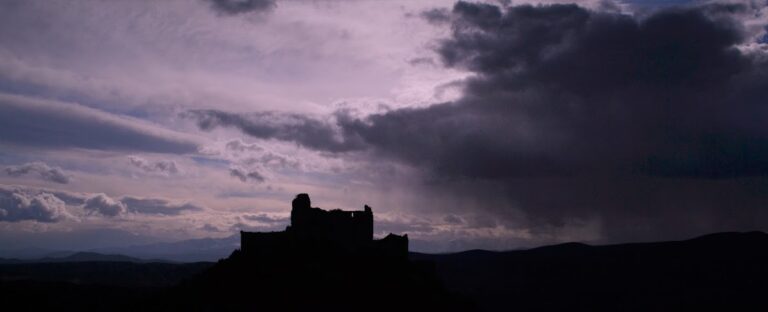
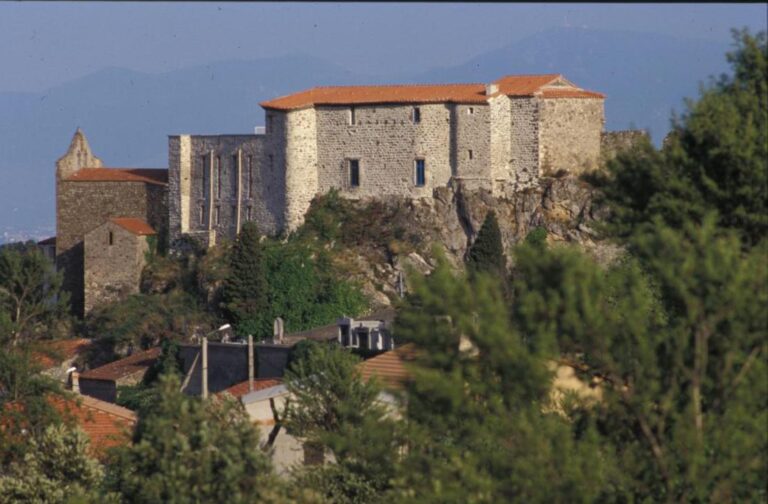
The ruins stand on a narrow rocky pinnacle above Cucugnan, near the boundary between the Aude and Pyrénées-Orientales departments. The fortress overlooks the Grau de Maury and the surrounding Corbières, Fenouillèdes, Roussillon plain, Pyrenees, Mediterranean Sea, and Corbières vineyards.
Three superimposed enclosures occupy the summit and extend along the cliff, reflecting four centuries of defensive development. Their defenses include chicanes, narrow openings for crossbowmen, larger gun ports for firearms, projecting structures with openings through which defenders could attack enemies below, and gate defenses such as murder holes and projecting defended balconies. Wall walks and casemates, protected chambers used for defense, guarded and monitored vulnerable points. The fortress could be defended by approximately fifteen to twenty men, while the cistern and buildings limited the number of soldiers who could be sustained there for long.
Residential and service buildings
The surviving complex contains a main residential block, storage rooms, cisterns, and the keep. Archaeological excavations carried out from 1984 to 1989 around and within the castle also revealed habitation structures on a platform below the fortress. These remains add evidence of occupation associated with the rocky stronghold and its supporting areas.
The keep
The keep, the principal fortified tower of a castle, occupies the third and highest enclosure at the top of the cliff. Built in several phases, it has walls reinforced to a thickness of several metres. Its polygonal plan reduced the destructive effects of projectiles.
Inside the keep, a Gothic hall is divided into a cellar and a principal room. A large window lights the room, whose west wall retains the remains of a fireplace. A substantial central pillar, dated to the thirteenth century, supports a ribbed vault, a vaulted ceiling carried by intersecting masonry ribs. Its pyramidal base supported the floor between the principal room and the cellar.
The pillar’s unusual position has been described as representing the only known chapel located at the heart of a keep, although the structure’s function remains enigmatic. The summit has a terrace reached by a spiral staircase in an attached rectangular tower. That terrace was restored and adapted for public access.
Name and landscape
The name Quéribus has been interpreted as “rock of the boxwoods.” Another etymological interpretation connects it with a rocky outcrop and the yew tree. These interpretations relate the castle’s name to the vegetation and rock formation of its elevated setting.