Durban Castle: A Ruined Fortified Castle in France


Site at a Glance
- Rating
- 4.4
- Popularity
- Very Low
- Country
- France
- Primary era
- Medieval
- Eras represented
- Medieval, Early Modern
- Civilizations
- French
- Site type
- Military
- Remains
- Castle
On this page7 sections
History
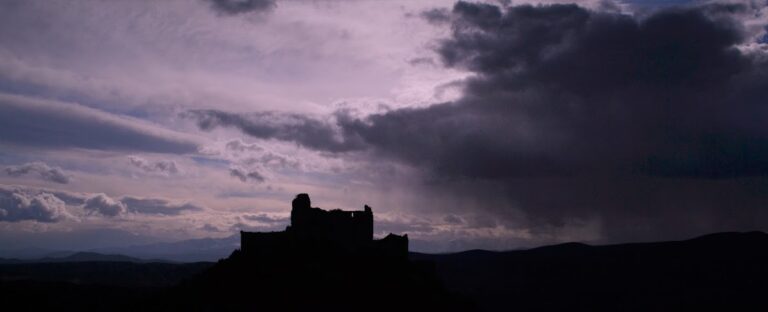
Durban Castle, also known as Château de Durban, is a ruined fortified castle in Durban-Corbières, France. Built in the eleventh century over Roman remains for the lords of Durban, it became the long-standing residence of a noble family whose name first appears in a document from 1018.
The lords of Durban
The lords of Durban were vassals of the viscounts of Narbonne, hereditary territorial rulers who governed the regional lordship. During the twelfth century, the Durban family owned Leucate and Fabrezan and held lands and rights in Fontjoncouse and Villesèque. Bernard de Durban was the castle’s owner during this period.
In 1229, Guillaume de Durban swore allegiance to the king of France and retained his lands as a result. Earlier members of his family had links with the Cathars, a medieval Christian movement regarded as heretical by the Catholic Church and especially influential in southern France during the twelfth and thirteenth centuries, although the family members concerned were not adherents. The castle nevertheless remained connected with the Cathar movement.
Renaissance changes and decline
The castle remained the Durban family’s residence for more than 600 years. During the sixteenth century, Renaissance influence brought alterations to the building, including elaborate windows cut into and decorated on the north and west walls.
Joseph de Gléon, Baron of Durban, was the last direct descendant of the Durban family to own the castle. He died without heirs in 1787 at the age of 82. The last inheritor sold the property to Paul Combes in 1873. Combes intended to reuse its stone as building material, and large parts of the castle had been destroyed by the end of the nineteenth century.
After the castle was abandoned, a Spanish soldier occupied it and lived in its remaining room. The property later became public and continued to serve as a source of building stone. Archaeological excavations took place in 1967, preservation work began in 1980, and the commune acquired the castle in 1989. It has been protected as a monument historique, the French legal designation for a protected historic monument or site, since 1926. The castle and its surroundings have also been listed as protected natural sites since 1942. The commune owns the property, which is cared for by the Committee for the Safeguarding of Old Durban.
Remains
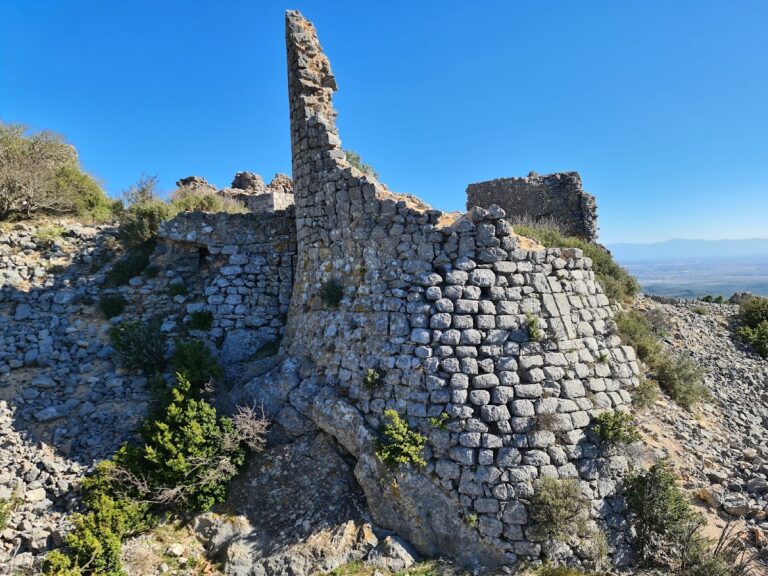
Durban Castle stands above the village and the Berre valley. Its surviving fabric consists of stabilized ruins, meaning remains secured against further collapse while retaining their ruined form. The visible complex includes the north face of the main building, a round stair tower, and a square tower. The castle was constructed over Roman remains.
Surviving castle structures
Main building and Renaissance windows
The north face of the main building survives as part of the stabilized ruins. Sixteenth-century windows in the north and west walls have marble columns and sculpted lintels, combining the castle’s defensive fabric with Renaissance decoration. These elements were restored in 1972.
Towers
A round stair tower and a square tower remain alongside the surviving face of the main building. Together, these structures form the principal visible elements of the ruined castle above Durban-Corbières.
Nearby sites