Castle of Talamantes: A Historic Fortress in Spain


Visitor Information
Google Rating: 4.2
Popularity: Very Low
Google Maps: View on Google Maps
Country: Spain
Civilization: Unclassified
Remains: Military

History
The Castle of Talamantes stands in the municipality of Talamantes, Spain. This fortress was originally built by the Christian kingdoms during the 12th century to secure the border area between Castile and Aragon. Constructed in 1175, it played a strategic role in overseeing a vital mountain pass connecting these neighboring realms.
In its early decades, the castle functioned as a military stronghold alongside nearby fortifications such as Ferrera and Ferrellón, collectively guarding the convergence of two ravines named Valdeherrera and Valdetreviño. Control over this rugged terrain was crucial for regulating movement and defense in the contested frontier region.
By 1210, authority over the Castle of Talamantes passed to the Knights Templar, a religious-military order known for their extensive involvement in the Iberian Peninsula during the Reconquista. The Templars maintained custody until their suppression in the early 14th century. After their dissolution, the ownership transferred to the Order of Saint John of the Hospital, also known as the Knights Hospitaller. This new custodianship lasted until 1780, a period during which the castle shared fate and administration with the nearby castle of Añón.
In recognition of its historical significance and cultural value, the castle was officially declared a Bien de Interés Cultural, or Cultural Heritage Site, in 2006 under regional heritage laws of Aragon.
Remains
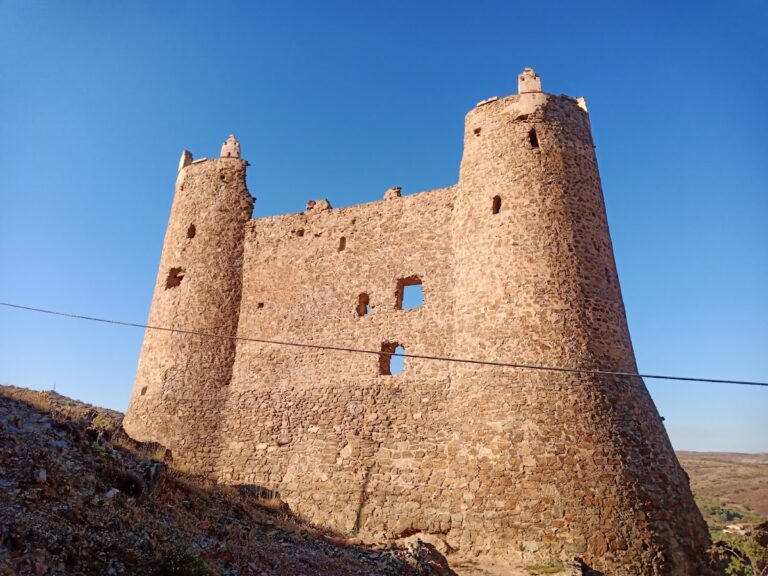
The Castle of Talamantes is situated atop the Silla mountain ridge and consists of a small rock fortress crafted mainly from masonry. Its design follows an elongated defensive layout that adapts to the natural contours of the rocky terrain, which contributed to the difficulty of access and defense.
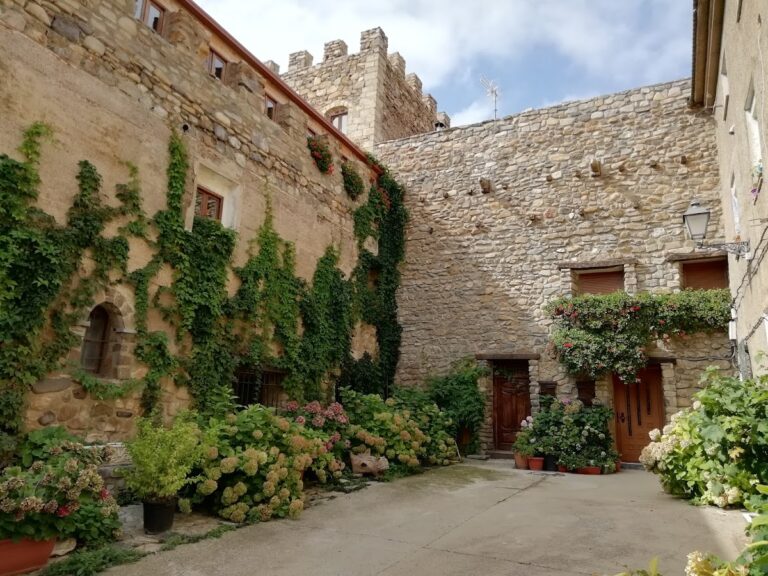
To the north, the castle retains a well-preserved wall featuring battlements—these low stone walls with regular openings allowed defenders to shield themselves while observing or shooting arrows. This northern barrier includes a walkway known as the camino de ronda, which enabled movement along the wall’s length, and narrow vertical slits called saeteras, designed as firing points for archers.
A notable tower projects outward from the northern wall, serving as a forward defensive element. On the western side stands the keep, or torre del homenaje—a central square tower roughly six meters on each side. Over time, this main tower has suffered reduced height and ruinous conditions, with its original entrance no longer identifiable.
The southern wall has experienced significant collapse due to the instability of the terrain beneath it. This failure has altered the form of the internal courtyard, known as the patio de armas, which once served as an open space within the fortress for assembling troops or equipment.
Together, these architectural features reveal how the castle’s builders worked with the landscape to create a naturally imposing and defensible position. While some areas remain in partial ruin, critical elements like the northern defenses offer insight into the fortress’s original military function.
Nearby sites