Castillo de Peñolite: An Almohad-Era Fortress in Spain

Visitor Information
Google Rating: 4.1
Popularity: Very Low
Google Maps: View on Google Maps
Country: Spain
Civilization: Unclassified
Remains: Military

History
The Castillo de Peñolite is situated near the municipality of Puente de Génave in Spain. This fortification dates back to the period of Almohad rule in the region, when Muslim rulers established various defensive sites across the Iberian Peninsula.
Constructed during the Almohad era, the castle functioned primarily as a small fortress or refuge connected to a network of rural farmsteads known as alquerías. These agricultural settlements formed the surrounding landscape, although no stable village existed directly adjacent to the castle during its active use. It served a strategic purpose tied to local defense and possibly the control of nearby lands and waterways.
The castle’s presence is recorded in historical documents from the late 15th and 16th centuries. Notably, it appears in the “Relación de pueblos” compiled in 1468 by Francisco de León, indicating its recognition during the late Middle Ages. By the time of the “Relación Topográfica” of 1575, ordered under King Philip II, the castle was already described as being in a state of ruin, reflecting its abandonment prior to the modern era.
The nearby village of Peñolite, which now shares its name with the castle, developed long after the fortification ceased to be habitable. Thus, the castle remains an isolated testament to the Almohad presence and early rural organization in this part of Spain.
Remains
The Castillo de Peñolite occupies a roughly rectangular area of about 30 meters by 15.6 meters. Its layout reflects typical medieval Muslim military architecture adapted for rural settings. The construction emphasizes solid defensive walls and corner towers designed for surveillance and protection.
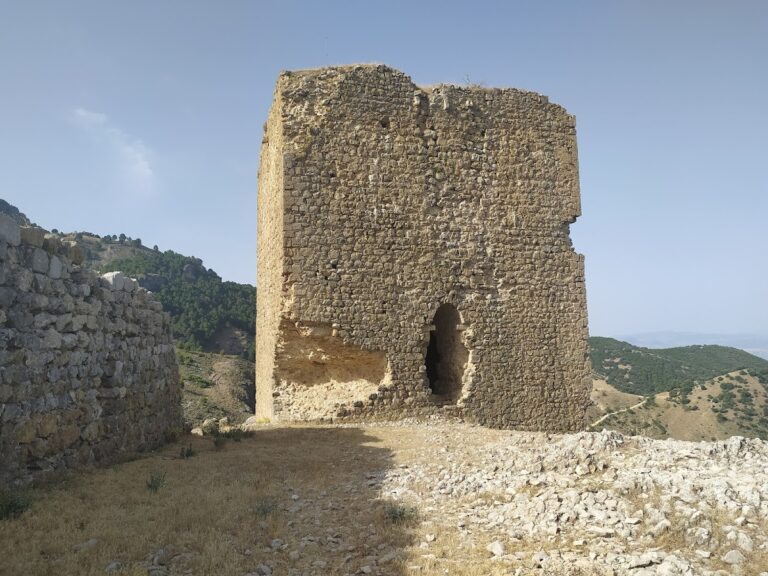
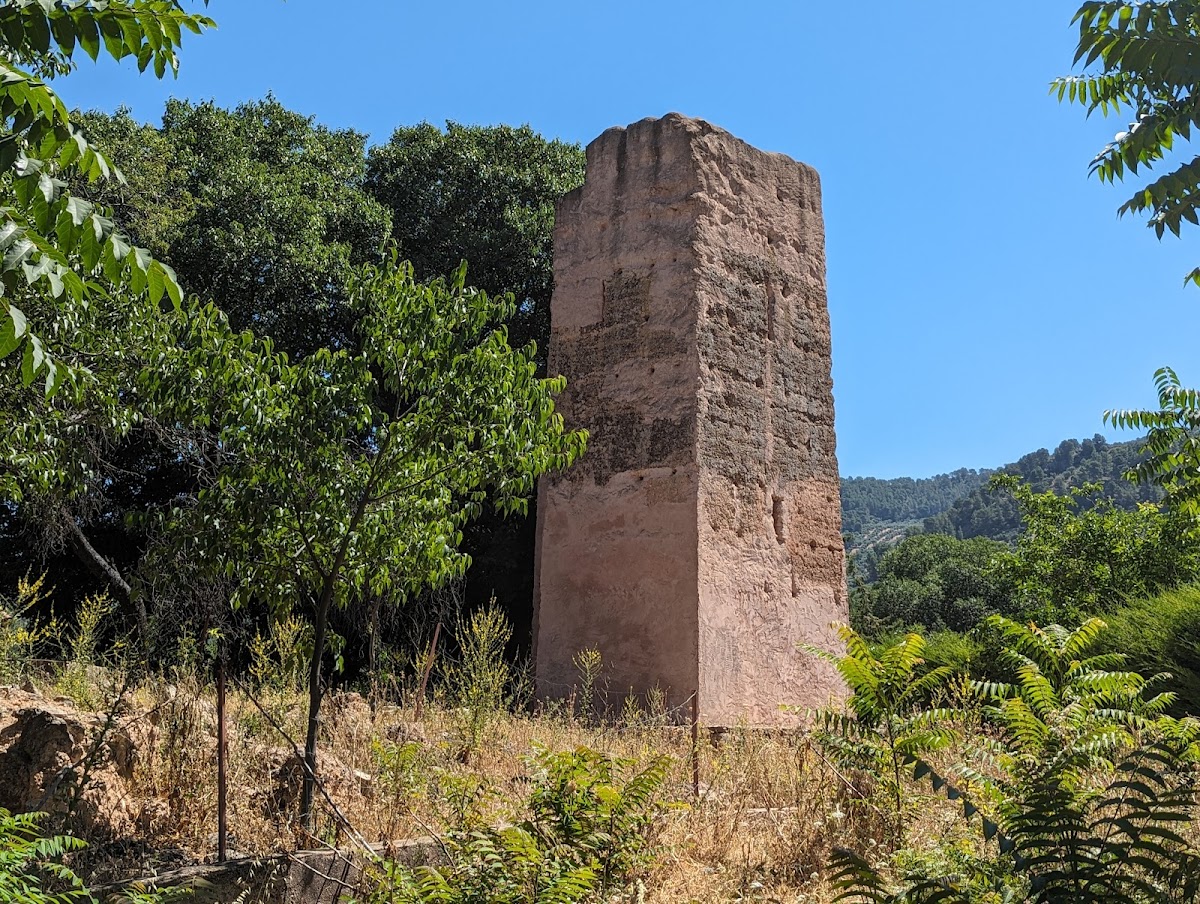
At the site, three towers still stand, positioned at the southern and western corners of the enclosure. These towers have square bases with a distinctive truncated conical form—wider at the bottom and tapering slightly upwards—and feature a sturdy lower section constructed for strength and durability. The design of these towers includes three internal floors, each supported by wooden beams, which would have provided lookout points and living or storage spaces.
The upper parts of the towers have narrow vertical openings called arrow slits. These allowed defenders to use bows or crossbows while remaining protected behind the thick walls. Among the surviving towers, one is fully intact and measures approximately four meters on each side, offering insight into the original scale and construction techniques of the castle.
Surrounding walls, now heavily ruined, once enclosed the fortress, with evidence suggesting a fourth tower likely completed the rectangular formation at the remaining corner. These fortified walls and towers demonstrate the castle’s role as a defensive refuge during the Almohad period, designed to secure the vulnerable rural landscape nearby.
Nearby sites