Castillo de la Corona: A Medieval Fortress in Almudévar, Spain

Visitor Information
Google Rating: 4.1
Popularity: Very Low
Google Maps: View on Google Maps
Country: Spain
Civilization: Unclassified
Remains: Military

History
The Castillo de la Corona is a medieval fortress located in Almudévar, Spain. Its origins trace back to a Muslim settlement, with the castle’s name deriving from the Arabic word meaning “The Round,” a reference to the shape of the original fortress established by the Muslim occupants.
By the late 11th century, specifically in 1083, Almudévar acknowledged the authority of Sancho Ramírez by paying him tribute. Historical records, including the Chronicle of San Juan de la Peña, note that King Pedro I reached Almudévar during his southern military campaign near the end of that century. Despite this presence, the Christian reconquest of the castle itself was not completed until 1118, marking a pivotal change in control from Muslim to Christian rule.
In the latter half of the 12th century, a significant administrative and religious transformation took place. In 1170, Alfonso II conferred a charter to Almudévar, designating it as a royal town governed by representatives known as tenentes. This charter allowed local inhabitants to repurpose the remains of the Muslim fortress to construct a church honoring the Virgin of La Corona. This religious building was erected between 1184 and 1231, following the architectural style associated with the Cistercian order, a reformist branch of the Benedictine monks.
The castle continued to play an important role in regional politics throughout the medieval period. Notably, in 1364, it served as the venue for a secret meeting involving Charles II of Navarre, Henry of Trastámara, and the Queen of Aragon. They convened here to discuss plans to depose Pedro I of Castile, known as Pedro the Cruel. This event underscores the strategic significance of the castle in the complex power struggles of 14th-century Iberia.
Over the subsequent centuries, the site experienced architectural and functional changes that reflected evolving political and religious needs. In the 16th century, the complex was expanded, and later Baroque elements were introduced, including the construction of a hermitage dedicated to the Virgin of La Corona. These adaptations demonstrate a shift from purely military use toward more devotional and domestic functions.
Remains
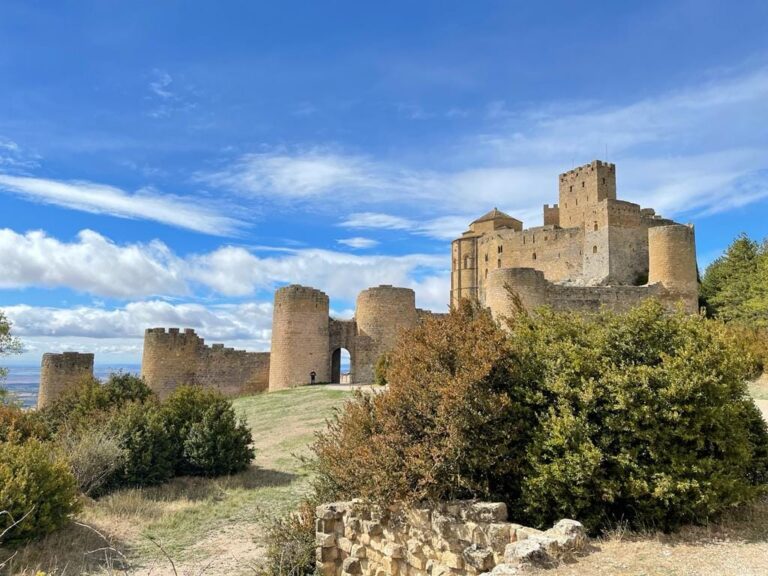
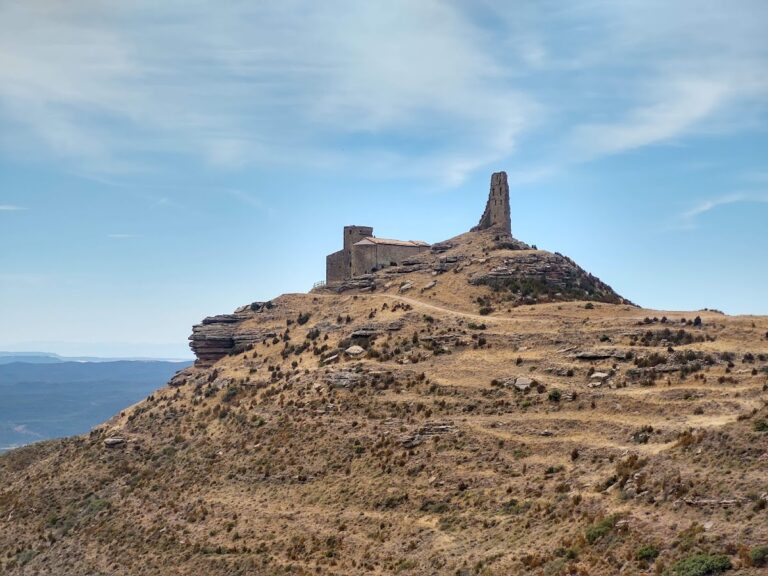
Perched atop a hill overlooking Almudévar, the Castillo de la Corona presents a complex formed by structures dating from the 12th through the 16th centuries. These buildings exhibit a blend of medieval military architecture alongside religious constructions, creating a distinctive outline visible across the surrounding landscape.
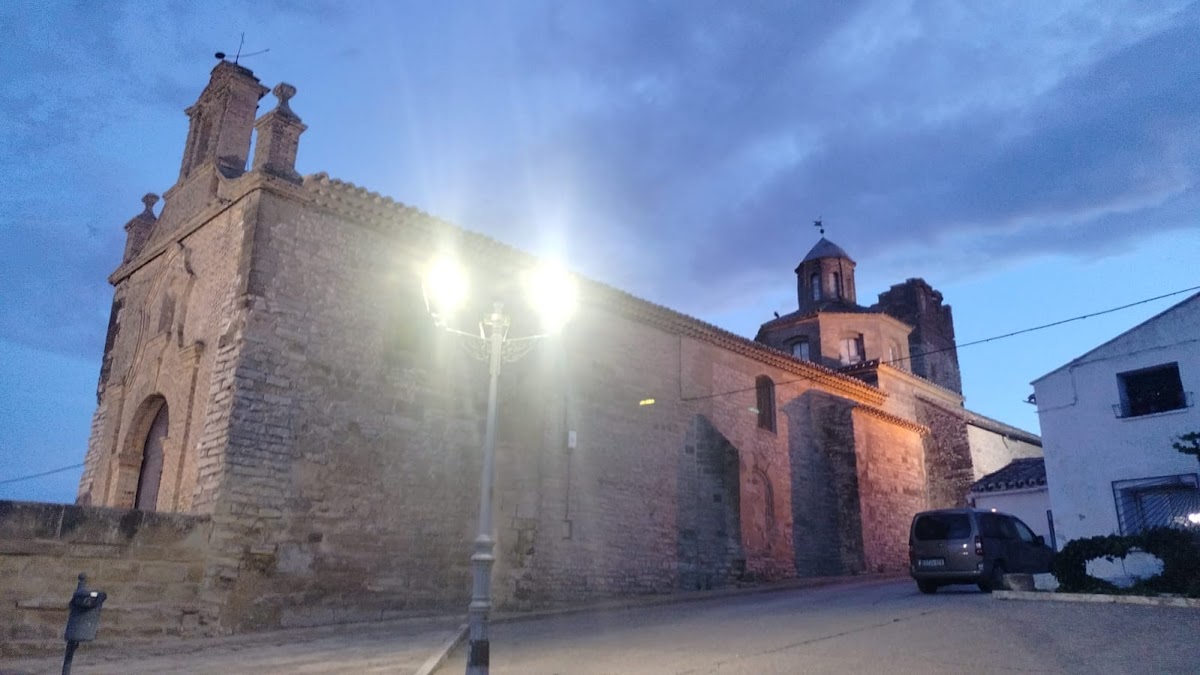
The most prominent surviving component is the former church, initially built between 1184 and 1231 in the Cistercian style, a form characterized by simplicity and austerity. Architectural evidence remains in the form of the springing points of the vaults, where the arches begin to curve. The church was enlarged during the 16th century with the addition of chapels accessible from a side nave, reflecting the building’s continued religious role and adaptation over time.
Another significant feature is the Baroque hermitage dedicated to the Virgin of La Corona, constructed later to accommodate evolving devotional practices. This addition showcases the site’s layered history, blending different architectural styles separated by several centuries.
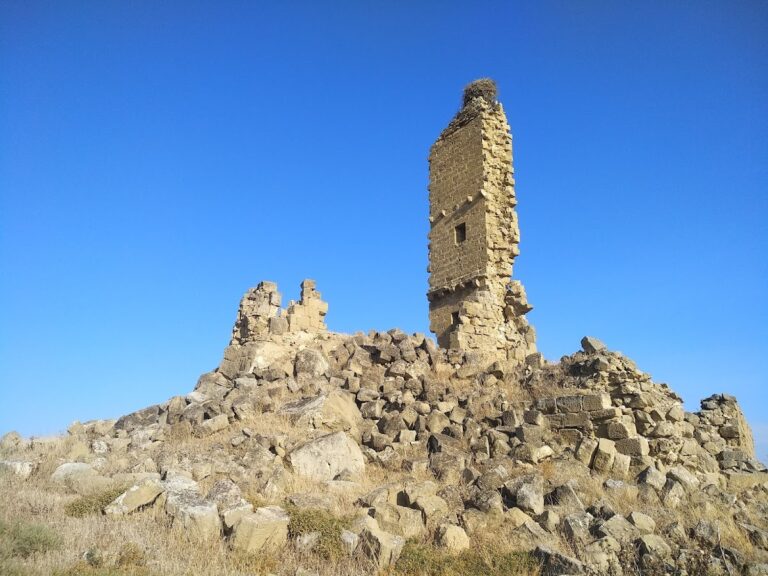
The castle’s defensive heart, the keep or “torre del homenaje,” is rectangular, measuring approximately 13 by 5.5 meters at its base and reaching about 15 meters in height. Its walls were built from roughly cut stone blocks known as sillarejo, which provided a sturdy, if somewhat irregular, masonry surface. These stones were reinforced with precisely cut ashlar blocks at critical points to strengthen the structure. In the 16th century, a brick arcade gallery was added atop the keep, exemplifying Renaissance-era modifications to the medieval fortification.
Defensive walls feature two low rectangular towers that once formed part of the castle’s fortifications. The main entrance is situated at the western end, marked by a semicircular arch constructed from large wedge-shaped stones called voussoirs. The keystone of this arch is decorated with a coat of arms bearing the date 1584, indicating the period of this particular entrance’s construction or renovation.
Together, these elements illustrate the layered history of Castillo de la Corona, where military, religious, and residential uses converged and evolved through the centuries, leaving behind a compound rich in historical and architectural significance.
Nearby sites