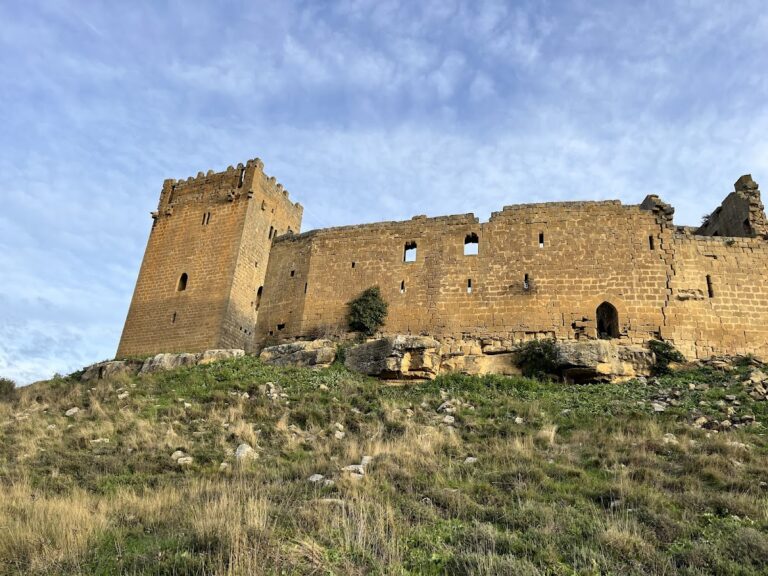
Castle of Santia: A Medieval Fortress in Spain


Site at a Glance
- Rating
- 4.4
- Popularity
- Very Low
- Country
- Spain
- Primary era
- Medieval
- Eras represented
- Medieval
- Civilizations
- Crown of Aragon
- Site type
- Military
- Remains
- Castle
On this page8 sections
History
Castle of Santia is a medieval castle in Spain, near Erla in Zaragoza Province, Aragon. Its visible remains are generally dated to the fourteenth century, although the site was already associated with a castle church in 1092. Standing within the Cinco Villas district, the fortress occupied a position connected with the medieval territorial network around Ejea de los Caballeros.
Medieval origins
The earliest reference to Santia dates from 1092, when King Sancho Ramírez of Aragon, who ruled from 1063 to 1094, ordered the transfer of the castle’s church to the Monastery of San Juan de la Peña, a major medieval monastic institution in Aragon. In 1110, Santia appeared among the castles associated with the territory of present-day Ejea de los Caballeros.
The site continued to be identified under related names. An Aragonese document from 1489 calls it Sentia, while the forms Santias and Santia are also used for the castle.
Early modern ownership and abandonment
In 1610, the geographer and cartographer Juan Bautista Labaña described Santia as a group of four houses and a castle belonging to Miguel de Gurrea, an Aragonese nobleman. By the eighteenth century, the property belonged to the Count of Contamina and had already been abandoned as a settled site.
The Peninsular War
The castle returned to practical importance during the Peninsular War, the Spanish phase of the wider conflict against Napoleonic France from 1808 to 1814. People serving the Count of Parcent occupied it during the war. In September 1808, the castle supplied 60 tonnes of barley to Ejea for Spanish troops.
Aragonese volunteers drew provisions from Santia several times in February and June 1811 and in January 1812. The 6th Volunteer Battalion under Francisco Espoz y Mina, a Spanish commander and guerrilla leader, used the site in November 1812, followed by the 2nd Battalion in December. A Volunteer Battalion of Navarre obtained provisions there in March 1813 and on several later occasions. These activities place the castle within the operational area of Mina’s forces west of the Gállego River and in the Cinco Villas district, as well as within the movements of Aragonese and Navarrese volunteer guerrillas.
Decline and protection
The castle walls remained almost complete until 1970. The tower began to deteriorate rapidly from the 1990s, and around fifty years after 1970 the fortress faced the serious possibility of complete loss. Spain listed Castle of Santia on its Red List of Endangered Heritage from 2008 onward. It also holds the status of an Asset of Cultural Interest, formally declared on 17 April 2006 and published on 22 May 2006.
Approval to consolidate the walls, financed by the Cinco Villas district, was announced on 2 April 2013. By the beginning of 2023, the planned work remained unrealized, leaving the surviving fabric in a highly vulnerable condition.
Remains
Walled enclosure
The castle stands on a small elevation across the broad plain southwest of Erla, near the road connecting Erla with Ejea de los Caballeros. Its fortification forms a low, trapezoidal enclosure whose longest side measures 20 metres. The walls retain considerable volume, although the enclosure and its entrance wall are in a very poor state of preservation.
Access was provided through a voussoired gate, meaning an entrance arch built from wedge-shaped stones. The outer opening survives as a semicircular arch cut through a very thick wall that is now partly ruined. A cross mounted on a nearby pillar collapsed in 2005.
Corner tower
A tower occupied one corner of the enclosure. Its plan measured 5 by 7 metres, and it rose through three stories containing arches. The elevated entrance included a pointed arch and was set high in the wall, facing inward toward the enclosure.
Only three exterior walls survived until a severe storm brought down two of them. One wall now remains standing, precariously balanced and at risk of collapse. The tower retains a visual connection with the castles of Sora and Erla, linking the isolated remains to the wider fortified landscape of the area.
Nearby sites