Castello Visconteo: A Medieval and Renaissance Fortress in Somma Lombardo, Italy


Visitor Information
Google Rating: 4.5
Popularity: Medium
Google Maps: View on Google Maps
Official Website: www.castelloviscontidisanvito.it
Country: Italy
Civilization: Medieval European
Remains: Military

History
Castello Visconteo is located in the town of Somma Lombardo, Italy. Its origins reach back to the early medieval period, with buildings on the site dating from the ninth century. By the thirteenth century, this location had been developed into a fortress as part of a defensive system along the Ticino River, designed to protect the region between Milan and Lake Maggiore.
In the fifteenth century, the castle’s strategic and residential importance rose sharply. Following the collapse of the Visconti ducal line and the emergence of the Ambrosian Republic in Milan, the Visconti family’s influence shifted to this fortress. In 1448, two brothers, Francesco and Guido Visconti, sought refuge within its walls. The siblings divided the castle and its surrounding lands between them. Francesco established the Visconti di San Vito branch, while Guido founded the Visconti di Modrone line. The following year, they undertook major renovations to adapt and enhance the fortress.
Throughout the early modern period, the Visconti di San Vito family remained residents of the castle. In 1619, King Philip III of Spain granted this branch the hereditary title of Marquis of San Vito, formalizing their aristocratic status. The castle was not only a noble residence but occasionally accommodated significant figures; notably, Niccolò Sfondrati, born at the castle in 1535, later became Pope Gregory XIV. Additionally, kings of Italy such as Vittorio Emanuele II and Umberto I stayed at the castle during military exercises and hunting expeditions, highlighting its continued use as a royal retreat.
In more recent history, the castle remained under Visconti ownership. Gabrio Luigi Visconti di San Vito, the last direct descendant, founded a preservation organization in 1997 to safeguard the site and promote its cultural heritage.
Remains
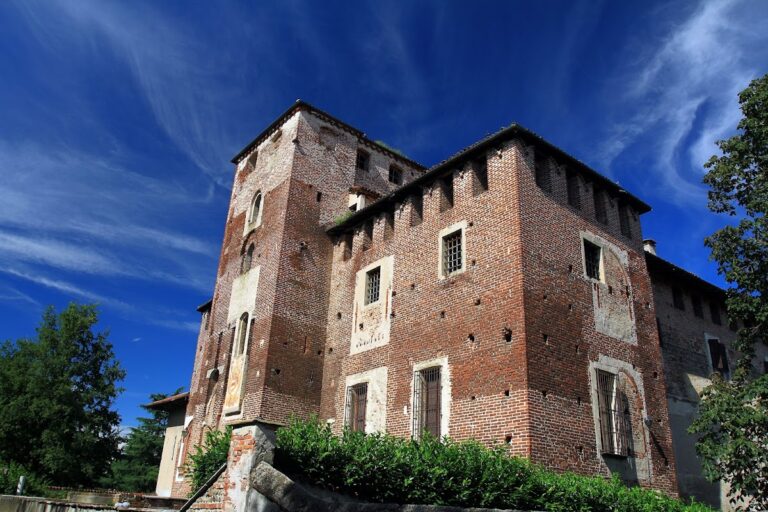
The Visconti Castle in Somma Lombardo presents a complex of connected buildings arranged around a central courtyard, developed gradually across several centuries. The structure’s core reveals a blend of medieval and Renaissance architectural styles, reflecting its prolonged occupation and adaptation.
The castle’s northwestern area, known as the “degli Armigeri” wing, dates from the fourteenth to the fifteenth centuries and forms one of the oldest parts of the fortress. This section, constructed with traditional masonry techniques, retains the fortified character essential to its original defensive purpose. The eastern wing, added in the fifteenth century, expanded the living and administrative spaces, while the southern wing, erected in the sixteenth century, further extended the residence’s footprint.
Surrounding the castle and the neighboring noble homes was originally a continuous moat, emphasizing its role as a fortified complex. Evidence of this water defense remains visible in parts of the site, though the moat no longer encircles the entire structure.
Inside the castle, the Salone d’Onore (Hall of Honor) stands out for its elaborate frescoes from the early seventeenth century. These paintings are attributed to artists influenced by the Procaccini family and were inspired by detailed Flemish engravings by Crispjin van de Passe, Theodor and Philippe Galle, and Adriaen Collaert. The chapel, dedicated to the Madonna Assunta, houses liturgical objects along with an altarpiece of the Annunciation, credited to the workshop associated with the artist Cerano.
The collection of Roman-era artifacts discovered on the castle’s grounds offers insight into the site’s ancient heritage. Inscriptions, boundary stones, and altars have been unearthed in the surrounding territory, indicating a long history of human settlement before the medieval fortress arose.
Among the castle’s unique holdings is a vast assortment of about 400 eighteenth-century barber’s basins, known as bacili. These ceramics, sourced from Faenza, Savona, and other European locations, were assembled by Marquis Carlo Ermes Visconti in the late 1800s. The Camera Reale (Royal Chamber) features a grand seventeenth-century wooden bed from Lombardy, reserved for the visits of Italian monarchs. Another room commemorates Count Gabrio Casati, a Risorgimento figure related to the Visconti family, with a portrait created by painter Eliseo Sala.
Overall, the castle retains well-preserved frescoes, furnishings, and collections, reflecting centuries of aristocratic life and historical continuity within its walls.
Nearby sites