Rocca Borromeo di Angera: A Medieval Fortress and Museum in Italy


Site at a Glance
- Rating
- 4.5
- Popularity
- Medium
- Country
- Italy
- Primary era
- Medieval
- Eras represented
- Medieval, Early Modern
- Civilizations
- Lombard
- Site type
- Military
- Remains
- Castle
On this page15 sections
History
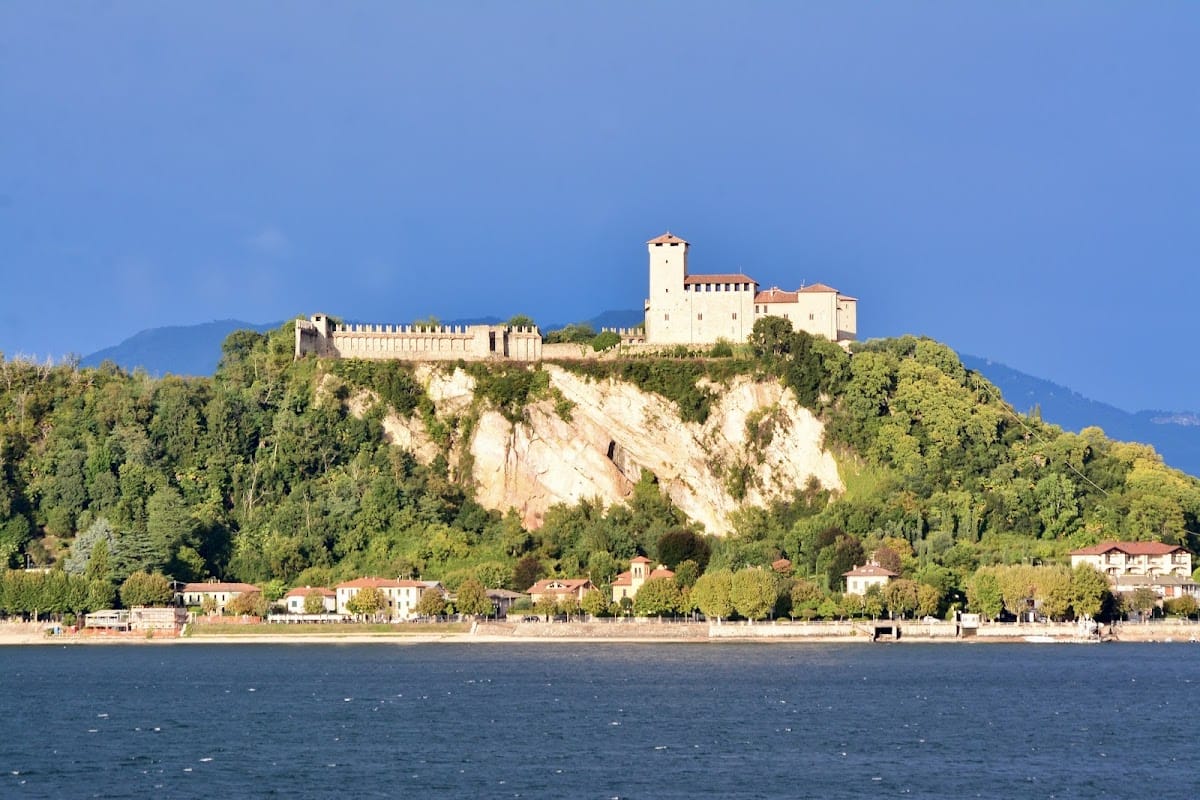
Rocca Borromeo di Angera is a fortified stronghold in Italy above Angera on the southern shore of Lake Maggiore. Built and enlarged by Lombard, Visconti, and Borromeo authorities from the early medieval period through the seventeenth century, it developed from a watchtower into a major lakeside fortress and later became a museum and historical interpretation center.
Lombard and archiepiscopal origins
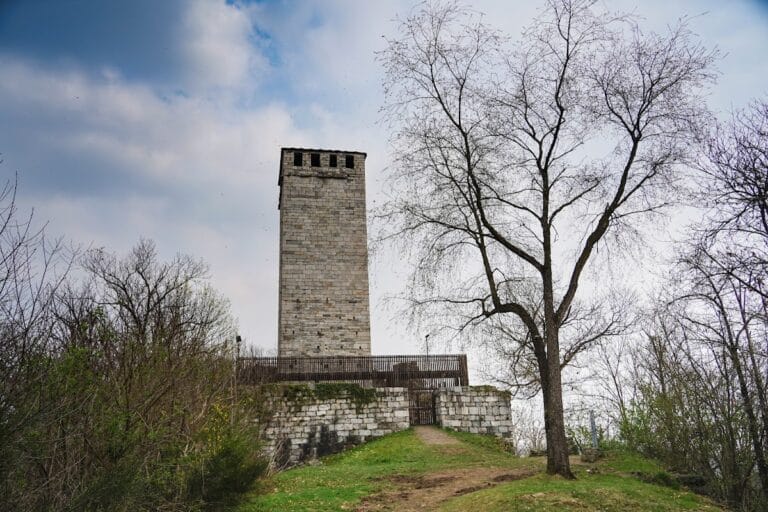
The earliest part of the Rocca is a square tower in the western section of the complex. It dates no later than the Lombard period, the era of Lombard rule in Italy from principally the sixth to the eighth century. The fortress grew around this early medieval watchtower on the hill above Angera, giving the site a defensible position overlooking the lake.
In its first known phase of ownership, the fortress belonged to the archbishops of Milan. During the thirteenth century, Archbishop Leone da Perego used it as a refuge after fleeing Milan amid conflict with the Della Torre faction, a rival Milanese political group later defeated by the Visconti.
Visconti expansion
The balance of power changed after the Battle of Desio in 1277, when the Visconti defeated the Della Torre faction. Archbishop Ottone Visconti expanded the fortress after the victory, creating the wing now called the Ottonian or Visconti wing. Ottone was a Milanese archbishop who became the first Visconti lord of Milan.
After Ottone’s death, the Visconti family took possession of the Rocca and other properties belonging to the Milanese church. The family regarded Angera as its legendary place of origin. The first major additions to the original tower were made around the transition from the thirteenth to the fourteenth century, establishing the multi-winged form that later owners would enlarge.
A concession by Pope Clement VI in 1350 placed the Rocca in the possession of the family of Bernabò Visconti, a fourteenth-century Visconti lord of Milan. Between 1375 and 1385, Bernabò built the Scaligera Wing for his wife, Regina Della Scala. The complex therefore continued to combine defensive functions with the residential and ceremonial needs of the ruling family.
From the Milanese duchy to the Borromeo state
After the death of Gian Galeazzo Visconti in 1402, political instability in Milan weakened the direct control of the Milanese dukes over Angera. Gaspare Visconti of Uberto, Count of nearby Arona and a distant cousin of the dukes, acquired rights over the town and perhaps the castle.
In 1439, Duke Filippo Maria Visconti ceded Arona to his treasurer, Vitaliano Borromeo. Vitaliano, a member of a wealthy Italian merchant and banking dynasty that established territorial power around Lake Maggiore, acquired jurisdiction over Angera in 1449 for 12,800 lire. An act signed on 18 January 1449 confirmed his acquisition of Angera, the Rocca, and its parish. Angera then became part of the small Borromeo state around Lake Maggiore.
Except for a brief period after 1497, when Angera returned to the direct control of the Sforza dukes of Milan, the Rocca remained with the Borromeo family. The family still owns the fortress. The Borromean wing, first built by the Visconti, was transformed between 1564 and 1631.
Borromeo renewal and later use
After centuries of substantial abandonment, Cardinal Federico Borromeo renewed attention to the Rocca. In 1623, King Philip IV of Spain granted him the title Marquess of Angera. Further restoration took place under Giulio Cesare III and Antonio Renato, members of the Borromeo family associated with the later work. Several interiors were redecorated by painters including the Santagostino brothers, Antonio Busca, and Filippo Abbiati.
The Hall of Justice received a fresco cycle commemorating Archbishop Ottone Visconti, the victory over the Della Torre faction at Desio in 1277, and the subsequent pacification of Milan. The cycle was probably commissioned by Ottone’s nephew, Matteo Visconti, a later Visconti ruler, to celebrate his memory. Its political and religious themes preserve the connection between the fortress and the Visconti struggle for control of Milan.
In the modern period, the complex became a museum and historical interpretation center focused on its medieval past while remaining in Borromeo ownership. Princess Bona Borromeo Arese founded the Museum of the Doll and Toy in 1988. It contains more than 1,000 dolls from around the world, dating from the eighteenth century to the present.
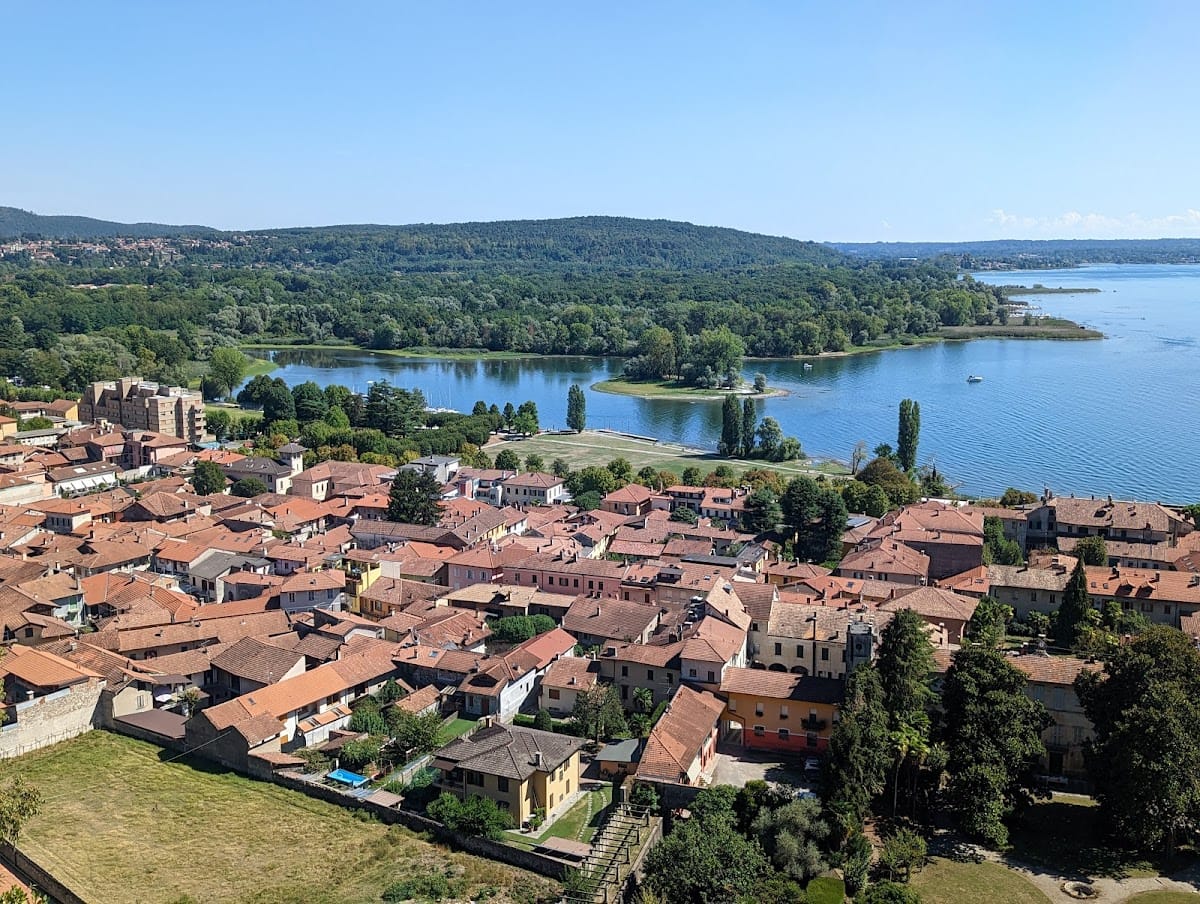
Medieval gardens were recreated during the twentieth and twenty-first centuries through research into historical codes and documents. The project established the Princes’ Garden, the Kitchen Garden, and the Little Herbs Garden, with medicinal and ornamental plants arranged according to reconstructed historical layouts. The Rocca is in excellent condition, and its keep provides views over the southern part of Lake Maggiore. Across the lake at Arona, remains of the related Rocca di Arona survive.
Remains
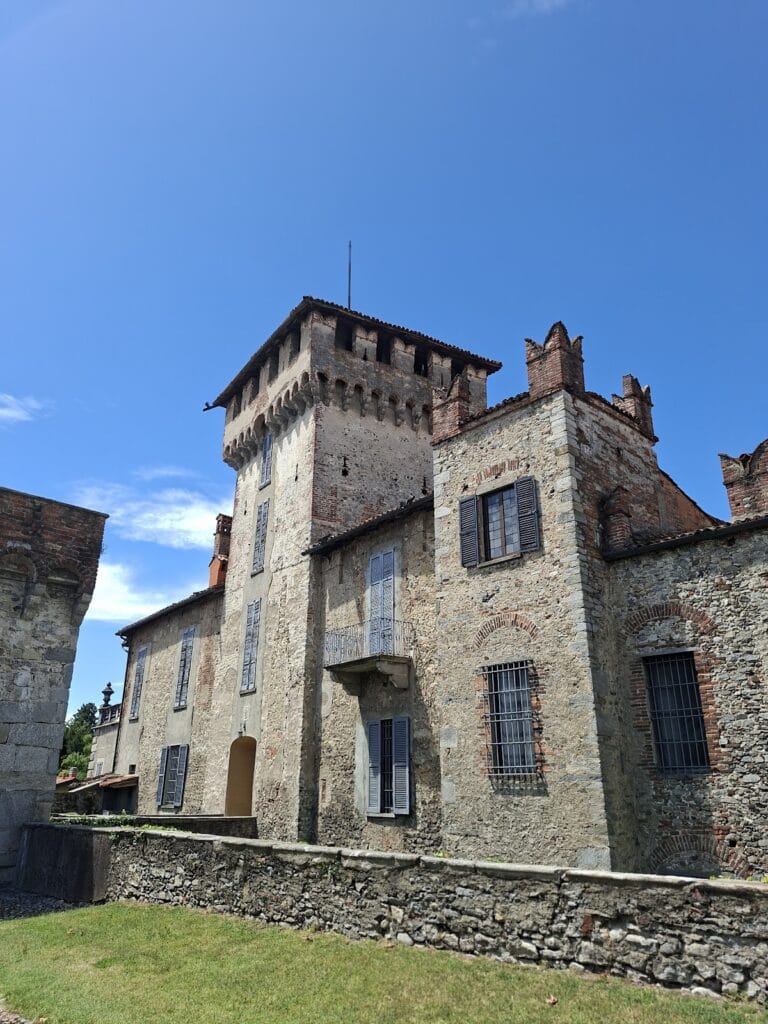
Rocca Borromeo di Angera occupies a hilltop above Angera and forms a multi-period fortress arranged around an internal courtyard. Its buildings were erected from the early medieval era to the seventeenth century, using primarily local stone. The complex comprises five building bodies, including the Scaligera Wing, the Visconti Wing, the Giovanni Visconti Tower, and the Borromean Wing, together with walls, corner turrets, historic rooms, former stables, and a garden extending toward the lake.
Fortress buildings and courtyard
Early tower and Visconti wings
The square tower in the western part of the Rocca is the oldest surviving component and belongs to the early medieval, possibly Lombard-period, nucleus. The Ottonian or Visconti wing was built entirely from squared, smoothly finished local stone against the ancient keep. Narrow windows serve its ground floor, while the upper level has mullioned windows, which are divided into separate openings by vertical stone supports. The wing blocked the keep’s original entrance.
The Scaligera Wing forms another major medieval addition, while the Giovanni Visconti Tower and the Borromean wing belong to the complex of later building bodies. The Borromean wing closes the fortress on the southeast. On the northeast, a wall with corner turrets extends beyond the building, bends toward the lake, and reaches the edge of the cliff, enclosing a garden.
Corte Nobile and former stables
The internal courtyard, known as the Corte Nobile, lies immediately beyond the entrance and provides the organizing space for the fortress buildings. Former stables beside the courtyard contain a large winepress described as one of the largest in Europe. Together, the courtyard, wings, towers, walls, and turrets preserve the layered arrangement created by successive medieval and early modern building campaigns.
Medieval garden
Outside the fortress, a medieval garden extends toward the lake. It contains medicinal plants, aromatic herbs, ornamental shrubs, and a vineyard. The plants are arranged in deliberate geometries based on the garden reconstruction project, which recreated three historical garden types: the Princes’ Garden, the Kitchen Garden, and the Little Herbs Garden.
Historic rooms and painted decoration
Hall of Justice
The Hall of Justice contains a thirteenth-century fresco cycle by an otherwise unidentified painter known as the Master of Angera. Its scenes concern Ottone Visconti and the Visconti victory at Desio in 1277. A Christian cross appears above Ottone’s head, while astrological symbols and all twelve zodiac signs are distributed across the six walls. A partly surviving Wheel of Fortune represents the reversal of the Della Torre family’s fortunes.
Hall of the Ceremonies
The Hall of the Ceremonies contains fifteenth-century frescoes recovered from Palazzo Borromeo in Milan after the palace was heavily damaged by bombing during the Second World War. The wall paintings were transferred to the Rocca as part of the preservation of the historic decoration.
Hall of the Borromean Splendors
The Hall of the Borromean Splendors, also called the Hall of the Fasti Borromeo, preserves detached frescoes from the first half of the fifteenth century. These wall paintings, made by Michelino da Besozzo, were transferred from Palazzo Borromeo in Milan in 1946 after the bombing. They form an important example of late Gothic secular painting in Lombardy and celebrate the Borromeo family.
Hall of Mythology
The Hall of Mythology contains more than 300 pieces of maiolica, a tin-glazed earthenware with an opaque light-colored surface suitable for painted decoration. The collection includes work from Dutch, French, German, Italian, Spanish, Persian, and Chinese workshops. Its arrangement recreates the collection of Madame Gisèle Brault-Pesché in her house museum in Tours.