Castle Bruneck: A Medieval Episcopal Fortress in Italy

Site at a Glance
- Rating
- 4.3
- Popularity
- Medium
- Country
- Italy
- Primary era
- Medieval
- External website
- Open
- Eras represented
- Medieval, Early Modern, Modern
- Civilizations
- Habsburg, Holy Roman Empire
- Site type
- Military
- Remains
- Castle
On this page12 sections
History
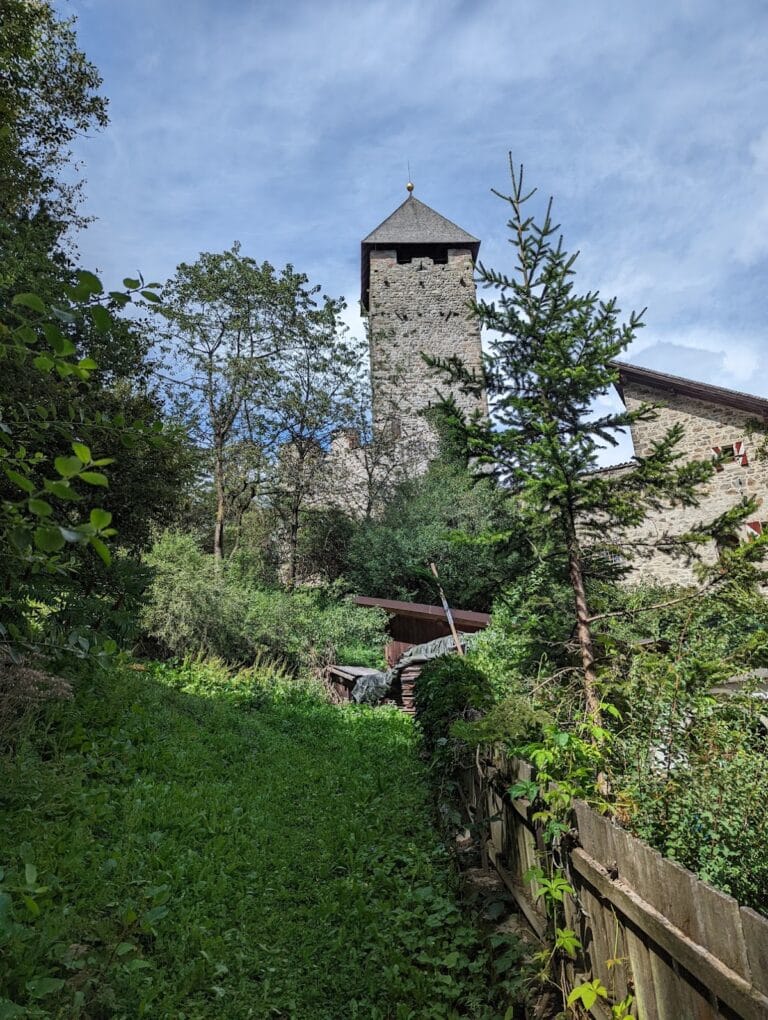
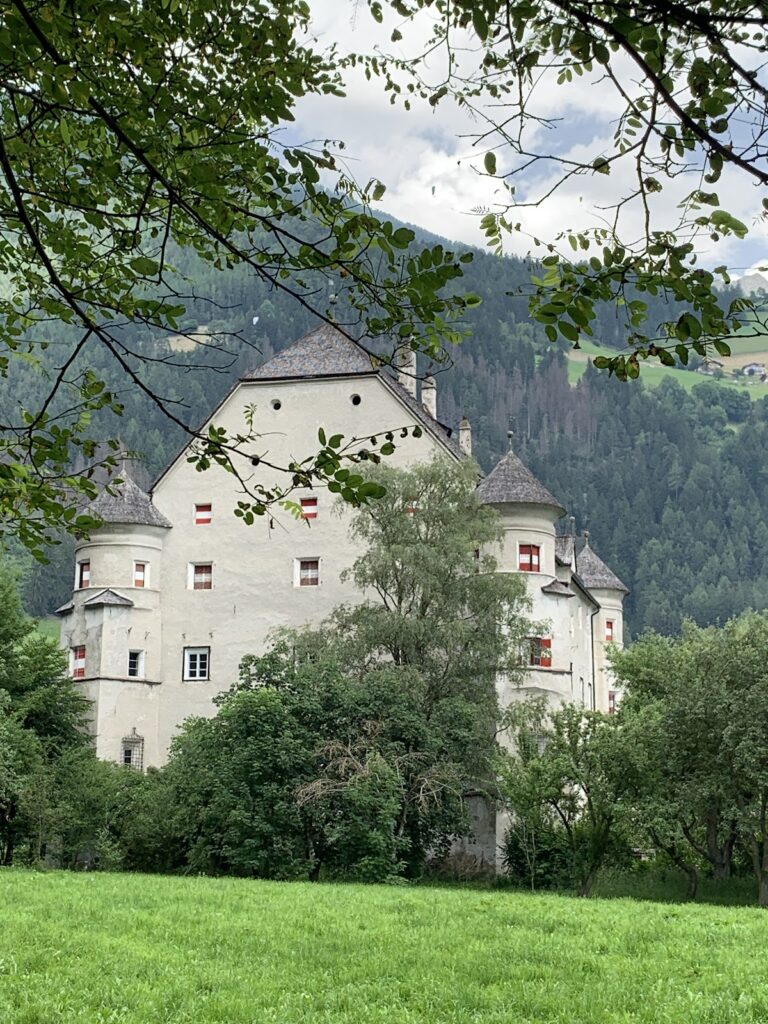
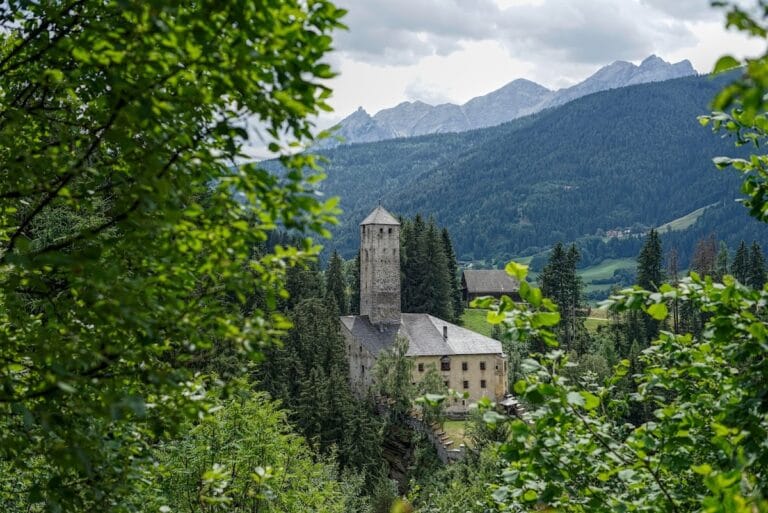
Castle Bruneck is a medieval fortress in Italy, rising above the historic center of Bruneck in the Puster Valley. Built between 1251 and 1288 for Bruno von Kirchberg, prince-bishop of Brixen, it protected the bishopric’s possessions and served the territorial administration of a church principality. Its construction accompanied the settlement below the hill, from which the town of Bruneck gradually developed.
Foundation and Episcopal Rule
The Brixen bishopric had received the County of Puster Valley from Emperor Henry IV in 1091. By the thirteenth century, however, the Counts of Tyrol, the principal territorial rulers of the region, were steadily challenging the bishops’ secular authority. Bruno’s administrative center at Aufhofen was considered too weakly defended, encouraging the construction of a fortified residence on the rocky hill above the valley basin.
The castle appears under the name Castrum Bruneke in 1271, while a dated document refers to it on 9 February 1276. Jakob von Trautson was probably its first captain, receiving the appointment in 1309. His remuneration included grain, barley, oats, cheese, sheep, pigs, cattle, wine, and money, together with the market court of Bruneck, selected revenues from the site, and half the hay along the Rienzbach. These arrangements reveal the castle’s role as both a military stronghold and an administrative center.
Expansion and Fifteenth-Century Conflict
Bishop Albert I von Enn enlarged the castle during the fourteenth century and added a further defensive wall. Later bishops continued to modify and extend the complex. Its military importance became clear in April 1460, when Nicholas of Cusa, the German churchman and theologian who was bishop of Brixen and a cardinal, sought refuge there during his dispute with Verena von Stuben, abbess of Castel Badia.
Sigismund of Austria, a Habsburg ruler of Tyrol, besieged the castle with 4,000 infantry and 1,000 cavalry. Nicholas was released only after signing a treaty against his will, and the fighting partly damaged the fortress. Bishop Georg Golser subsequently rebuilt the damaged defenses and strengthened them further because of fears of an Ottoman attack. The defensive works were also substantially expanded during the fifteenth century.
Residence, Refuge, and Military Use
In the early sixteenth century, Prince-Bishop Christoph von Schroffenstein transformed the fortified complex into a residential castle. It also received distinguished visitors. Emperor Maximilian I of the Holy Roman Empire stayed there for a week while traveling through the Puster Valley toward his new possessions in Carinthia, and Bishop Melchior of Brixen received him. In 1544, the sons of Emperor Ferdinand I were brought to the castle for protection from plague in the Inn Valley.
In April 1552, Emperor Charles V rested at Castle Bruneck after fleeing from Maurice I, Elector of Saxony, a Wettin ruler who had turned against him. Maria Theresa, the future Habsburg empress, visited in 1738 while staying at Sternbach Palace.
During the Franco-Bavarian occupation from 1805 to 1812, the military used the castle. French artillery placed on the castle and its hill halted an assault by insurgent peasants. After the restoration, the building returned to the Bishop of Brixen. In 1825, it was authorized for use as a prison and barracks, but later deterioration led to a major renovation under Bishop Simon Aichner around 1900.
Modern Institutional History
The castle continued to receive Habsburg associations after its renovation. Emperor Franz Joseph, who ruled the Habsburg monarchy from 1848 to 1916, visited while staying at Bruneck’s Hotel Posta during major military maneuvers. The episcopal rooms remained a summer residence for the bishops of Brixen until the 1950s.
From 1969, some rooms served as classrooms, including emergency accommodation for Bruneck’s commercial college and secondary school when their own premises lacked space. The South Tyrolean Savings Bank Foundation acquired the building in 2004 and made it available to the municipality of Bruneck for municipal use and for the work of mountaineer Reinhold Messner. A remodeling campaign carried out from 2009 to 2011 followed designs by Kurt Egger, Gerhard Mahlknecht, and Heinrich Mutschlechner. In 2011, Messner opened MMM Ripa, a branch of the Messner Mountain Museum, in one wing. The museum presents the lives, cultures, religions, and relationships to tourism of mountain peoples from Europe, South America, Africa, and Asia.
Remains
Castle Bruneck occupies Monte Spalliera, also known as Schlossberg, a rocky eminence above Bruneck’s historic center. The original stronghold was small but heavily fortified, standing on rock that projected into the valley basin. Later enlargement produced a more extensive complex enclosed by a high outer defensive wall, a secondary fortified line around the principal buildings.
Fortifications and Courtyard
Southern Entrance
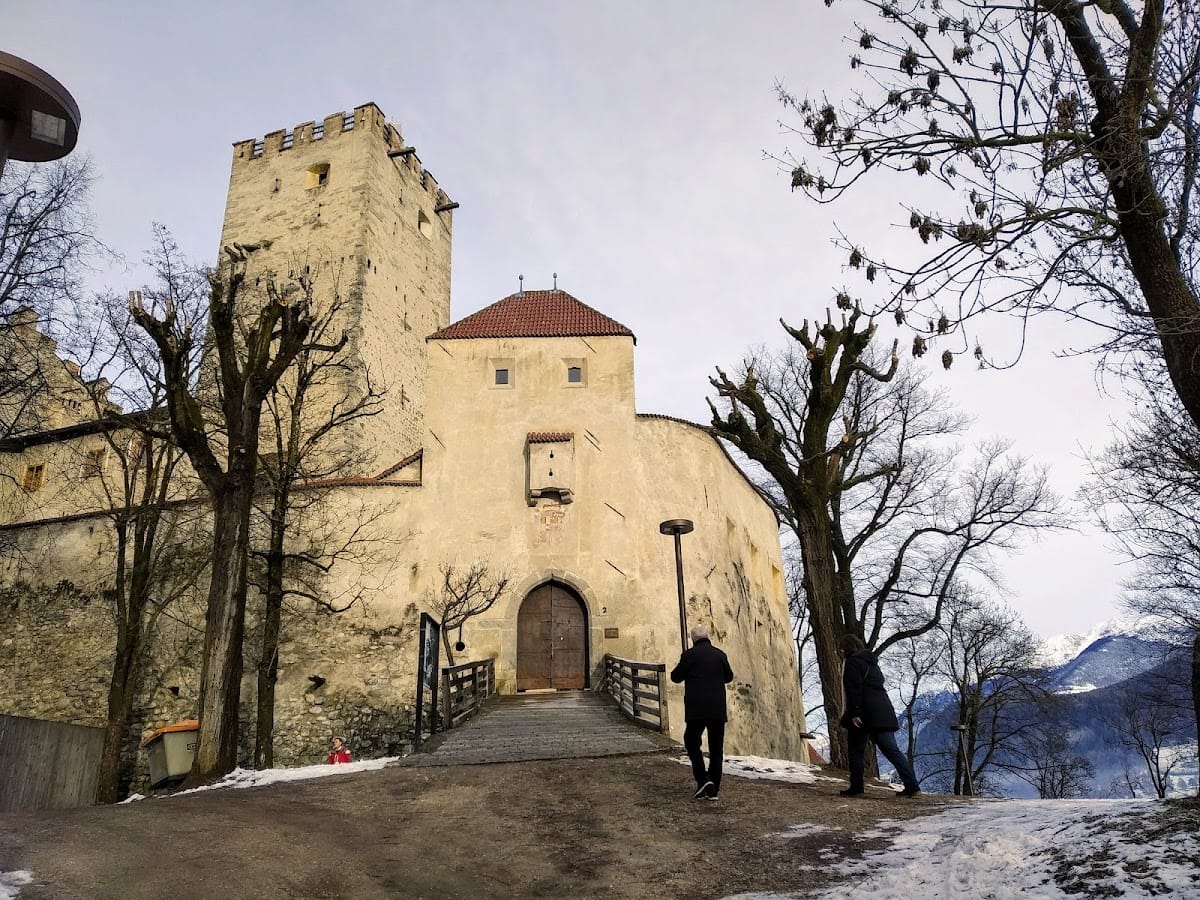
The southern approach formerly crossed a drawbridge, a movable bridge that could be raised to obstruct the entrance. The gateway contains a Gothic portal dated 1584, with the coat of arms of Bishop Andreas von Österreich above it. The entrance therefore preserves both the defensive arrangements of the castle and a later architectural intervention.
Bell Tower and Wings
A courtyard lies within the walls and contains a circular tower with a staircase leading to the upper rooms. The bell tower is described as the oldest part of the castle and was probably inhabited in an earlier phase, while other parts of the complex adjoin it. The right wing contains the bishops’ accommodation, and the left wing holds the administrator’s apartment and staff quarters. Another wing was adapted for the Messner Mountain Museum.
Episcopal Rooms and Chapel
Episcopal Rooms
The episcopal rooms include a sitting room, conference rooms, and a bedroom. They were entirely renovated around 1900 in the style of that period, creating broad, bright interiors with views over Bruneck. The sitting room has a coffered ceiling, formed from recessed decorative panels, bearing the arms of the von Spaur counts and bishops. Its carved wooden floor includes the date 1900 and the initials “A” and “S,” referring to Bishop Simon Aichner. Each room contains a stucco stove, while paintings decorate the walls in a style described as rare in the area. One painting represents the city of Brixen; the others show imaginary landscapes.
Castle Chapel
The castle chapel was built during the renovation around 1900 in the Neo-Gothic style. Its Neo-Gothic triptych altar, an artwork of three adjoining panels, dates from the same period. The altar depicts five scenes from the lives of the Virgin Mary and Jesus: the Annunciation, Mary with Elizabeth, the Nativity, Mary with Jesus in the Temple, and Jesus among the scribes. The lower scenes show Adam and Eve in Paradise.
The chapel’s stained-glass windows display the Habsburg arms with a black double-headed eagle, the Tyrolean arms with a red eagle, and Simon Aichner’s arms. The latter include a lamb, an eagle with a crozier, an arrow, and an anchor.