Castello Malaspina: A Medieval Fortress in Bobbio, Italy


Visitor Information
Google Rating: 4.1
Popularity: Low
Google Maps: View on Google Maps
Official Website: www.comune.bobbio.pc.it
Country: Italy
Civilization: Medieval European
Remains: Military

History
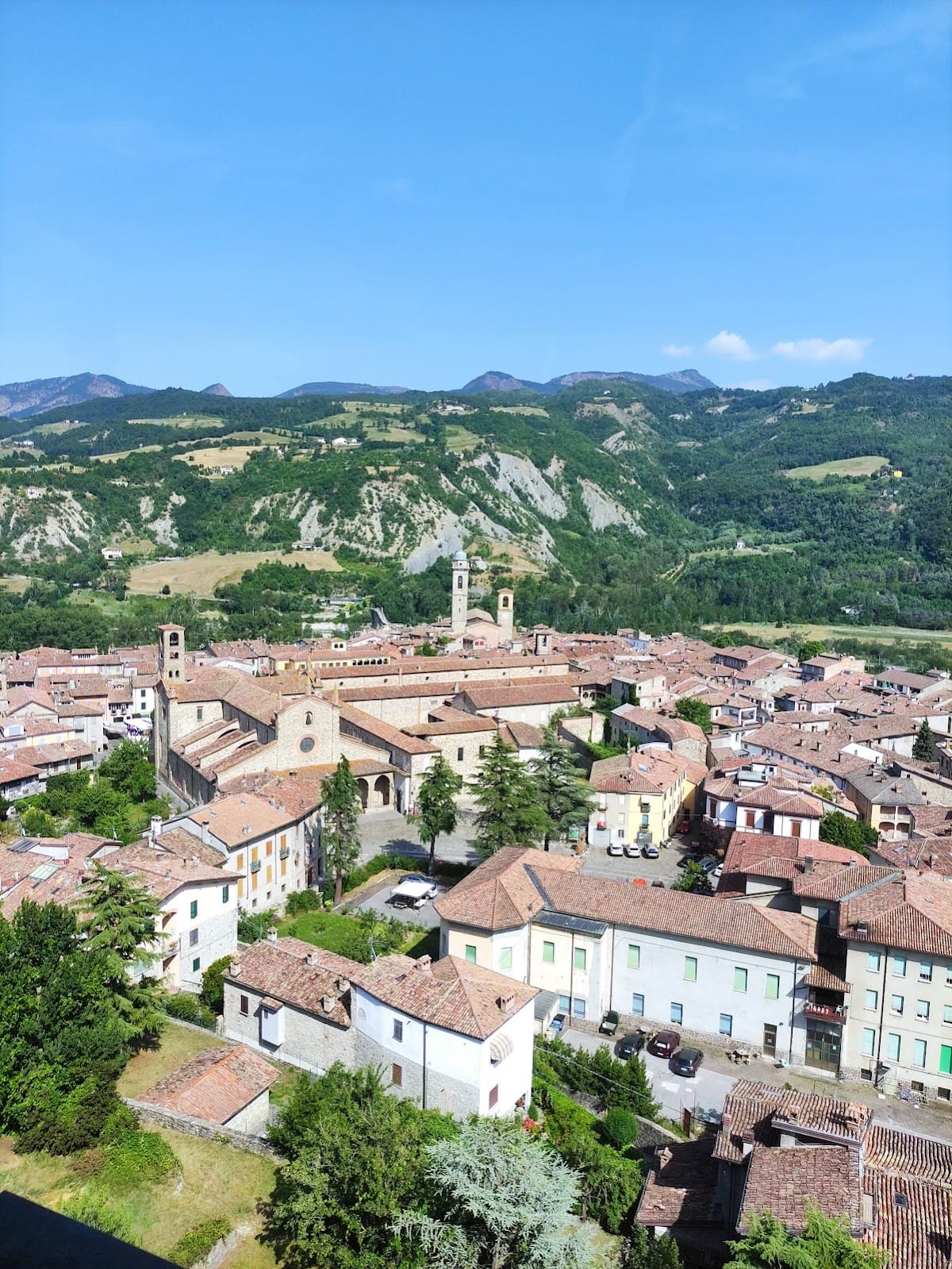
Castello Malaspina stands within the town of Bobbio in what is now Italy, built originally by medieval Christian settlers who developed the area upon earlier Roman and Lombard foundations. Its location near an ancient Roman church situates the castle within a long continuum of religious and military significance dating back to late antiquity.
The earliest fortifications in Bobbio began in the 13th century, marked by the construction of surrounding city walls. A 1219 document references the “Braida de Castello,” indicating that the area of the castle held a clear defensive role even before the current structure took shape. The castle as it appears today was commissioned in the early 14th century by Corradino Malaspina, a member of the prominent Malaspina family, who gave the fortification its name and major form. This construction came on the site adjacent to what was once believed to be the ancient Basilica of San Pietro, established by an unknown missionary prior to the arrival of Saint Columban in the area.
Before the Malaspina-built castle, the site included the old Church of Santa Maria, referred to in medieval times as the “Bishop’s Church.” This church played an important role from Lombard times onward, being one of the few religious spaces where women could participate in worship. Between 1017 and 1075, it served temporarily as the seat of the bishop-count, who led both religious and civilian administration during the early period after Bobbio was elevated to city and bishopric status in 1014. Initially, Pietroaldo combined the roles of abbot and bishop until they were divided in 1017, when Bishop Attone shifted the diocese’s seat back to this church from the new cathedral under construction.
The castle became a focal point in regional power struggles during the medieval period. Throughout the bitter conflict between the Guelfs and Ghibellines, the fortress was controlled by the Ghibelline faction, offering sanctuary to nobles escaping the aggression of the Guelf city of Piacenza, which targeted castles in the Val Trebbia area. Control of the castle changed hands several times in the following centuries. In 1342, it came under the rule of the Visconti family from Milan, a powerful dynasty in northern Italy. For a brief interval beginning in 1413, the Anguissola family from the nearby town of Travo captured the castle, holding it for a single year before it was retaken by the Visconti.
In 1436, the Visconti granted the castle along with the associated titles of Count of Bobbio, Voghera, and Val Tidone to the Dal Verme family, who maintained possession until feudal rights were abolished by Napoleon in 1805. After this period, the castle fell into neglect and gradual disrepair. It was sold in 1814 to Paolo dalla Cella, whose descendants later donated the property to the Italian state in 1956.
In more recent decades, the castle has been subject to changing administrative oversight. Since December 2014, management was handled by the Ministry of Cultural Heritage through a regional museum hub organization, later renamed as the Regional Directorate of Museums in 2019. Beginning in January 2020, responsibility for the castle passed to the Municipality of Bobbio.
A striking local legend persists about a well in the southeastern round tower known as the “Knife Well.” According to tradition, the well’s opening was once covered with sharp blades arranged horizontally, connected to a secret dungeon designed to imprison enemies or unwanted visitors. Tales speak of prisoners choosing to leap onto the blades rather than endure lingering injury, and some locals claim that their spirits manifest as apparitions on the tower walls.
Remains
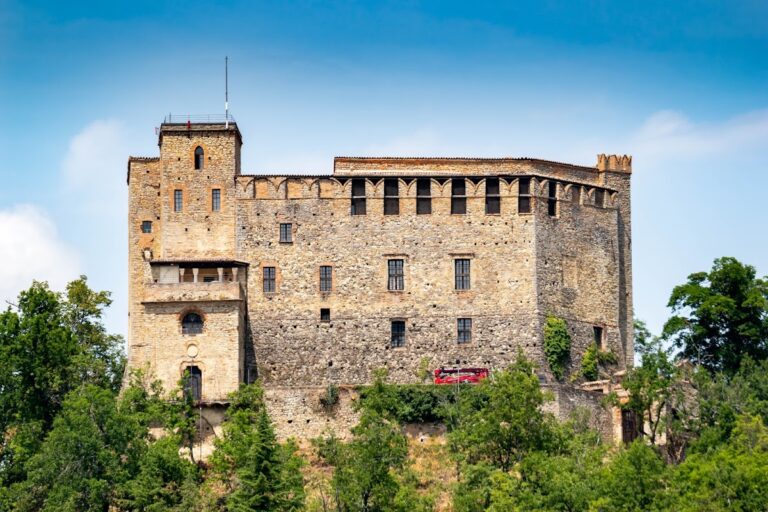
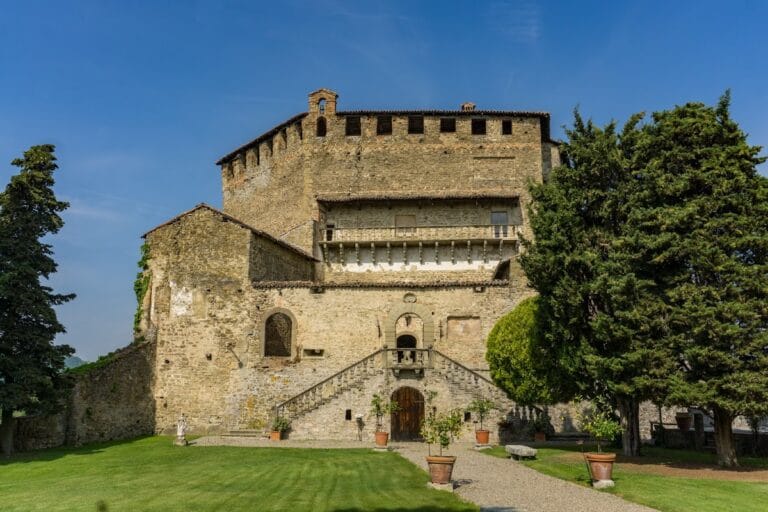
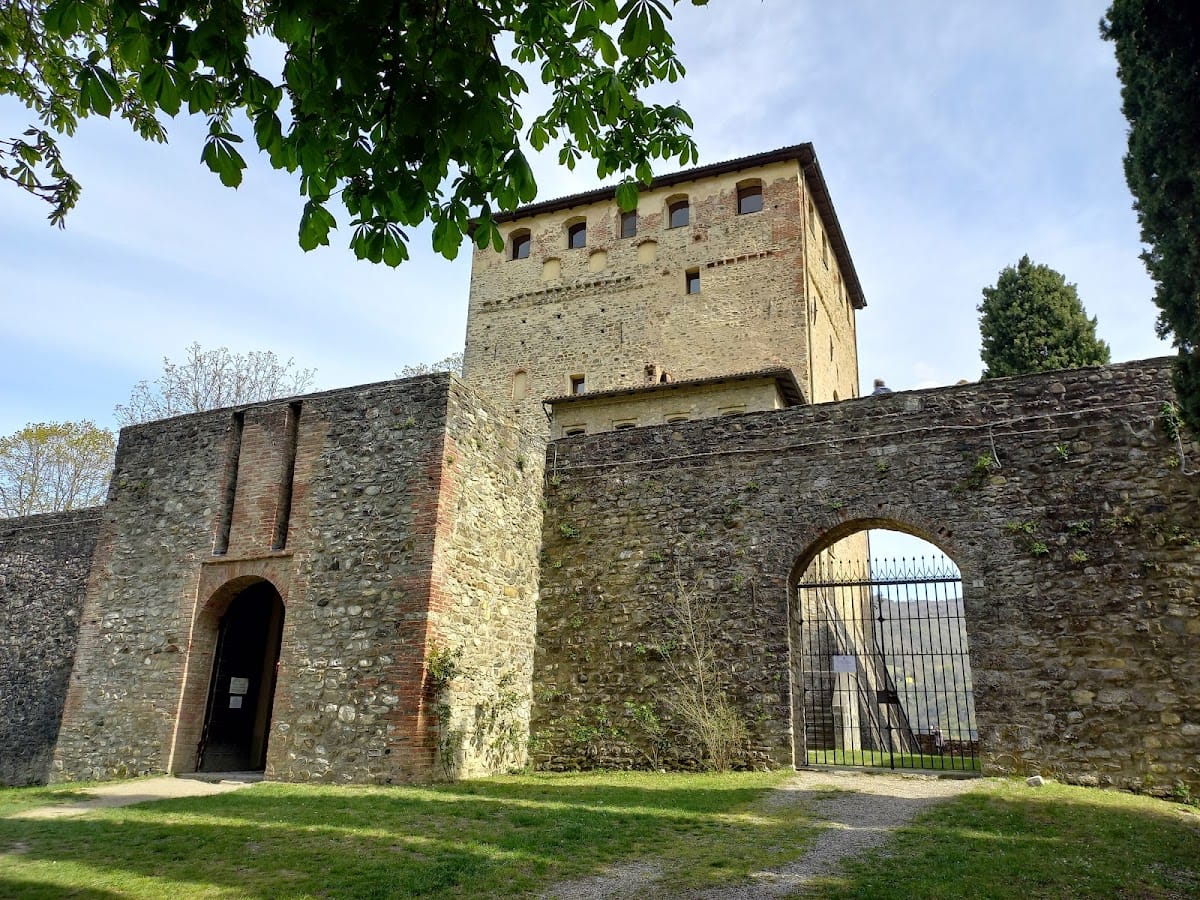
The castle occupies an elevated position reinforced by two sets of defensive walls, though only the inner wall remains today. Its layout is anchored by a large rectangular keep, known in Italian as a mastio, linked to a small round tower and a square tower, alongside additional smaller buildings and guard quarters. A more recent, lower structure completes the complex. All buildings are constructed primarily from stone with interspersed brick sections, featuring small windows and roofs covered with traditional tiles.
The oldest architectural element is the Bishop’s Tower, erected shortly after 1017 adjacent to the ancient Roman Church of Santa Maria. This tower likely originated as a bell tower with added defensive capabilities, serving as both a lookout and a place to house troops prior to the erection of the full castle. Historical modifications include a reduction in the tower’s height, though the exact timing remains unknown.
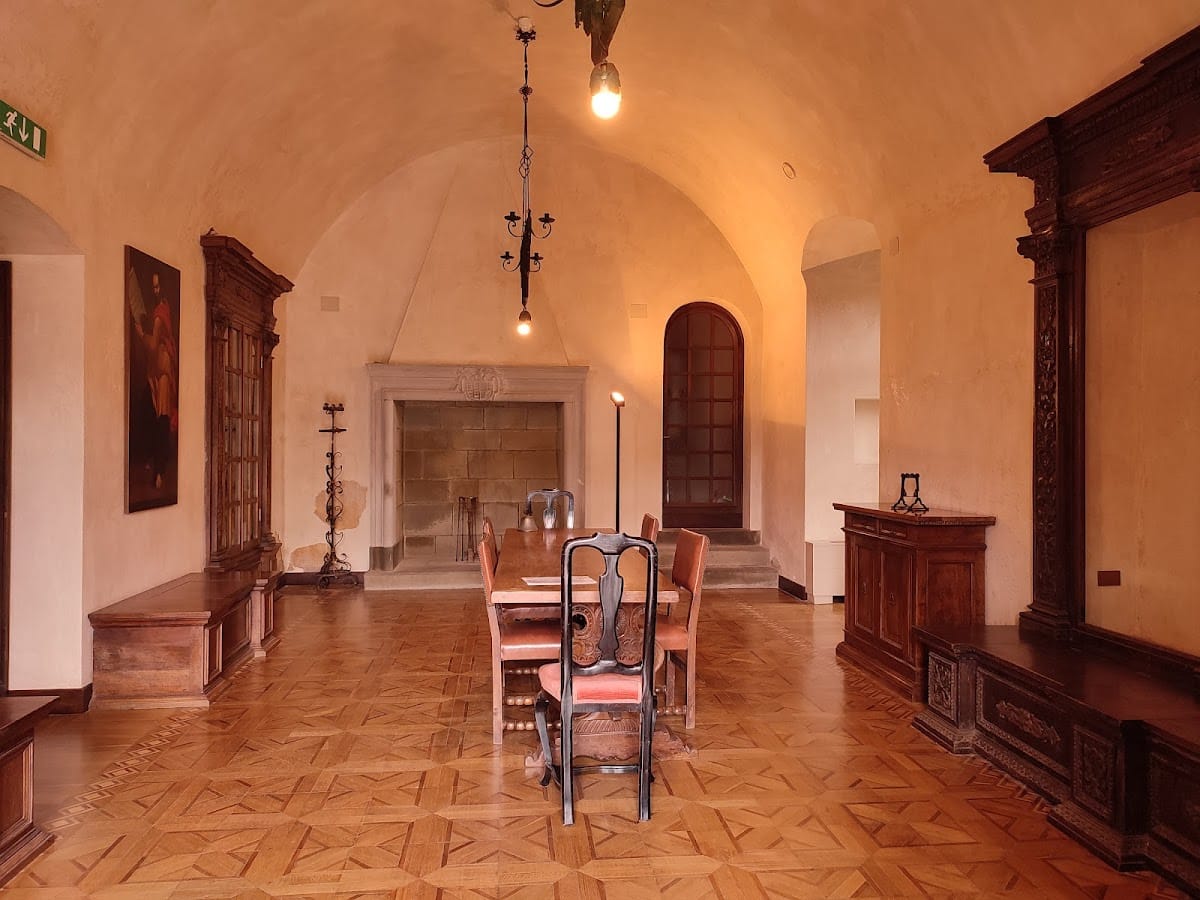
The central keep rises across five floors. The ceilings of these levels are constructed with barrel vaults—arched stone ceilings shaped like half-cylinders—supported by wooden floors with decorative inlays. The lower three floors were used as living quarters, while the fourth floor accommodated soldiers. The topmost floor, situated under the attic and supported by four stone pillars, served a purely military function, providing space for defensive maneuvers. Originally, this floor was lit only by narrow, splayed arrow slits designed for archers; today, 18 newly installed windows brighten the space.
The castle’s perimeter was once enclosed by two fortified curtain walls. The inner wall forms a rectangular enclosure closely hugging the keep, built on an earth embankment that elevates the stronghold above its surroundings. The outer wall, removed in 1858, was linked historically to fortified gates and contained two towers inside its boundaries: the small tower and the Torre di Primatello. Early maps from the 18th century document these features in detail.
Access to the keep was originally through a single northwest entrance equipped with drawbridges, though traces remain of a second entrance as well. These defenses reflect the castle’s strategic military role in controlling the town and its approaches.
Among the castle’s interior enigmas is the “Knife Well,” located in the basement of the southeastern round tower. This feature is now filled in and sealed. Historical accounts describe the well’s opening as once covered with horizontally mounted blades, designed to deter escape from a connected secret dungeon below. Legends tell that victims, including captives and abducted women, met their fate in this grim space, sometimes choosing death by the blades over slow suffering. Stories of ghostly apparitions linked to this site add a haunting layer to the castle’s historical narrative.
Nearby sites