Castello Gizzi: A Historical Castle and Cultural Center in Torre De’ Passeri, Italy

Visitor Information
Google Rating: 4.1
Popularity: Very Low
Google Maps: View on Google Maps
Country: Italy
Civilization: Unclassified
Remains: Military

History
Castello Gizzi is situated in Torre De’ Passeri, Italy, a site with historical roots stretching back to medieval times. Its origins can be traced to a defensive tower constructed in the 12th century, initially under the ownership of the Abbey of San Clemente a Casauria, a religious institution with considerable regional influence during the Middle Ages.
In 1719, Marquise Smeralda Mazara di Sulmona constructed the castle we see today on the foundations of this earlier tower. The new building incorporated elements of the medieval structure, demonstrating a continuity of the site’s defensive and residential use. For over two centuries, the castle remained in the hands of the Mazara family, marking a prolonged period of private ownership without notable interruptions in its function or status.
A significant transition occurred in 1967 when the Gizzi family acquired the property. This change in ownership paved the way for a new cultural chapter for the castle. In 1979, the castle became the headquarters of the Institute of Studies and Research officially named “Casa di Dante in Abruzzo.” Founded by Corrado Gizzi, this institute also houses the Dante Museum “F. Bellonzi” and the library “M. A. Caldora,” dedicating itself to the promotion and study of Dante Alighieri’s works and legacy.
The foundation actively connects with prominent cities linked to Dante, such as Florence, Ravenna, and Rome, and organizes scholarly activities including conferences and round tables. Its inaugural conference took place in 1980 with a presentation by Giorgio Petrocchi, followed by a 1981 event focused on “Dante e il Rossettismo.” The foundation gained formal recognition as a moral entity in 2005, consolidating its mission and presence within the castle. After suffering damage in 2009, the castle underwent restoration efforts and was reopened in 2019. It continues to function under the oversight of Italy’s Ministry of Cultural Heritage and Activities, maintaining its role as the foundation’s official seat.
Remains
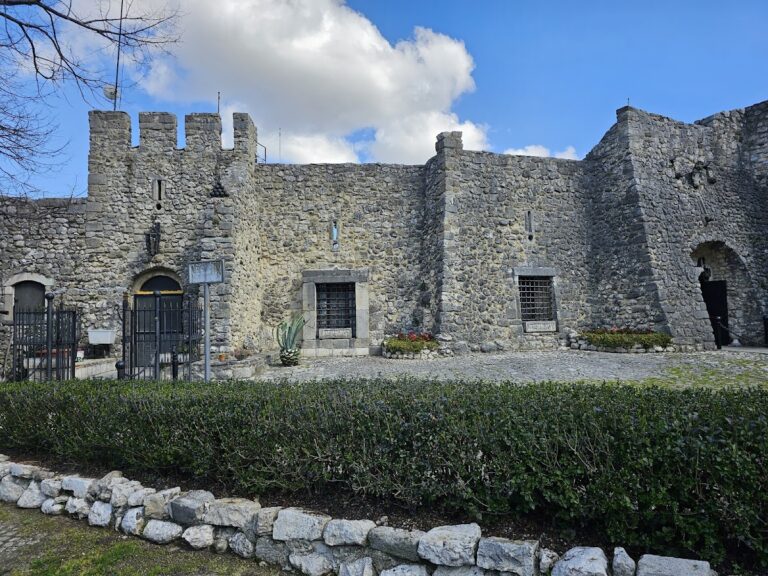
The castle complex presents a well-organized arrangement, comprising a main four-story building, a dépendance, a cellar, and an extensive park encompassing eight hectares. Constructed predominantly using stone, the main façade features a prominent stone portal crowned by a balcony, above which the Mazara family coat of arms is displayed, recalling the castle’s aristocratic origins.
Adjacent to the façade, five arches from the medieval period remain embedded within the structure. These arches are vestiges of earlier architectural forms, reflecting the castle’s connection to the original 12th-century tower built by the Abbey of San Clemente a Casauria. Their presence indicates the integration of medieval elements into the later 18th-century construction.
The courtyard before the castle hosts a significant archaeological ensemble that includes a sarcophagus dating back to the 4th century BC. This funerary monument, crafted from stone, points to the area’s long-standing use and importance before the medieval period. Accompanying this sarcophagus are fragments of columns believed to be from the imperial Roman era, suggesting the reuse or preservation of classical materials within the site. These remain visible in situ, offering a tangible connection to ancient times.
Following the 2009 damage, the castle underwent thorough restoration, which preserved its historical and architectural features. Today, it stands as a restored monument that embodies the layers of its past—from Roman relics and medieval arches to its 18th-century rebuilding—while continuing to serve as a center dedicated to Dante Alighieri’s cultural heritage.
Nearby sites