Rocca Calascio: A Mountaintop Fortress in Italy


Site at a Glance
- Rating
- 4.8
- Popularity
- High
- Country
- Italy
- Primary era
- Medieval
- External website
- Open
- Eras represented
- Medieval
- Civilizations
- Kingdom of Naples, Norman
- Site type
- Military
- Remains
- Fort
On this page9 sections
History
Rocca Calascio is a mountaintop fortress in Italy, in the Abruzzo area of the Province of L’Aquila. Traditionally attributed to Roger II of Hauteville, the Norman ruler who became king of Sicily, it began in the tenth century as a single watchtower during the period of Norman expansion in southern Italy. The fortress later developed into a fortified complex with a medieval settlement, and its elevated position made it part of a defensive and lookout system extending from the Apennines to the Adriatic coast.
From watchtower to medieval stronghold
During the Middle Ages, a village grew around the original tower. From the twelfth century, Rocca Calascio and the settlement formed part of the Barony of Carapelle, a territorial lordship that also included Calascio, Carapelle Calvisio, Castelvecchio Calvisio, and Santo Stefano di Sessanio. The fortress and village therefore belonged to a wider political and defensive network rather than functioning as an isolated stronghold.
In the thirteenth century, the original watchtower was expanded with a walled courtyard and four cylindrical corner towers around a taller central tower. The complex was intended for military use and to house troops, not as a noble residence. Its position between the Campo Imperatore plateau and the lower plateaus of Navelli and the Tirino allowed it to overlook the Plain of Navelli and the surrounding valleys.
Earthquake, firearms, and economic change
The L’Aquila earthquake of November 1461, estimated at magnitude 7–8, badly damaged Rocca Calascio. Calascio below the fortress was rebuilt, but the fortress was not reconstructed at that time. It was never tested in battle. In 1463, Ferdinand I of Naples granted ownership of the complex to Antonio Todeschini of the Piccolomini Todeschini, an Italian aristocratic family. Todeschini commissioned its adaptation to firearms, producing the form associated with the later castle.
Under Aragonese rule in the Kingdom of Naples, the establishment of a sheep-transhumance customs administration for Apulia gave the surrounding economy new impetus. Transhumance was the seasonal movement of livestock between different grazing grounds. Pastoralism and related activities became the principal source of income for the village, fortress, and surrounding area. In 1474, the settlements of the barony possessed more than 90,000 sheep, and the area became a center of wool production and trade.
Medici ownership and decline
In 1579, Costanza Piccolomini and Francesco I de’ Medici, grand duke of Tuscany, reached an agreement through which the Medici, the prominent Florentine ruling and banking family, acquired the village and fortress. The purchase also included the Barony of Carapelle and the Marquisate of Capestrano, a territory governed by a marquis, for 106,000 ducats.
After Bourbon rule began in 1743, the settlement entered a period of decline and was progressively abandoned. The village was completely uninhabited by 1957, although it remains semi-depopulated. Restoration and consolidation began in the 1980s. Some houses in the medieval village were recovered and converted into accommodation, while the fortress became a major cultural and tourist destination in the L’Aquila area. Rocca Calascio is regarded as one of the symbols of Abruzzo and lies within the Gran Sasso e Monti della Laga National Park. The village and fortress continue to be associated with cultural events, including falconry, classical-music concerts, and historical-cultural activities.
Remains
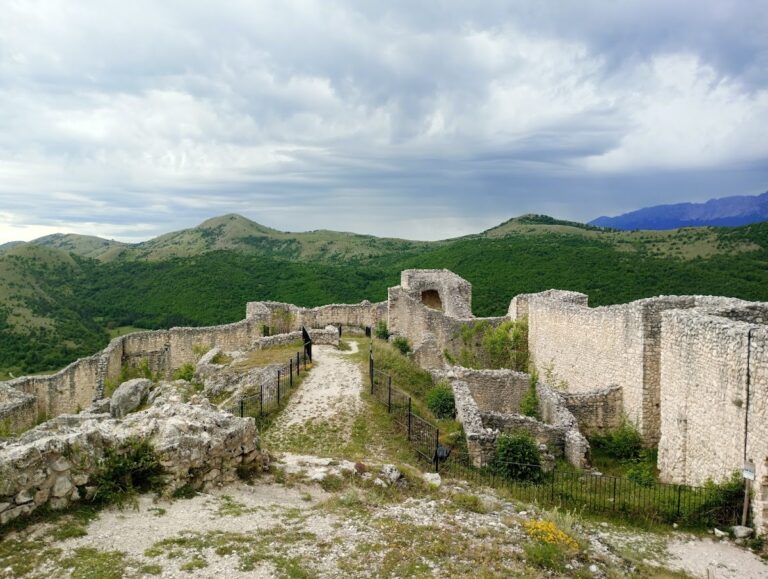
Rocca Calascio consists of a mountaintop fortress and an adjacent medieval village extending southeast as a single fortified complex. The village lies about 3 kilometres from the town center of Calascio and approximately 200 metres higher. The fortress occupies the highest point of the ridge, at an elevation variously given as about 1,410–1,520 metres, with approximately 1,460 metres commonly cited. It is among Italy’s highest castles and is described as the highest fortress in the Apennines, although the Castle of Andraz, above 1,700 metres, stands higher.
Fortress and village
Mountaintop fortress
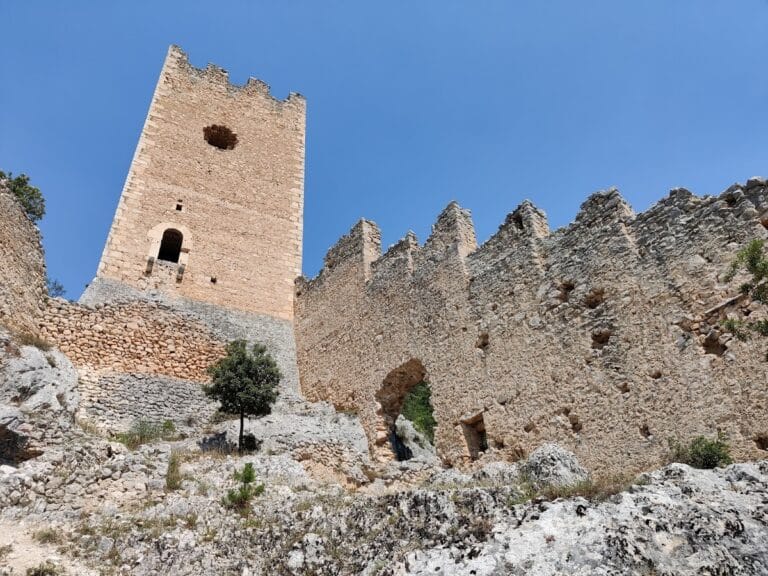
Built exclusively for military purposes, the fortress is formed from stone and masonry. Its original tenth-century watchtower was enlarged in the thirteenth century by a walled courtyard. Four cylindrical towers occupy the courtyard’s corners, surrounding a taller central tower that forms the principal fortified mass. The lower half of the fortress uses noticeably larger stones than the upper half, an arrangement believed to have strengthened the base against invading forces. The complex stands between the Campo Imperatore plateau and the lower plateaus of Navelli and the Tirino, with a commanding position over the surrounding valleys and the Plain of Navelli.
Medieval village
The settlement has a higher, older section represented by archaeological remains and a lower, later section that has been partly recovered. Its limited development was related to the fortress’s small capacity and the need to shelter the local population from attacks by invaders. A wooden drawbridge once connected the village to the fortress. That bridge has been replaced by a simple fixed ramp. The recovered houses form part of the surviving relationship between the residential settlement and the military stronghold.
Santa Maria della Pietà
The church of Santa Maria della Pietà stands northwest of the fortress, beside the route toward Santo Stefano di Sessanio and at a slightly lower elevation. It was erected in 1596, probably over an earlier Renaissance wayside shrine. The building has an external octagonal plan, a sacristy attached to one façade, and an eight-segment dome. Inside, Tuscan pilasters, flat rectangular supports based on the plain Tuscan order of classical architecture, articulate the space. The church contains a painting of the miraculous Virgin and a sculpture of an armed Saint Michael.
The painting and sculpture represent the expulsion of brigands, the event that tradition associates with the church’s construction. Santa Maria della Pietà now functions as a simple oratory, a small place of prayer, and remains a destination for worshippers and devotees.