Castello di Pergolato: A Medieval and Renaissance Residence in Tuscany

Visitor Information
Google Rating: 4.2
Popularity: Very Low
Country: Italy
Civilization: Unclassified
Site type: Military
Remains: Castle

History
Castello di Pergolato is a medieval noble residence located in San Casciano in Val di Pesa, Italy. Its origins date back to at least the late 12th century, with the first recorded mention in 1185, which also notes the existence of a mill within its territory. Initially constructed during the medieval period, the castle was part of a network of fortifications and residences in the Tuscan countryside.
The castle became the property of the Buondelmonti family, an influential noble lineage in the region, who controlled several nearby strongholds including those at Fabbrica, Bibbione, and Montefiridolfi. Under their ownership, Castello di Pergolato held not only a defensive role but also served as a family seat. Historical records link the castle to notable events such as the assassination of Ugone di Valberto Buondelmonti, underscoring the turbulent nature of noble rivalries during the period.
In the 16th century, the Buondelmonti undertook significant renovations to transform the medieval fortress into a Renaissance villa. This shift brought with it architectural and cultural changes, as reflected by an inscription found on one of the interior door architraves that commemorates this remodeling. During this era, the castle was home to Caterina Picchena, the wife of a member of the Buondelmonti family, whose personal life was marked by dramatic love affairs, often set against the backdrop of the villa.
Ownership of Castello di Pergolato remained with the Buondelmonti through to the early 18th century. Subsequently, the estate passed through inheritance and sale to the Rinuccini family and later to the Corsini family, both prominent in Tuscan aristocracy. Over time, the castle changed hands several times until it came into the possession of the Poccianti family, its current owners.
Remains
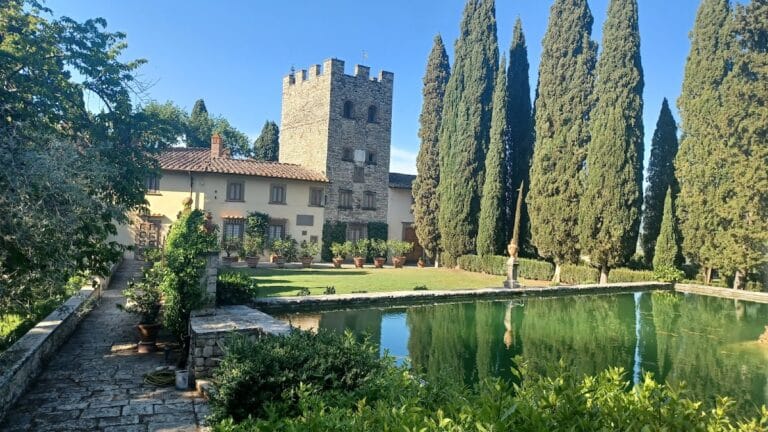
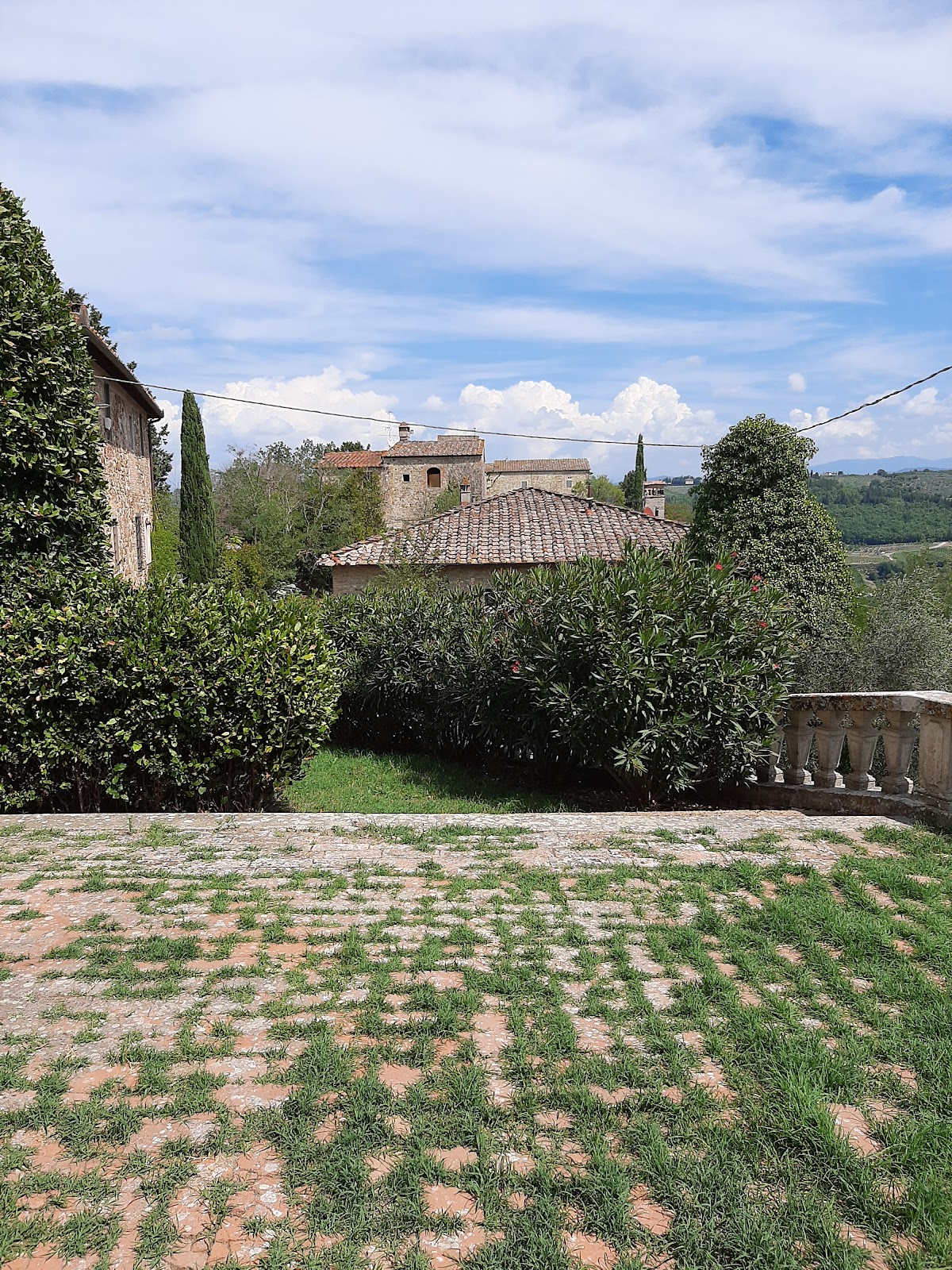
Castello di Pergolato presents a distinctive architectural layout formed by two adjoining rectangular structures set perpendicular to each other and connected by a central square tower. This arrangement sits prominently on a rocky outcrop, surrounded by a characteristic grove of cypress trees, overseeing the valley of the Pesa River with commanding views.
Along the side that faces the river valley, a notable feature is the two-level loggia, an open gallery or corridor. Constructed in 1520 as indicated by an inscribed epigraph on site, this loggia consists of three openings on each level; the lower arcade is composed of rounded arches typical of Renaissance design, while the upper level features horizontal beams or architraves. This architectural element reflects the villa’s transition from a medieval fortress to a Renaissance residence.
Positioned at the base of the castle is the church of San Pietro a Pergolato, which historically formed part of the estate’s complex. Its proximity suggests a close relationship between the religious and residential functions within the site’s grounds, although detailed information on the church’s age or architectural specifics is not provided by the sources.
Together, these structures compose a site where medieval fortification and Renaissance elegance coexist, illustrating the layered history embedded in Castello di Pergolato’s walls and surroundings.
Nearby sites