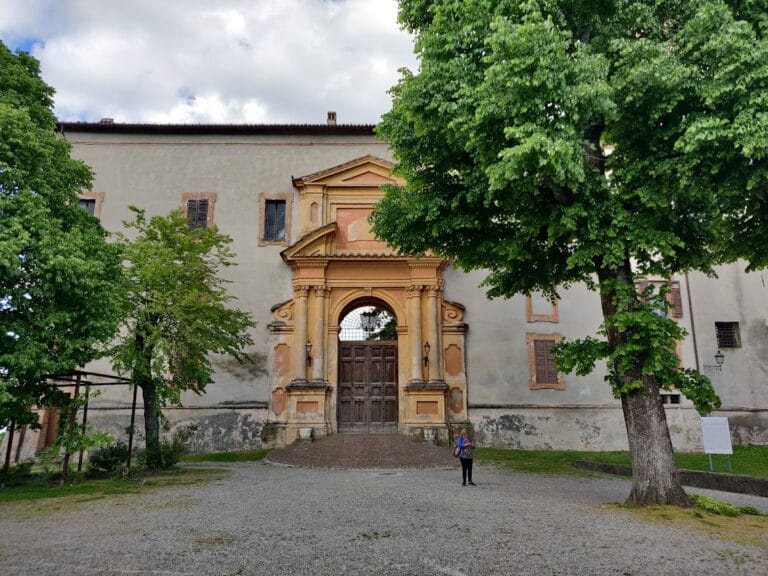
Castello di Montecuccolo: A Medieval Fortress in Pavullo nel Frignano, Italy


Visitor Information
Google Rating: 4.5
Popularity: Medium
Google Maps: View on Google Maps
Official Website: www.castellodimontecuccolo.com
Country: Italy
Civilization: Medieval European
Remains: Military

History
The Castello di Montecuccolo stands in the municipality of Pavullo nel Frignano in Italy and was originally constructed by local medieval rulers. Its earliest phase began in the early 11th century as a simple wooden watchtower and palisade built between 1019 and 1027. This initial structure served as a lookout point on the hill overlooking the Pavullo valley.
By 1027, the castle was mentioned in historical documents, marking its recognized presence in the region. In 1116, Emperor Henry V granted the site as a fief to loyal vassals of Matilda of Canossa, a powerful noblewoman influential in northern Italy. Under her vassals, the castle underwent its first major stone rebuilding, replacing the wooden defenses with more durable stone walls. During this period, construction began on a tower and a palace, laying the foundations for the fortress’s later expansion.
From the 13th through the 16th centuries, the castle grew substantially. Successive additions increased the size and strength of the walls, eventually enclosing a courtyard and a lower village surrounding the main stronghold. In 1469, the small church dedicated to Saint Lawrence was built within this lower section, reflecting the integration of religious functions alongside the castle’s military and administrative roles.
The Montecuccoli family rose to prominence locally after a series of feudal conflicts and managed to centralize control of the fortress between the 15th and 17th centuries. They expanded the complex to include a new palace, a square tower, and an administrative building known as the podesteria, signaling the site’s growing importance as a noble residence and seat of local governance.
A notable historical figure born in the castle is Raimondo Montecuccoli, a renowned 17th-century military commander and strategist, who entered the world there on 21 February 1609. His family’s prestige associated with the castle remains one of its enduring legacies.
After the main Montecuccoli lineage ended toward the late 1600s, the castle’s fortunes declined. It suffered significant damage in 1799 when Napoleonic forces attacked and set fire to the complex during the conflicts marking the Napoleonic Wars. The fortress was partially ruined and largely abandoned for more than a century.
In 1961, ownership transferred to the municipal authorities of Pavullo. Over the following decades, especially between 1977 and 2009, restoration efforts stabilized and rebuilt much of the castle and its surrounding village. These efforts allowed the castle to transition from neglect to becoming a cultural site preserving its layered history.
Remains
The Castello di Montecuccolo is arranged into two main sections: the upper borgo, which houses the main fortress or rocca and attached buildings, and the lower borgo, a small medieval village organized around a communal square and the Church of San Lorenzo. The castle’s construction predominantly uses stone masonry typical of medieval fortifications, employed in walls, towers, and residences.
The original wooden palisade and watchtower from the early 11th century gave way in the 12th century to substantial stone walls forming multiple concentric defenses. These layers of fortification were built over centuries, each phase reflecting expansions to adapt to military needs.
Within the lower borgo, the Church of San Lorenzo dates to 1469 and underwent several changes over the centuries. Its presence highlights the religious life integrated into the feudal settlement and supports the composite function of the castle as both fortress and community center.
A central palace built during the 15th to 16th centuries connects the main keep to the tower known as the tower of the trebbo through a spiral staircase erected at that time. This architecture facilitated easier movement within the complex and linked the residential and defensive areas.
One interior room, known as the “stanza del Generale” or General’s room, contains remarkably preserved decoration from 1545. It retains friezes, coats of arms, and Latin inscriptions, rare survivals amid the general deterioration the castle endured, offering direct visual evidence of the owners’ identities and their alliances.
The coat of arms of the Montecuccoli family prominently features six mountains adorned with olive branches symbolizing peace and strength. An imperial eagle, granted by Emperor Charles IV in 1369, is also part of the heraldry, underscoring the family’s noble and imperial connections.
Originally, the main access to the castle was on the south side, but today’s visitor entrance is located on the northern end near a parking area. Inside the enclosure, several residential houses, an underground restaurant, and a historic street lead toward the castle’s foundational structures.
The restoration campaigns undertaken from the late 20th century to the early 21st century have repaired leaning towers, stabilized stone walls, and restored key buildings, including the church, allowing these various components to be appreciated as a cohesive historical complex. Together, the fortified stronghold and the adjoining village reveal the multiple roles the site played through centuries as a defensive, residential, and administrative center.
Nearby sites