Castle Badenburg (Gießen): A Medieval Waterside Castle

Site at a Glance
- Rating
- 4.4
- Popularity
- Medium
- Country
- Germany
- Primary era
- Medieval
- External website
- Open
- Eras represented
- Medieval, Modern
- Civilizations
- Holy Roman Empire
- Site type
- Military
- Remains
- Castle
On this page7 sections
History
Castle Badenburg is a medieval waterside castle on the Lahn in Gießen, Germany, expanded in the fourteenth century as a fortified residence and controlling an important riverside route. From the fourteenth century until the nineteenth century, its lords held influence over the principal connection between Lollar and Gießen.
Early fiefs and fourteenth-century expansion
In 1323, the knight Bernhard von Göns enfeoffed Hartrad VI, also numbered Hartrad VII, von Merenberg with his “Gaden” at Dyduldishusen. This term referred to a storehouse and place of refuge. The grant also included a farm in front of it. The settlement of Dilshausen, later abandoned, was still mentioned near Badenburg in 1541.
In 1353, Johann von Weitershausen, known as von Bleichenbach, received newly cleared and arable land in the Wieseck Forest from Heinrich I of Isenburg-Büdingen. He expanded Badenburg near Wieseck or Wißmar around 1356. Between 1356 and 1358, Johann received the residence on the bank at Badenberg as a fief, meaning a residence or estate granted by a superior lord in return for service. The grant came from Johann I of Nassau-Weilburg-Merenberg and Landgrave Heinrich II of Hesse, and Johann was later also enfeoffed by Heinrich II’s co-ruler, Landgrave Hermann II of Hesse. Badenburg was therefore held under the joint feudal lordship of Hesse and Nassau. A landgrave was a noble ruler with a rank comparable to that of a count.
Schrautenbach ownership and decline
Through Gerhard von Buseck, known as Rüsser, and his descendants, the fief passed to the Weitolshausen family, known as Schrautenbach. This family was distinct from the von Weitershausen family. Philipp Rode, also called Roth von Burg Schwalbach, sold the estate in 1523 or 1524 to the Hessian councillor Balthasar von Weitolshausen, known as Schrautenbach. The Schrautenbach family used Badenburg as a residence. One later owner was Lieutenant General Ludwig Balthasar von Schrautenbach-Weitolshausen, who lived from 1654 to 1738.
Badenburg was damaged during the Thirty Years’ War, the major European conflict fought from 1618 to 1648, and subsequently declined. During the eighteenth and nineteenth centuries, parts of the site were reused as a smithy and as accommodation for shepherds. From 1760, the castle also became known as an inn.
Badenburg and the republican opposition
Gießen students used the castle and inn for excursions, fencing practice, secret meetings, and protest processions. In 1834, Georg Büchner hid there with republican revolutionaries including Friedrich Ludwig Weidig and Karl Minnigerode. Büchner was a nineteenth-century German writer and revolutionary; Weidig was a Protestant pastor and political activist, while Minnigerode was a republican revolutionary.
The Press Association emerged from these meetings in July 1834. This political organization was concerned with publishing and distributing oppositional writings. Further pamphlets were intended to be issued from Badenburg alongside The Hessian Courier, written by Büchner and later revised by Weidig.
Later alterations and heritage status
Construction of the Main-Weser Railway in a deep cutting parallel to the Lahn destroyed part of Badenburg’s historic garden. The castle and inn were renovated in 1975, although the work did not fully respect the historic arrangement. Badenburg is designated as a cultural heritage monument in Hesse, and the complex continues to house the Badenburg Ritterkeller inn.
Remains
Riverbank setting and surviving complex
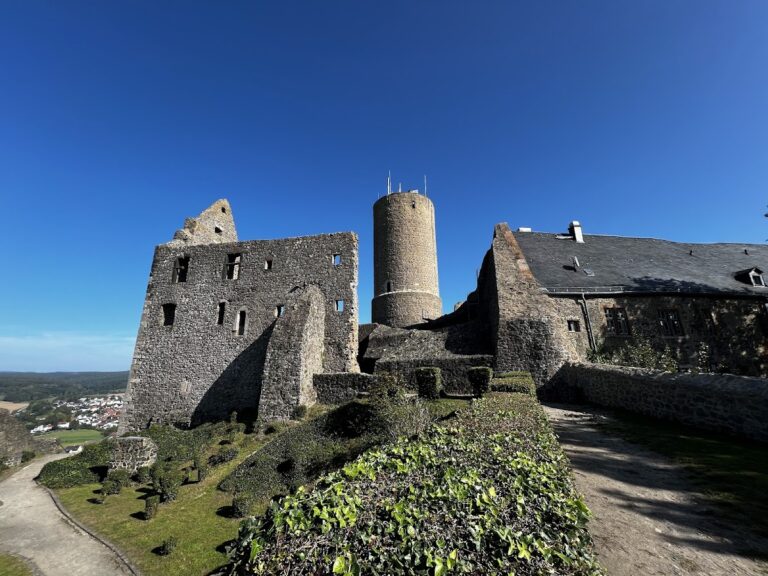
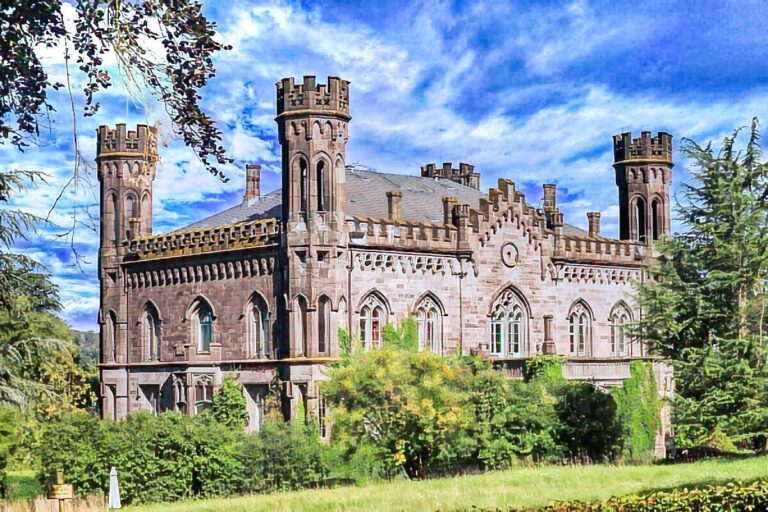
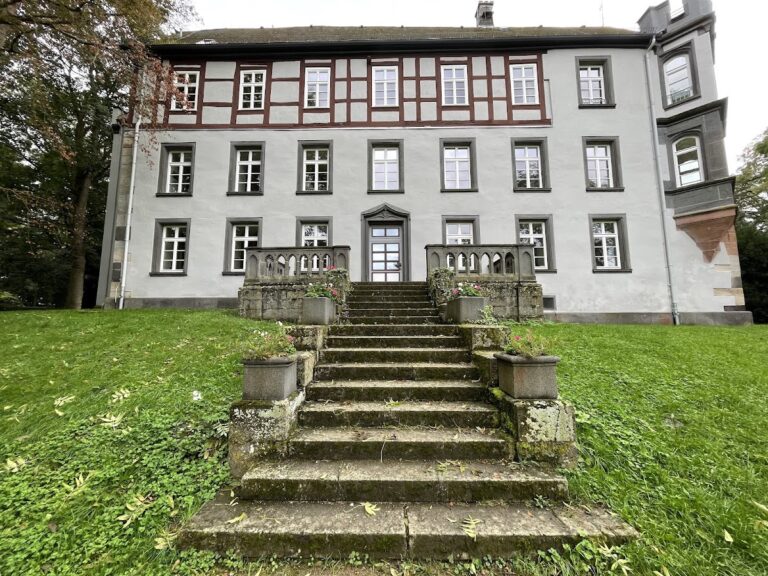
Badenburg is a lowland castle built in relatively level terrain directly beside the Lahn, slightly above rapids in the river. Its position makes it a waterside or riverbank castle, a fortified site located beside a river in relation to a route or natural obstacle. The surviving complex includes substantial parts of the castle and a historic garden.
Part of the garden was destroyed when the Main-Weser Railway was laid in a deep cutting alongside the Lahn. The remaining castle complex now contains the Badenburg Ritterkeller inn. The 1975 renovation altered the historic arrangement, while substantial portions of the medieval riverbank site survive.