Bodobrica Roman Fort: A Late Roman Military Site in Boppard, Germany



Visitor Information
Google Rating: 4.2
Popularity: Low
Google Maps: View on Google Maps
Official Website: www.mittelrheinentdecken.de
Country: Germany
Civilization: Roman
Remains: Military

History
The Bodobrica Roman Fort, located in present-day Boppard, Germany, was established by the Romans around the mid-4th century AD. It served as a military camp on the Rhine frontier, a critical boundary line protecting the Roman Empire from Germanic tribes. The fort was positioned on a slight rise above the river to avoid flooding and to oversee river traffic and movements along the frontier.
Before the fort’s construction, the site hosted an earlier Roman settlement. Historical records from the 2nd and 3rd centuries, including the Tabula Peutingeriana and the Itinerarium Provinciarium Antonini Augusti, mention the location under names such as Bouobriga and Bontobrice. These names likely stem from an earlier Celtic settlement called Boudobriga, indicating a long history of habitation before Roman military use.
In the early 5th century, the Notitia Dignitatum, a Roman administrative document, lists the fort as housing milites balistarii, specialized artillery troops. These soldiers operated stone-throwing and arrow-shooting weapons and were under the command of the Dux Mogontiacensis, the military leader based in Mainz. This highlights the fort’s role in the defensive network along the Rhine.
Following the Roman military withdrawal in the early 400s, the fort’s military function ceased, but a civilian population remained. Around 406 or 407 AD, the military bathhouse was destroyed by fire. In its place, an early Christian church was constructed in the mid-5th century, which later became the foundation for today’s St.-Severus-Kirche. This transition reflects the shift from military to religious and civilian use during the post-Roman period.
During the Middle Ages, the fort’s walls were integrated into the city’s defenses and remained in use until the 12th century. Over time, parts of the fortifications were altered or demolished as the town evolved. Archaeological interest in the site began in 1939 with accidental finds during sewer work, followed by systematic excavations from 1959 to 1966 and further digs between 1989 and 1995. These investigations uncovered well-preserved remains, confirming the fort’s importance in late Roman frontier defense.
Since 2002, the Bodobrica Roman Fort has been recognized as part of the UNESCO World Heritage Upper Middle Rhine Valley, highlighting its cultural and historical significance.
Remains
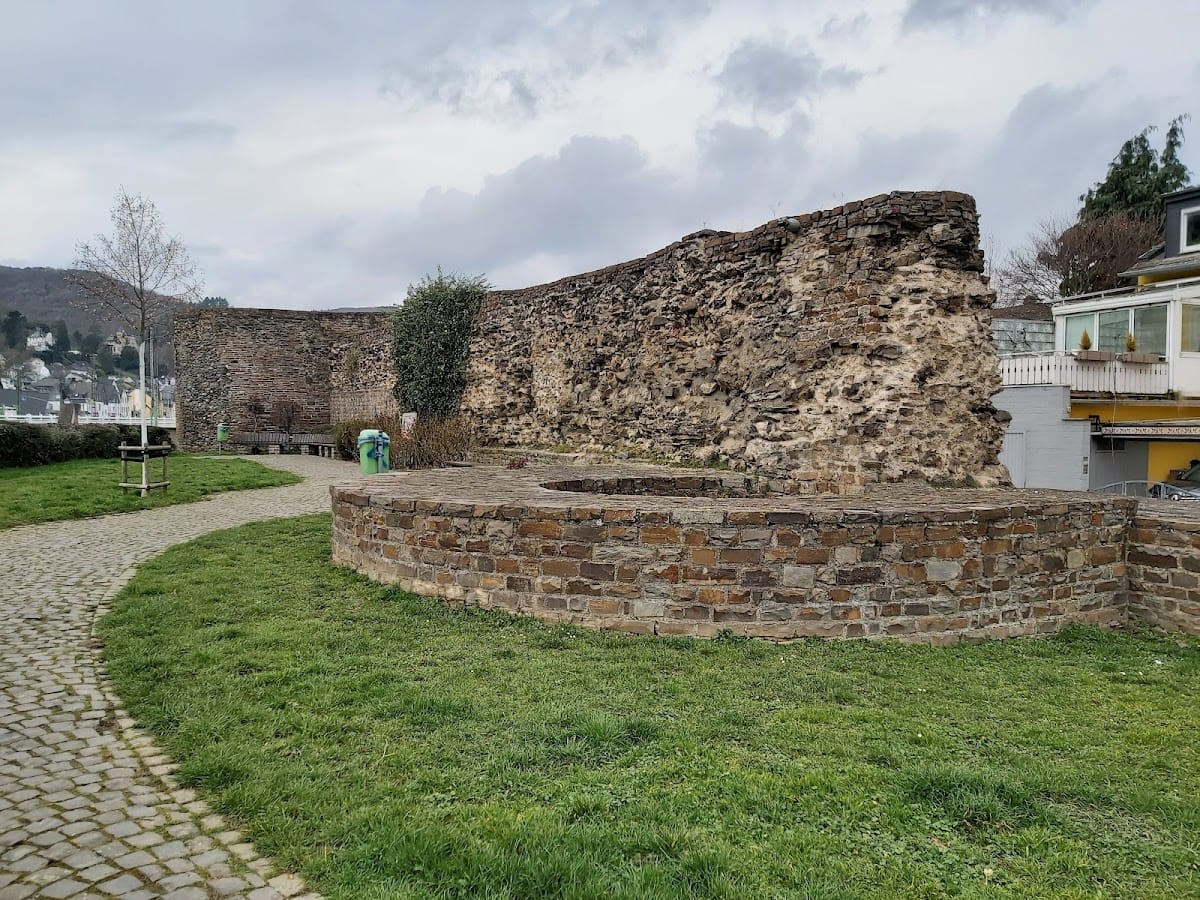
The Bodobrica Roman Fort covers about 4.6 hectares, enclosed by a stone wall roughly three meters thick. The wall is preserved in places up to nine meters high. It features around 28 round towers spaced about 27 meters apart, each up to 10 meters tall and nearly nine meters wide. These towers were designed to hold artillery operated by the stationed troops, allowing them to defend the fort with stone-throwing and arrow-shooting weapons.
The fort’s southern wall was further protected by a defensive ditch. It had main gates on the west and east sides without towers, a narrow postern gate on the south, and possibly a gate on the north side, though this remains unconfirmed. Inside, a main street aligned with today’s Oberstraße ran through the fort, connecting to the road outside the southern wall.
The masonry includes small greywacke stone blocks on the outer side, with more finely cut stones and a herringbone pattern called opus spicatum in some sections and towers. Two surviving towers still show arrow slits beneath later medieval additions, indicating their original defensive purpose.
Next to the northern wall stood a large military bathhouse measuring 50 by 35 meters. Built at the same time as the fort, it used slate greywacke stone with brown-red plaster on the outside and had a red tiled roof with glazed windows. The bathhouse featured an entrance vestibule leading to changing rooms, a large multipurpose room, a heated apsidal room with an underfloor heating system called a hypocaust, and bathing facilities including cold, warm, and sweating baths. Water was supplied from nearby hills and drained through a lead pipe into the Rhine.
Coins from Emperor Constantius II’s reign (341–346 AD) and stamps from the 22nd Legion found beneath the bathhouse floor date its use to no later than the mid-4th century. The bathhouse was destroyed by fire around 406 or 407 AD and later replaced by a Christian church.
Excavations also uncovered early Christian graves from the 7th century and a 5th-century baptismal font preserved beneath the current St.-Severus-Kirche. The surrounding civilian settlement, or vicus, extended about 50 meters beyond the fort walls. It contained substantial houses, some with cellars, inhabited by relatively wealthy residents during the 2nd and 3rd centuries, as shown by elaborate tomb monuments along the Roman road.
Among notable finds is a well-preserved terracotta figurine of the Celtic horse goddess Epona, about 12 centimeters high, discovered in a vicus house. This artifact is now kept in the Landesmuseum Koblenz, with copies displayed locally.
The remains of Bodobrica Roman Fort rank among the best-preserved late Roman fortifications in Germany. Parts of the western wall and towers have been exposed following modern urban redevelopment, allowing a clear view of the fort’s original defensive structures.
Nearby sites