Lahneck Castle: A Medieval Fortress Above the Lahn in Germany


Site at a Glance
- Rating
- 4.3
- Popularity
- Medium
- Country
- Germany
- Primary era
- Medieval
- External website
- Open
- Eras represented
- Medieval, Modern
- Civilizations
- Holy Roman Empire
- Site type
- Military
- Remains
- Castle
On this page11 sections
History
Lahneck Castle is a medieval castle in Germany, built by the Archbishopric of Mainz in 1226 above Lahnstein at the mouth of the Lahn. Mainz Archbishop and Elector Siegfried III of Eppstein established it to protect territory that had entered the archbishopric through an imperial fief granted by Frederick II in 1220. The castle belongs to the Hohenstaufen period, the era when that dynasty provided the German kings and Holy Roman Emperors, especially during the twelfth and thirteenth centuries.
Foundation and the Electorate of Mainz
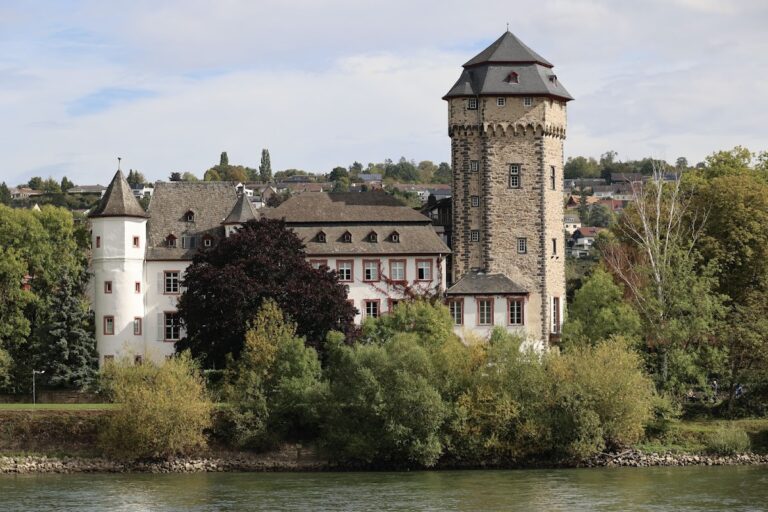
The fief included Oberlahnstein and the Tiefenthal silver mine. Lahneck was not a customs castle, however, because it stood too far from the Rhine to control toll traffic. That responsibility was assigned to Martinsburg Castle on the river. Lahneck’s earliest names, Logenecke and Loynecke, came from the historical name of the Lahn. After 1365, the name developed into Lahneck.
A chapel dedicated to Saint Ulrich of Augsburg, a tenth-century bishop of Augsburg and widely venerated Christian saint, was built in 1245. That year also brought the first recorded reference to the castle and its burgrave, Embricho of Lahneck. A burgrave was the governor responsible for a castle’s military and administrative affairs. Until 1803, Lahneck formed the northernmost exclave of the Electorate of Mainz, an ecclesiastical principality of the Holy Roman Empire governed by its archbishop-elector. Although the castle and Oberlahnstein belonged politically to Mainz, they were ecclesiastically part of the Archdiocese of Trier.
Royal associations and political events
King Adolf of Nassau stayed at Lahneck in 1298, shortly before he was killed at the Battle of Göllheim by the forces of King Albert I of Habsburg. A later tradition says that Friedrich Schilling of Lahnstein, Lahneck’s burgrave, joined a conspiracy against Albert to avenge Adolf. Mainz forces stormed the castle in 1309 and executed Schilling. A Friedrich is also recorded as burgrave in 1307, when he owed wine and wheat to the Teutonic Order commandery in Koblenz. The Teutonic Order was a medieval religious-military institution that maintained commanderies and other properties across Central Europe.
Another tradition places twelve Templars at Lahneck in 1312. According to the story, they sought refuge there after Pope Clement V ordered the dissolution of the Templars, a military-religious order suppressed in the early fourteenth century, and died fighting troops of Mainz Archbishop Peter of Aspelt. This episode is treated as legend rather than established history.
Religious and imperial politics also brought important visitors to the castle. In 1332, Pope John XXII granted a 40-day indulgence to people attending services in the Saint Ulrich chapel. An indulgence was a remission of ecclesiastical penalties under specified conditions, not forgiveness of the underlying sin. On 15 July 1338, Mainz Elector and Archbishop Henry III of Virneburg took part from Lahneck in the electors’ assembly at Rhens, which led to the Electoral Association of Rhense. On 20 August 1400, the four Rhenish prince-electors met at Lahneck and declared King Wenceslaus deposed. Frederick V, Burgrave of Nuremberg, hosted city delegates at the castle with the Mainz elector. The following day, Rupert of the Palatinate was elected King of the Romans at the King’s Chair of Rhens.
Fortification and destruction
During the Mainz Bishops’ Feud in 1475, Archbishop Diether II of Isenburg strengthened Lahneck against attack. The works added a second wall circuit, an outer defensive enclosure known as a zwinger, three shell towers, the Fuchsturm or Fox Tower, and a square gate tower on the side most exposed to assault. A shell tower was backed by the wall and generally open toward the interior rather than enclosed on every side.
Swedish and Imperial troops severely damaged Lahneck during the Thirty Years’ War in 1632 and 1636. The castle then lost much of its importance. In 1688, during the War of the Palatine Succession, French troops burned its remaining roofs with artillery. These attacks left the medieval stronghold in a ruined condition before its later reconstruction.
Romantic restoration and modern protection
On 18 July 1774, Johann Wolfgang von Goethe, Johann Caspar Lavater, and Johann Bernhard Basedow stopped at Lahnstein during a river journey. While viewing Lahneck, Goethe dictated Geistesgruß, a poem that preceded the song “The King in Thule,” later associated with Faust.
The secularization of 1803, part of the German Mediatisation that abolished or transferred many ecclesiastical territories to secular states, ended Mainz’s rule at Lahneck. The castle passed to the Duchy of Nassau and was assigned that year to the official Peter Ernst von Lassaulx. The Scottish railway entrepreneur Edward A. Moriarty acquired the ruin in 1850, and a Neo-Gothic rebuilding began in 1852. Gustav Göde continued the work from 1864.
Count Ewald von Kleist-Wendisch-Tychow bought Lahneck in 1878 for his wife, Anna, née Baroness von Kleist, who died there in 1892. The Magdeburg manufacturer Hauswald became owner in 1893. Naval captain and later Vice Admiral Robert Mischke acquired the castle in 1907, after which it remained with his family and the Mischke and von Preuschen heirs’ community. Further rebuilding continued until 1937 under Karl Caesar, a Karlsruhe architecture professor and physician. Between 1936 and 1938, romanticizing crenellations and flat roofs were removed and partly replaced with steeply pitched roofs.
A tradition concerns Idilia Dubb, a 17-year-old tourist from Edinburgh who allegedly died of thirst in the high tower in 1851 after a decayed staircase collapsed behind her. Her final diary entry is dated 19 June. The diary and her skeleton were reportedly discovered during restoration in 1860. The story remains a tradition rather than established history. Lahneck has been open to visitors at set times since the 1930s, while some residential rooms on the first upper floor remain periodically inhabited. In 2002, the castle became part of the UNESCO World Heritage Site of the Upper Middle Rhine Valley. It is also protected as a cultural monument under Rhineland-Palatinate’s monument-protection law and as cultural property under the Hague Convention.
Remains
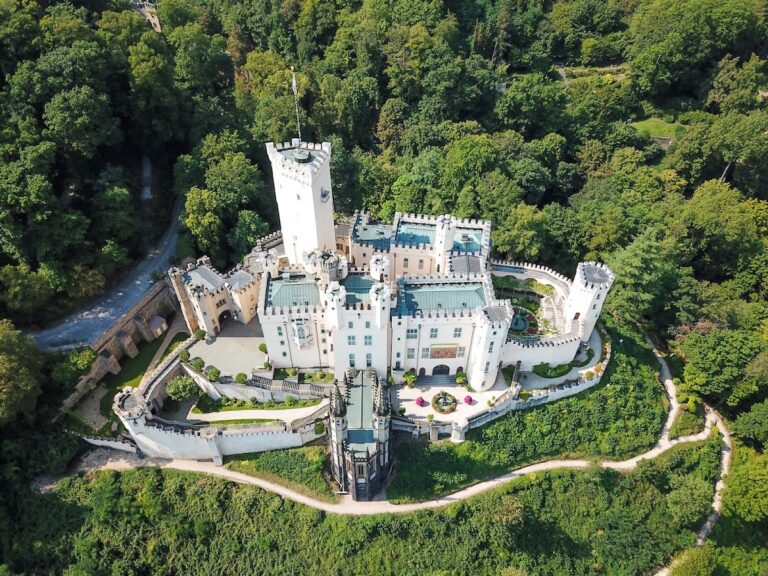
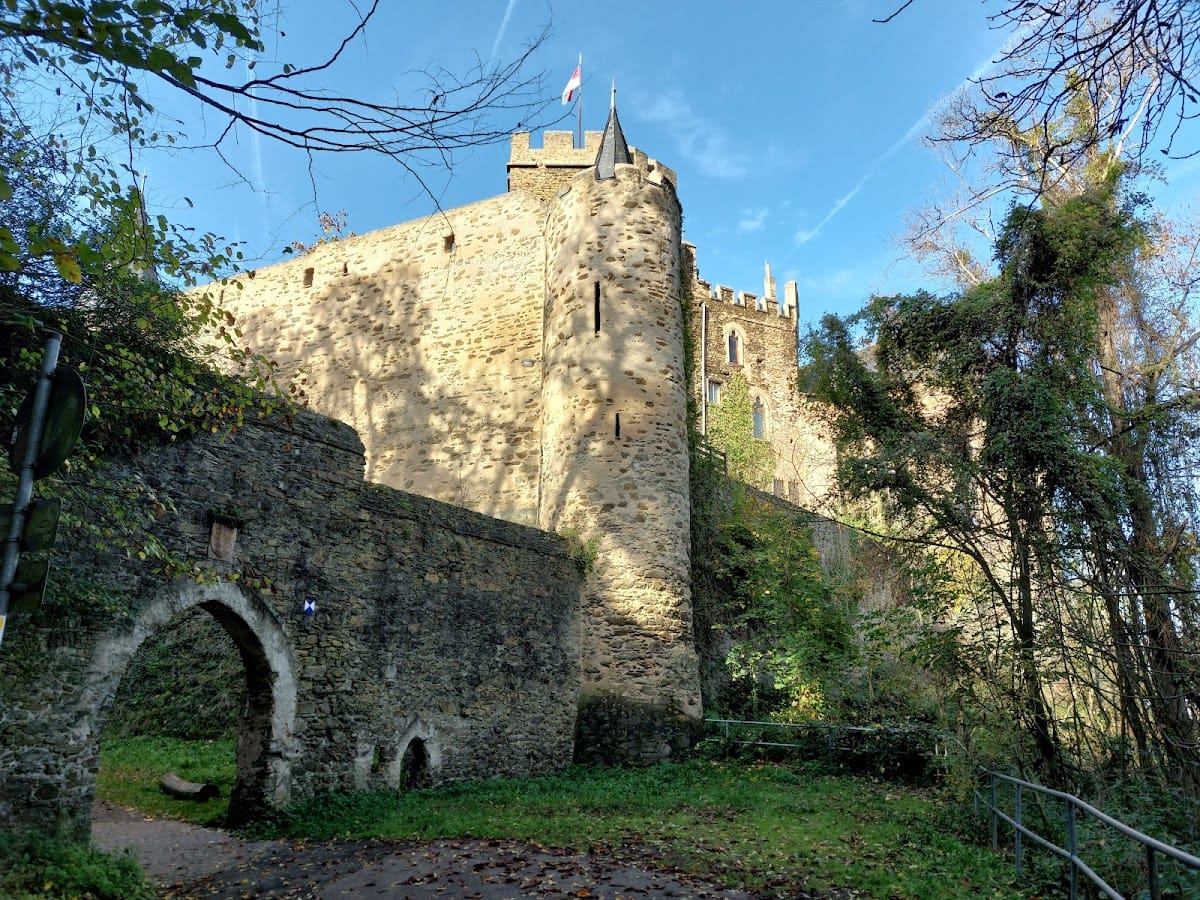
Lahneck is a spur castle on a steep, projecting rocky ridge about 164 metres above sea level, above the left bank of the Lahn where it meets the Rhine. It stands in Oberlahnstein, within the city of Lahnstein, opposite Stolzenfels Castle. The elongated rectangular plan is symmetrical and characteristic of later Hohenstaufen-period castles. The surviving complex also reflects its nineteenth-century restoration as a medieval romantic castle.
Defensive architecture
The bergfried
The bergfried, the principal tower of a medieval German castle and a place of defence and refuge rather than permanent residence, rises approximately 29 metres. Its unusual pentagonal plan is also found at Stolzenfels. The pointed side faces south, where the castle was most vulnerable. Its design was intended to make stone balls fired from the Streitacker glance away from the point instead of striking a flat wall surface. The tower provides broad views over the Lahn Valley, toward Stolzenfels Castle, and across the Rhine Valley toward Koblenz. It is not normally accessible to visitors.
The outer defenses
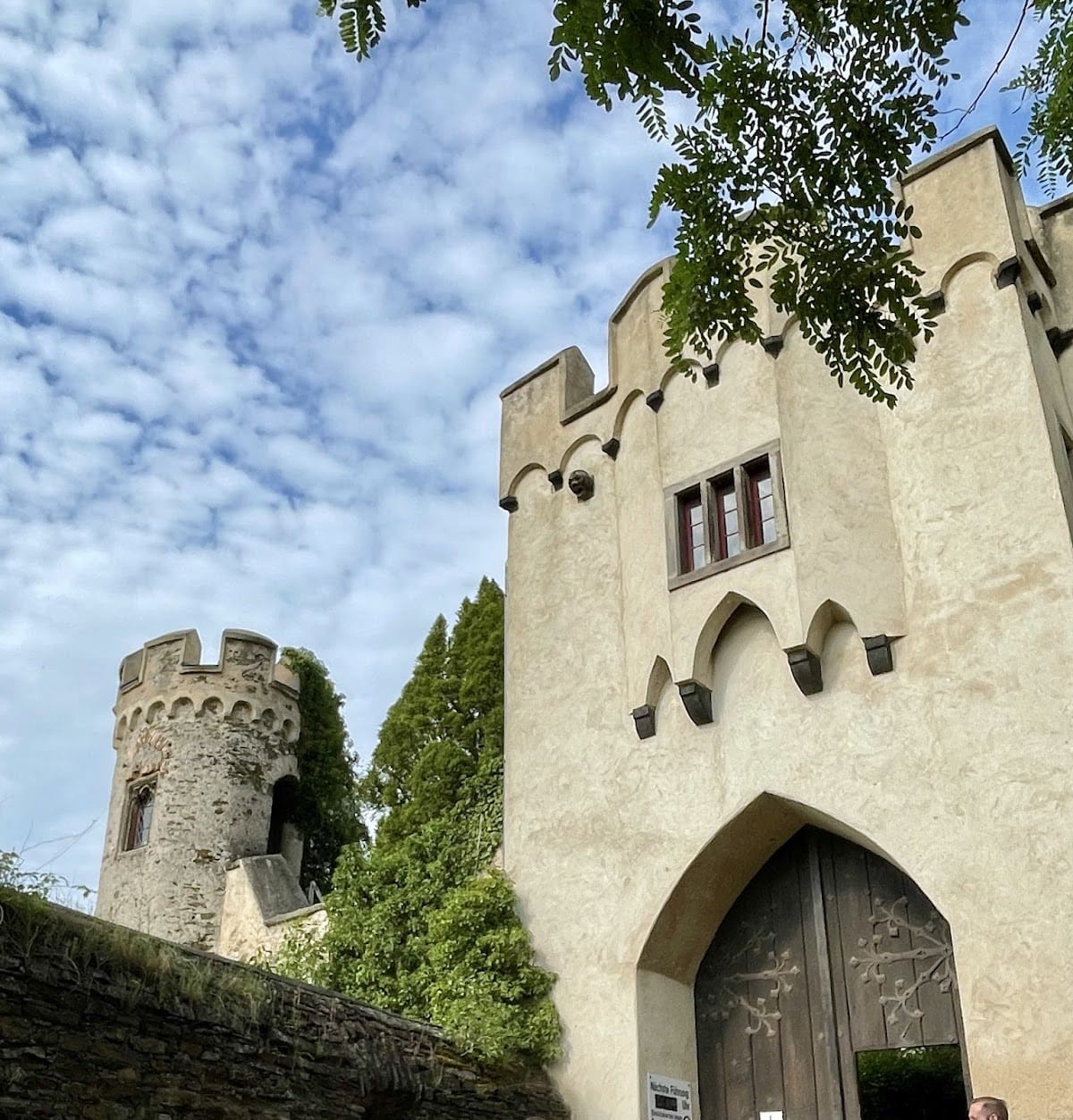
The 1475 defensive expansion is represented by a second wall circuit and a zwinger, the outer enclosure between the main and outer walls that exposed attackers to defensive fire. Three shell towers, the Fuchsturm, and a square gate tower formed part of this system on the attack-facing side. The medieval defenses were later encountered within a castle whose appearance had been reshaped by rebuilding from 1852 onward, work continued from 1864, and alterations completed up to 1937.
Chapel and restored interiors
The Gothic chapel built in 1245 is dedicated to Saint Ulrich of Augsburg. It contains a copy of the papal indulgence document issued by John XXII in 1332, while the original is preserved in the Lahnstein municipal archive. The restored castle also retains a more-than-life-size portrait of Queen Victoria, presented during Count von Kleist-Tychow’s ownership.
The high tower tradition
The Idilia Dubb tradition is connected with Lahneck’s high tower. It holds that the wooden staircase collapsed behind Dubb and that a surrounding wall about three metres high prevented her cries from being heard. Her diary was reportedly concealed in the tower walls and later found with her remains. The account forms part of the castle’s later legend, alongside its documented medieval and nineteenth-century history.