Bodfeld: A Medieval Royal Hunting Lodge and Administrative Site in Germany
Visitor Information
Google Rating: 3.7
Popularity: Very Low
Country: Germany
Civilization: Unclassified
Site type: Military
Remains: Castle

History
Bodfeld is a medieval royal hunting lodge and administrative site located near Elbingerode, Germany, originally established by the Ottonian dynasty. It functioned primarily as a retreat for hunting and as a center for managing nearby ore mining activities in the central Harz mountains.
The earliest recorded royal connections to Bodfeld date back to the 10th century during the reign of Henry I, who fell ill at the site in 935. His son, Otto I, officially designated Bodfeld as a hunting lodge around 936 and is known to have visited on multiple occasions. The lodge remained an important location for subsequent rulers, with Otto II making four visits, and Otto III spending at least two recorded periods there around the turn of the millennium, including time spent with his grandmother Adelheid in 991. Bodfeld continued to serve Ottonian and Salian kings throughout the 11th century; Conrad II visited at least once, while Henry III made several trips and issued his final known document at Bodfeld in September 1056 before his death there in October of the same year, attended by the pope and imperial princes. Henry IV was crowned King of the Germans at Bodfeld later in 1056, underlining the site’s continued importance in imperial ritual and administration.
Following the 11th century, documented use of Bodfeld gradually declined. By the end of the 13th century, the royal hunting lodge was no longer in use, and the exact location of Bodfeld had faded from memory. Interest in rediscovering the site revived in the late 19th century when Paul Höfer initially misidentified the location near Königshütte. His theory was corrected in the early 20th century through archaeological findings, notably by Paul Grimm who demonstrated that the Königshütte site lacked typical artifacts such as red pottery associated with Ottonian royal residences.
Further research by Carl Erdmann and Friedrich Stolberg favored a location north of the River Bode near the now-abandoned village of Lüttgen-Bodfeld. Modern techniques, including infrared aerial photography and archaeological surveys, ultimately confirmed the presence of an Ottonian royal lodge on the Schloßkopf hill spur northeast of Elbingerode. This location aligns with historical descriptions and closely resembles other royal lodges from the era like the Pfalz of Grone, though scholars note that Bodfeld did not hold major church festivals and therefore may have lacked the full political status of a Pfalz.
Bodfeld was also part of a network of Saxon hunting lodges, connected by routes such as the Königsstieg, or “King’s Path.” Nearby villages linked to Bodfeld include Erdfeld, situated about 1.5 kilometers away on an old military road. Erdfeld, mentioned in documents from 1483 and 1531, was likely associated with the hunting lodge but was eventually abandoned in the late Middle Ages as Elbingerode grew in prominence.
The name Bodfeld refers not only to the lodge itself but also to a large forested area granted by Henry II in 1009 to Gandersheim Abbey. This territory extended across parts of the Harz, from Braunlage in the west to Elbingerode in the northeast, and reached down to the villages of Stiege and Beneckenstein, reflecting the region’s importance in medieval resource management and territorial organization.
Remains
The archaeological site identified as Bodfeld occupies a hill spur known as Schloßkopf northeast of Elbingerode. Excavations and geophysical surveys conducted under the guidance of historian and building archaeologist Heinz A. Behrens have established the presence of a sizeable and defensible complex dating to the Ottonian period.
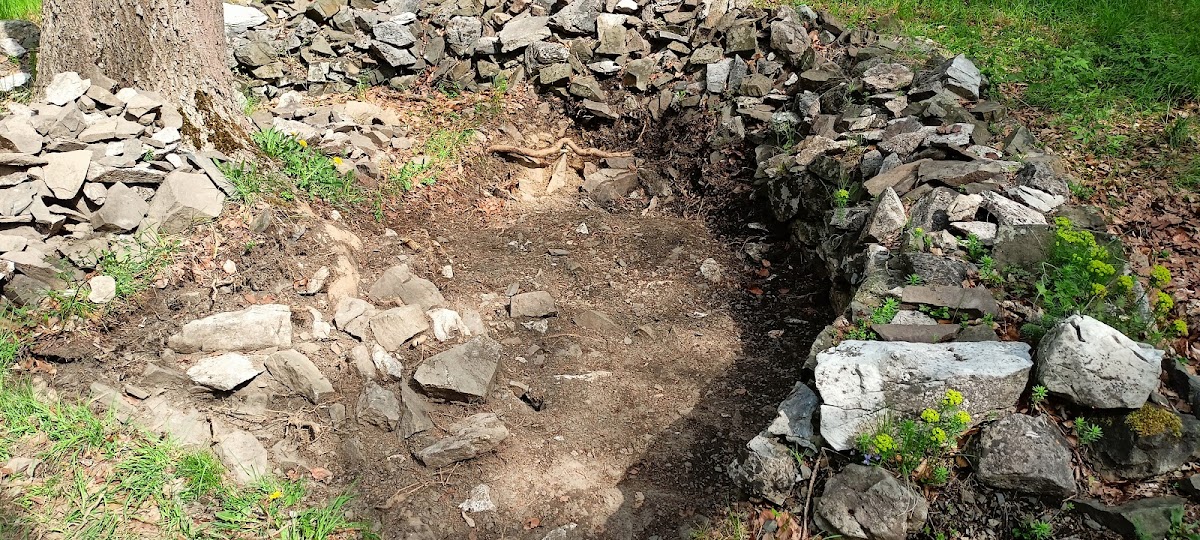
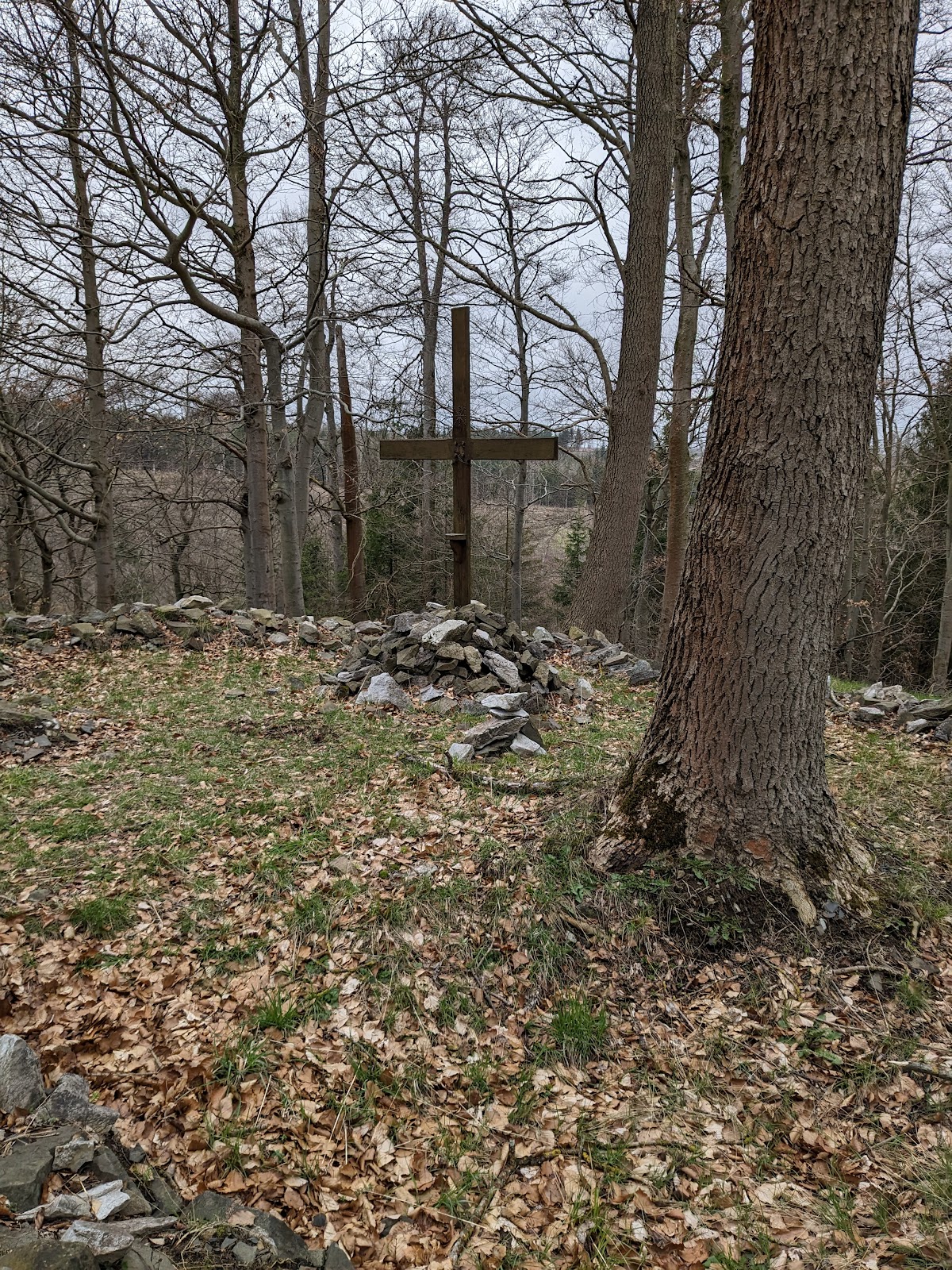
The layout features a fortified enclosure, with stone walls constructed on two sides of the site. These defensive walls provided protection, suggesting that the lodge functioned not only as a hunting retreat but also as a secure administrative center. Two round towers reinforce the impression of a fortified residence, likely serving as observation points or strongholds within the enclosure.
Within the walls, several substantial buildings have been documented. A chapel forms part of the complex, reflecting the spiritual needs of the occupants and their status. Two large halls were identified: a great hall, which would have served as the main assembly and reception area, and a second hall possibly used for additional gatherings or administrative functions. Several residential buildings accommodated the staff and visitors who would have stayed during royal visits.
A gatehouse marks the main entrance to the enclosure, controlling access to the site. Its strategic position on the hill spur follows Ottonian patterns for royal lodge construction, which favored elevated and defensible locations often removed by several kilometers from nearby rivers—in this case, the River Bode lies approximately four to five kilometers away.
The overall arrangement bears architectural similarities to the Pfalz at Grone, constructed by Henry I, indicating a shared design tradition among royal lodges of the era. The presence of multiple halls and residences alongside fortifications suggests Bodfeld served multifaceted roles: as lodging for the king and his retinue, a base for controlling hunting expeditions, and as an administrative hub for mining operations in the surrounding Harz region.
Today, the main structural elements of walls, towers, and building foundations remain in situ and have been confirmed through archaeological investigation. These remains provide tangible evidence of a complex that combined residential comfort with military and administrative functions during the height of Ottonian and early Salian rule.
Nearby sites