Hohnstein Castle: Medieval Fortress and Renaissance Palace in Germany

Site at a Glance
- Rating
- 4.7
- Popularity
- Medium
- Country
- Germany
- Primary era
- Medieval
- External website
- Open
- Eras represented
- Medieval, Early Modern
- Civilizations
- Holy Roman Empire
- Site type
- Military
- Remains
- Castle
On this page7 sections
History
Hohnstein Castle is a ruined medieval fortress and Renaissance palace in Germany, near Neustadt in the southern Harz. Its Romanesque fabric indicates that the original complex was built no earlier than the mid-12th century, during the Hohenstaufen–Guelph conflict, a struggle between two German dynastic groups over the royal throne. The castle became the family seat of the Counts of Honstein and later developed into one of the largest castles in the Harz.
Foundation and the Counts of Honstein
Older research placed the foundation around 1120 and attributed it to Konrad of Sangerhausen, a nephew of Louis the Springer, the medieval Landgrave of Thuringia. No connection, however, has been demonstrated between Konrad and the Counts of Honstein, who first appear in written records from 1182 onward.
In the mid-1170s, the Counts of Ilfeld acquired the castle from the Guelphs rather than taking possession of an entire county. They then adopted the title Counts of Honstein, established the Honstein–Ilfeld dynasty, and used Elger as a recurring dynastic name. Hohnstein became their family seat. The nearby Ilburg at Ilfeld, a more modest stronghold, was probably abandoned during this transition and was demolished under Elger III, who died in 1219.
Hohnstein Castle was first recorded in 1202. The counts expanded their territory rapidly across the southern Harz and later gained lands around Arnstadt and Gotha in the Thuringian Basin. Their first period of prosperity came in the 13th century, but the family’s position weakened after an inheritance division created several lines in 1315.
Conflict, modernization, and loss of the family seat
The castle soon became militarily outdated. It was captured in 1380 and again in 1412, when a dispute within the family developed into the Flegler War, a late-medieval conflict caused by the quarrel among the Hohnstein relatives. The Counts of Hohnstein subsequently lost their family castle.
During the first quarter of the 15th century, Hohnstein passed by purchase to the Counts of Stolberg. They carried out extensive military and structural modernization, including the construction of an artillery tower, a fortified tower intended for cannon and other firearms. Count Heinrich of Stolberg also reshaped the complex as a Renaissance palace, a fortified aristocratic residence adapted for courtly representation as well as defense.
Hohnstein passed to the Lords of Schleinitz in 1593 and to Duke Heinrich Julius of Brunswick-Wolfenbüttel in 1603. The Counts of Hohnstein died out in 1593, after the end of their rule had been concluded at Lohra Castle.
Destruction and preservation
Hohnstein was still regarded as a secure fortress during the Peasants’ War, the major uprising in the German lands in 1524 and 1525. The abbot of Ilfeld Abbey took refuge there with the abbey treasure. During the Thirty Years’ War, a European religious and political conflict fought mainly in Central Europe from 1618 to 1648, the castle was extensively plundered and then destroyed by fire. Troops under Lieutenant Colonel Christian Vitzthum von Eckstedt set fire to the castle and its associated outbuilding on 10 or 20 July 1627, depending on the calendar used.
Only a few usable objects were recovered from the burned ruins, including the bell of the castle chapel and the altar of the palace chapel. The remains continued to decay for centuries. An inn was built below the ruins in 1908, while safety and restoration work began after 1990. Hohnstein is protected as a heritage monument in Thuringia.
Remains
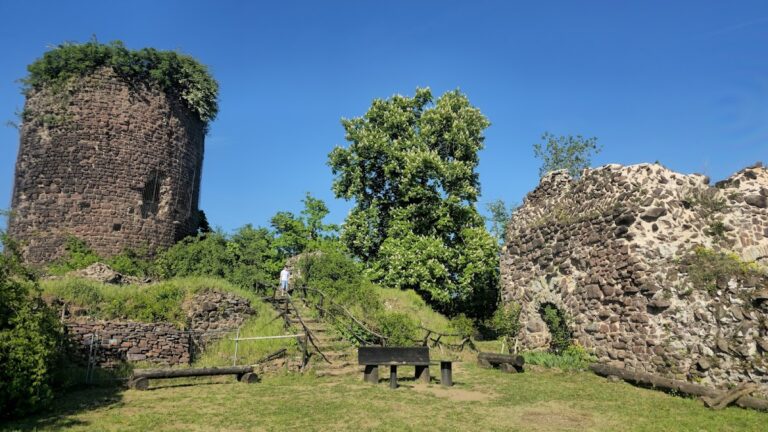
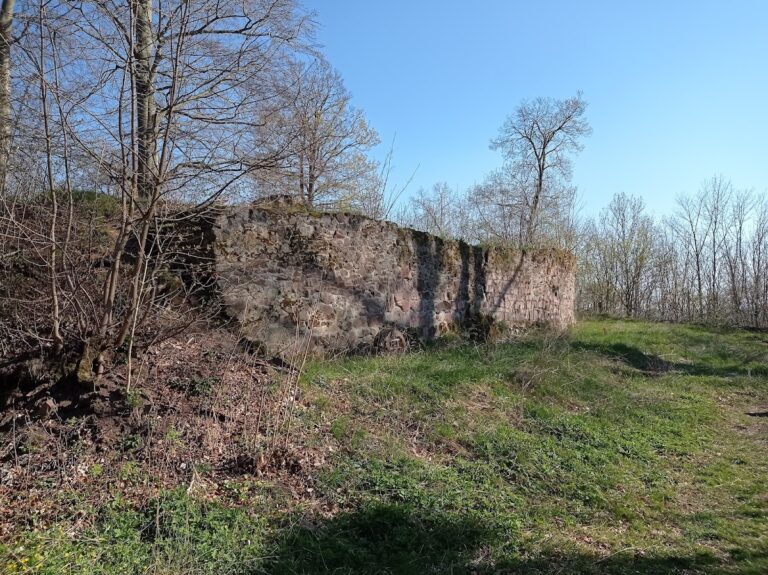
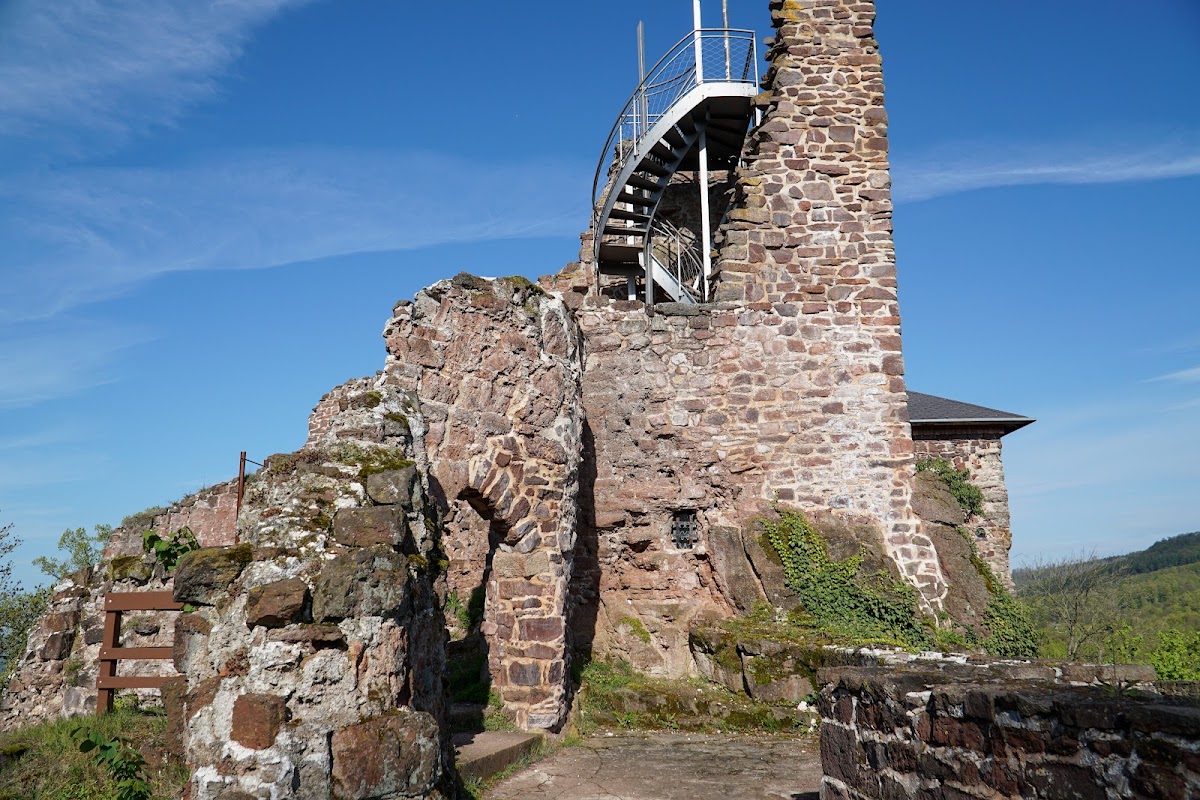
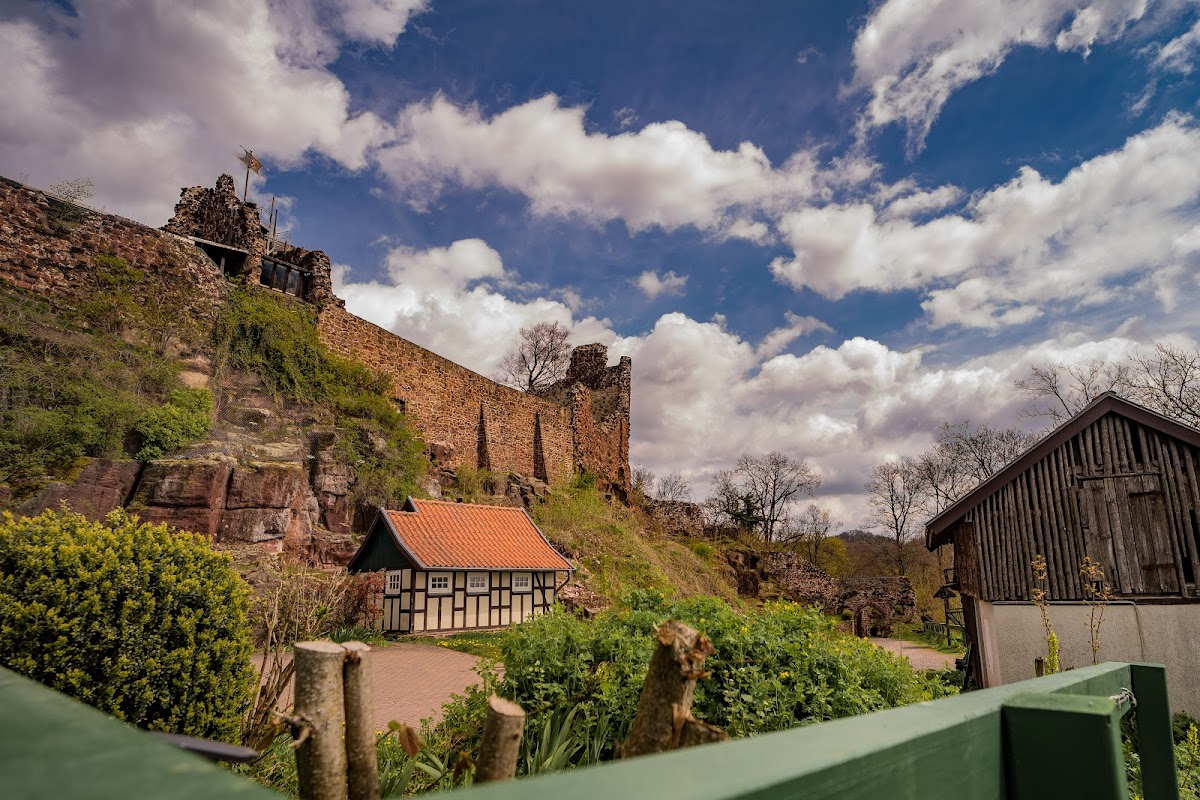
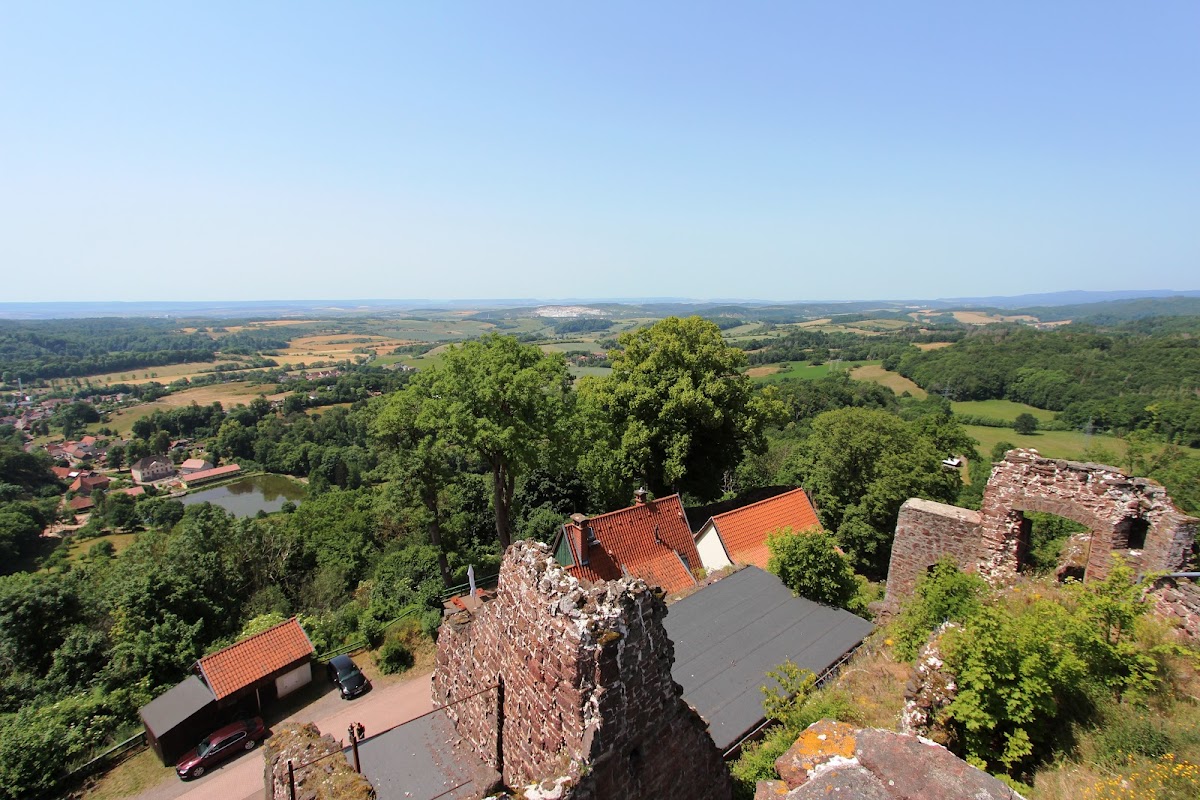
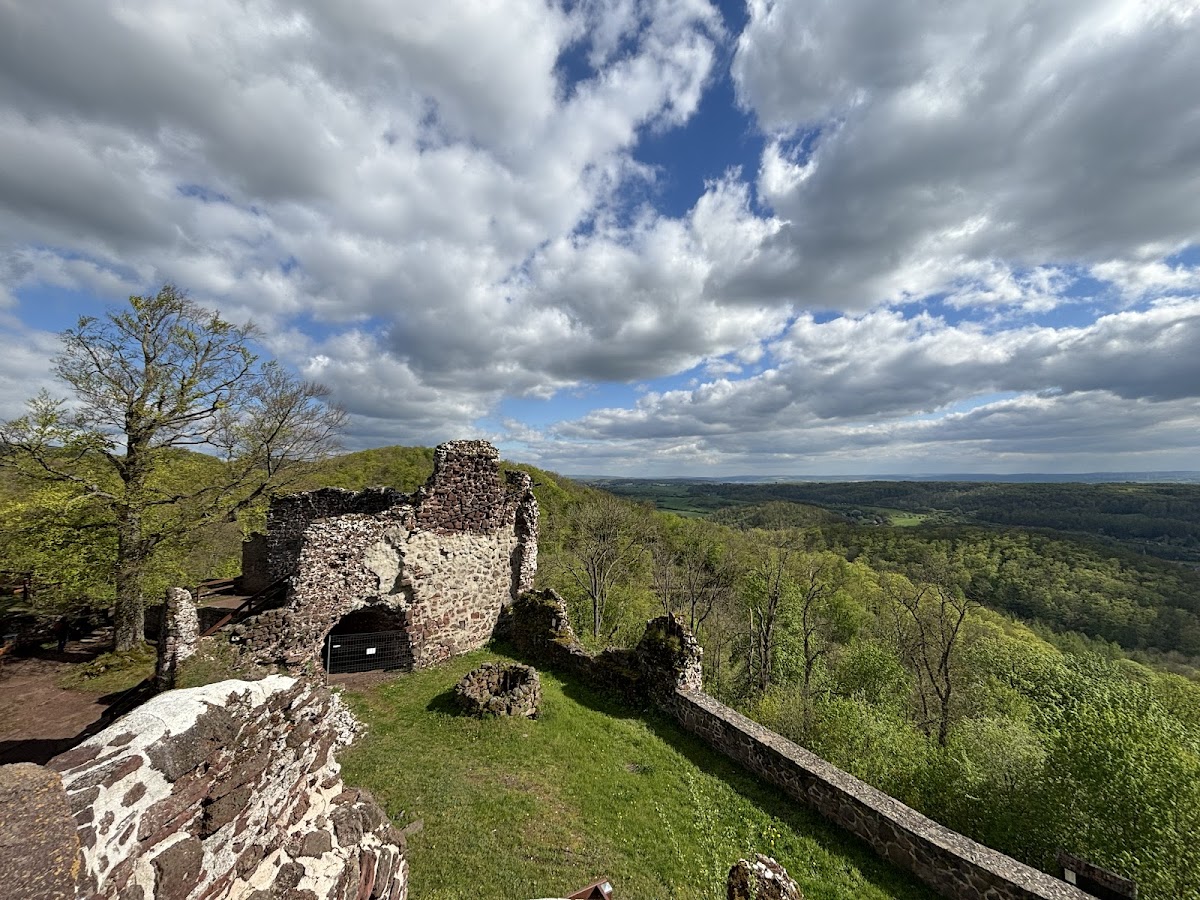
Hohnstein Castle survives as a hilltop ruin in a spur position on the wooded, rocky Schlossberg, a high spur rising to approximately 402.9 to 403 metres above sea level. The complex stands on the southern edge of the Harz Mountains within the South Harz Nature Park, about 1 to 1.1 kilometres north or northeast of Neustadt and approximately 1.5 kilometres east-northeast of the Osterode district of Harztor. Its surviving fabric reflects the change from a fortified castle to a Renaissance palace, with rubble stone among the identified building materials.
Fortifications and palace complex
The later castle incorporated an artillery tower added during the military modernization undertaken by the Counts of Stolberg. Designed to accommodate cannon and other firearms, the tower formed part of the complex’s adaptation to changing warfare. The broader layout also preserves the transformation into a Renaissance palace, whose fortified aristocratic residence combined defense with representational courtly use. The castle chapel bell and palace chapel altar were recovered after the fire and belong to the surviving historical evidence associated with the ruined complex.
Lower site
An inn stands below the castle ruins. Built in 1908, it forms part of the later physical history of the site, while safety and restoration measures carried out after 1990 addressed the condition of the surviving remains.