Stapelburg Castle: A Medieval Road-Protection Castle in Germany


Site at a Glance
- Rating
- 4.6
- Popularity
- Low
- Country
- Germany
- Primary era
- Medieval
- External website
- Open
- Eras represented
- Medieval, Early Modern
- Civilizations
- Holy Roman Empire
- Site type
- Military
- Remains
- Castle
On this page11 sections
History
Stapelburg Castle is a ruined medieval hilltop castle in Germany, located at Stapelburg in Saxony-Anhalt at the northern edge of the Harz Mountains. Built before 1306 by the Counts of Wernigerode, it protected and monitored the military road linking their ancestral castle with Goslar, an imperial and mining town. Its role combined defense with that of a toll station, where charges were collected from people or goods using the route.
Wernigerode and Halberstadt control
The castle later passed through a succession of pledges and other transfers. In 1394, it was transferred to the Diocese of Halberstadt for 600 marks. A pledge temporarily transferred control as security for a debt or obligation. On 25 January 1432, Count Botho of Stolberg accepted Stapelburg and its estate as a pledge from Bishop John of Halberstadt. The diocese later redeemed the property and pledged it to Heinrich von Bila.
On 4 June 1463, Bishop Gebhard of Halberstadt pledged the castle for life, until 1511, to Count Henry the Elder of Stolberg for 200 Rhenish guilders. During the final years of Henry’s tenure, Stapelburg fell into serious disrepair. On 13 April 1509, Henry and his son Botho promised Archbishop Ernest of Magdeburg, the administrator of the Bishopric of Halberstadt, that they would rebuild the castle within eight years. Their stated aim was to make it suitable once again for residence by a nobleman or steward. The two counts were subsequently enfeoffed with Stapelburg, meaning that a superior authority granted them rights or property as vassals.
The Bila family and later ownership
In 1559, Archbishop Sigismund of Magdeburg, acting as administrator of Halberstadt, installed the former Halberstadt councillor Dr. Heinrich von Bila and his brothers at Stapelburg, despite the heavy debts of the Counts of Stolberg. Dr. von Bila was an assessor at the Imperial Chamber Court, a major judicial institution of the Holy Roman Empire whose members adjudicated cases.
The Bila family established the outlying estate of Bilashausen at the foot of the castle. A rural settlement that developed nearby took the name Stapelburg. In 1596, Dr. von Bila’s heirs sold the castle and village to Statius von Münchhausen for 45,000 talers. Following his bankruptcy in 1619, the property returned to the Halberstadt Cathedral Chapter in 1625.
Return to Wernigerode and decline
The Berlin Agreement of 11 March 1722 secured Stapelburg permanently as an appurtenance of the County of Wernigerode for Count Christian Ernest of Stolberg-Wernigerode. On 11 December 1727, King Frederick William I of Prussia removed the sovereign claims of the now-Prussian Halberstadt Cathedral Chapter and restored the castle’s connection with the county.
By the beginning of the eighteenth century, the castle was again in very poor structural condition. In 1737, one room was reportedly still habitable and was sometimes used by members of the Wernigerode court during excursions. A major fire almost completely destroyed Lange Street in 1743. Substantial parts of Stapelburg Castle were then dismantled for building material to reconstruct the village houses, hastening the castle’s decline into ruin.
Conservation and public stewardship
Activity on the Burgberg revived in the early 2000s through a castle festival and voluntary work by local associations. The Interessengemeinschaft Burgberg was established in 2004 to organize protection of the ruins and earthworks, encourage public interest, and research and present the castle’s history. A major communal project involving association members, local residents, and sponsors secured the surviving masonry, converted the old cellar into an event room, and prepared the grounds for outdoor events. The association honored 44 active participants with the title “Honorary Knight of Stapelburg.” Stapelburg Castle is designated a cultural heritage monument of Saxony-Anhalt.
Remains
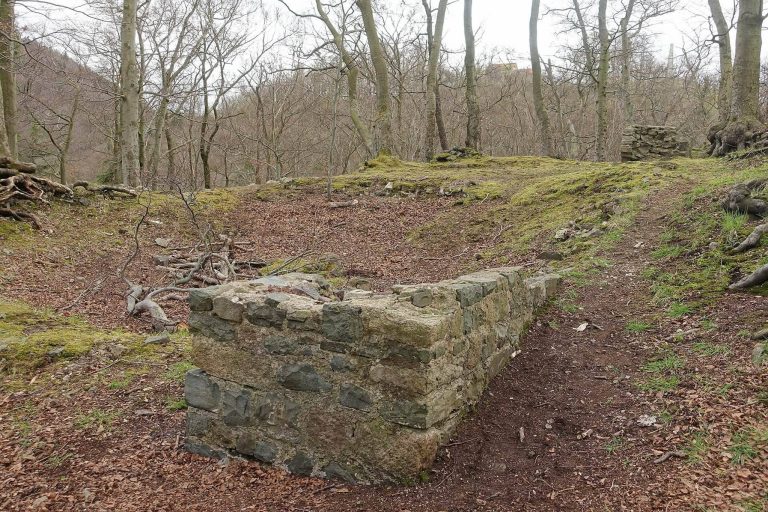
The surviving castle occupies the Burgberg at the northeastern edge of Stapelburg. The hill rises about 20 metres above the settlement and about 30 metres above the surrounding land, with the site at approximately 239 metres above sea level. Earth ramparts encircle the hill and preserve the outline of the former fortifications. The surviving masonry and earthworks form a conserved ruin, while the grounds retain traces of the castle’s defensive position above the village.
Fortifications and surviving structures
Earth ramparts
The former fortifications are represented by earth ramparts surrounding the Burgberg. Sparse trees grow across them, including some fruit trees. These raised earthworks remain part of the castle’s physical defensive system and define the perimeter of the hilltop site.
Southern castle wall
A surviving section of castle wall stands along the southern edge of the plateau. Built from rubble stone, it contains openings for windows and a gate. The wall remains as fragmentary masonry within the wider fortified enclosure and has been structurally secured through modern conservation work.
Reconstructed cellar
Farther north, a locked door gives access to a reconstructed former castle cellar. The cellar has been converted into an event room. Its ventilation shaft was designed in the form of an imitation well, linking a practical modern intervention with the appearance of a historic feature.
Landscape feature
A very large old linden tree stood near the route to the Burgberg and was protected as a natural monument until a storm gust blew it down on 7 February 2022.